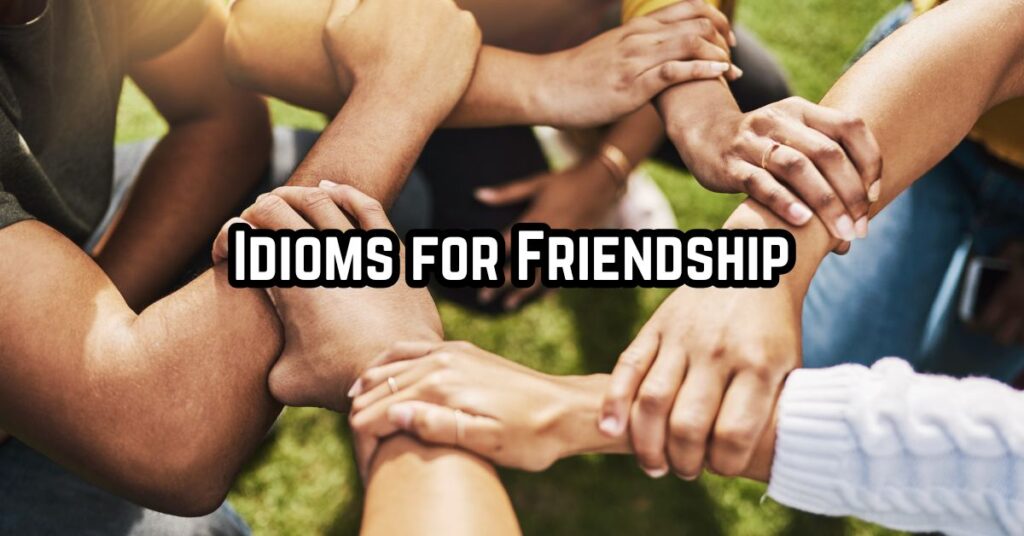

Understanding idioms is crucial for mastering English, especially when it comes to expressing nuanced relationships. Friendship idioms add color and depth to conversations, allowing speakers to convey feelings of loyalty, support, and shared experiences in a vivid and memorable way. This article provides a comprehensive guide to friendship idioms, explaining their meanings, usage, and providing numerous examples. It will benefit English language learners, teachers, and anyone looking to enhance their communication skills by adding a touch of colloquial flair to their speech.
Table of Contents
- Introduction
- Definition of Friendship Idioms
- Structural Breakdown
- Types or Categories of Friendship Idioms
- Examples of Friendship Idioms
- Usage Rules for Friendship Idioms
- Common Mistakes with Friendship Idioms
- Practice Exercises
- Advanced Topics in Friendship Idioms
- FAQ Section
- Conclusion
Introduction
Friendship, a cornerstone of human connection, is often expressed through a rich tapestry of language. Idioms, those colorful expressions that carry a meaning beyond their literal words, play a vital role in conveying the depth and nuances of these relationships. Mastering friendship idioms not only enhances your comprehension of English but also allows you to express yourself more vividly and authentically. This article aims to be your comprehensive guide to understanding and using these expressions effectively. By exploring their meanings, structures, and usage rules, you’ll gain the confidence to incorporate them into your everyday conversations, adding warmth and personality to your interactions.
Definition of Friendship Idioms
Friendship idioms are expressions or phrases where the overall meaning differs from the literal meaning of the individual words. They are a type of figurative language that relies on shared cultural understanding and context. These idioms are used to describe different aspects of friendship, such as loyalty, support, shared history, and common interests. They add color and depth to conversations, making them more engaging and relatable.
Classification: Friendship idioms fall under the broader category of idioms, which are a type of figurative language. More specifically, they are a subset that pertains to relationships and social connections. They can be further classified based on the specific aspect of friendship they describe, such as loyalty idioms, support idioms, or idioms that describe the longevity of a friendship.
Function: The primary function of friendship idioms is to express complex emotions and ideas related to friendship in a concise and memorable way. They allow speakers to convey nuanced feelings that might be difficult to articulate through literal language. For example, saying someone is a “fair-weather friend” immediately communicates that they are only supportive during good times.
Contexts: Friendship idioms are commonly used in informal conversations, narratives, and creative writing. They are often found in everyday speech, literature, movies, and songs. However, it’s important to use them appropriately, considering the audience and the context of the conversation. Overusing idioms can make your speech sound unnatural, while using them incorrectly can lead to misunderstandings.
Structural Breakdown
Friendship idioms, like all idioms, do not follow standard grammatical rules in terms of their literal meaning. Their structure is often fixed, meaning the words cannot be changed or rearranged without altering the idiom’s meaning or making it nonsensical. Understanding the structure of idioms involves recognizing that their meaning is derived from their collective usage, not from the individual words.
Many friendship idioms are based on metaphors, similes, or other figures of speech. For example, “to be thick as thieves” uses a simile to describe a very close and secretive friendship. The structure of this idiom is simple: “as adjective as noun,” but its meaning goes beyond the literal comparison of thickness. Instead, it implies a bond of deep trust and shared experiences.
Some idioms involve verbs and prepositions, such as “to patch things up.” This idiom uses the phrasal verb “patch up” to describe the act of repairing a damaged friendship. The structure here is verb + preposition, where the combination has a specific meaning related to reconciliation.
Other idioms may be complete sentences or clauses, such as “A friend in need is a friend indeed.” This proverb-like idiom presents a complete thought about the value of friendship during difficult times. Its structure is a simple declarative sentence, but its meaning is profound and widely understood.
Types or Categories of Friendship Idioms
Friendship idioms can be categorized based on the different aspects of friendship they describe. Here are some common categories:
Idioms Describing Loyalty and Trust
These idioms emphasize the dependability and trustworthiness of a friend.
Idioms Describing Support and Help
These idioms focus on the assistance and encouragement that friends provide each other.
Idioms Describing Shared History and Experiences
These idioms highlight the common memories and experiences that strengthen a friendship.
Idioms Describing Closeness and Intimacy
These idioms express the deep connection and understanding between friends.
Idioms Describing Challenges in Friendship
These idioms address the difficulties and conflicts that can arise in friendships.
Examples of Friendship Idioms
Here are some detailed examples of friendship idioms, organized by category:
Examples Describing Loyalty and Trust
The following table presents a list of idioms related to loyalty and trust in friendship, along with their meanings and example sentences.
| Idiom | Meaning | Example Sentence |
|---|---|---|
| Thick as thieves | Very close and secretive friends. | They’ve been thick as thieves since kindergarten, always sharing secrets. |
| A friend in need is a friend indeed | A true friend is someone who helps you when you are in trouble. | When I lost my job, Sarah was there to support me; a friend in need is a friend indeed. |
| To have someone’s back | To support and protect someone. | Don’t worry, I’ve got your back in this negotiation. |
| To be there for someone | To be available and supportive. | I know I can always count on him to be there for me when I need him. |
| To stick by someone | To remain loyal to someone even when they are in trouble. | Despite all the rumors, she stuck by her friend. |
| To stand by someone | To support someone, especially in a difficult situation. | His family stood by him throughout the trial. |
| To be a true blue friend | A loyal and reliable friend. | He’s a true blue friend; you can always count on him. |
| To be a shoulder to cry on | Someone who offers sympathy and support. | After the breakup, she needed a shoulder to cry on. |
| To go to bat for someone | To defend or support someone. | My boss went to bat for me when I was being unfairly criticized. |
| To vouch for someone | To guarantee someone’s good character or abilities. | I can vouch for her; she’s a very reliable person. |
| To be in someone’s corner | To support and encourage someone. | I’m always in your corner, no matter what. |
| To be someone’s rock | Someone who provides stability and support. | During the crisis, she was my rock. |
| To have unwavering support | Consistent and firm support. | He had unwavering support from his friends during his illness. |
| Ride or die | Extremely loyal and supportive, no matter what. | She’s my ride or die; I know she’ll always be there for me. |
| To swear by someone | To have complete faith in someone’s honesty and reliability. | I swear by my best friend; she would never betray me. |
| To take someone at their word | To believe someone’s statement without question. | I always take him at his word; he’s a very honest person. |
| To trust someone implicitly | To have complete and unquestioning trust in someone. | I trust her implicitly with my secrets. |
| To be as good as their word | To be reliable and keep promises. | He’s as good as his word; if he says he’ll do something, he will. |
| To be a steadfast friend | A loyal and unwavering friend. | He has been a steadfast friend to me through thick and thin. |
| To be a pillar of support | Someone who provides strong emotional support. | She was a pillar of support for me when my father passed away. |
| To be a confidant | Someone you trust with your secrets. | He’s not just a friend; he’s also my confidant. |
| To keep someone’s secrets safe | To be trusted with confidential information. | I know I can trust her to keep my secrets safe. |
| Blood brothers/sisters | People who have made a pact of loyalty, often through a symbolic ritual. | They consider themselves blood brothers after going through so much together. |
Examples Describing Support and Help
The following table provides idioms that describe the act of supporting a friend.
| Idiom | Meaning | Example Sentence |
|---|---|---|
| To lend a helping hand | To offer assistance. | She always lends a helping hand to those in need. |
| To go the extra mile | To do more than what is expected. | He always goes the extra mile for his friends. |
| To pull someone through | To help someone overcome a difficult situation. | Her friends pulled her through after her divorce. |
| To bail someone out | To rescue someone from a difficult situation. | He had to bail his friend out of jail. |
| To pick someone up | To cheer someone up. | I tried to pick her up after she failed the exam. |
| To give someone a leg up | To help someone advance. | He gave his friend a leg up by recommending him for the job. |
| To be a lifesaver | Someone who helps you out of a difficult situation. | You’re a lifesaver for helping me move! |
| To offer a shoulder to lean on | To provide emotional support. | She offered a shoulder to lean on when I was feeling down. |
| To rally around someone | To come together to support someone. | The community rallied around the family after the fire. |
| To give moral support | To provide encouragement and emotional support. | I’m here to give you moral support during your presentation. |
| To prop someone up | To support someone physically or emotionally. | Her friends propped her up when she felt like giving up. |
| To hold someone’s hand | To provide comfort and support during a difficult time. | I held her hand as she went through the surgery. |
| To lift someone’s spirits | To make someone feel happier. | His visit really lifted my spirits. |
| To lend an ear | To listen attentively and sympathetically. | I’m always here to lend an ear if you need to talk. |
| To offer reassurance | To provide comfort and confidence. | She offered reassurance that everything would be alright. |
| To be a source of strength | Someone who provides emotional support and resilience. | He has been a source of strength for me during this difficult time. |
| To encourage someone every step of the way | To provide continuous support and encouragement. | She encouraged me every step of the way as I trained for the marathon. |
| To be someone’s cheerleader | Someone who enthusiastically supports and encourages someone. | She’s always been my biggest cheerleader. |
| To help someone get back on their feet | To assist someone in recovering from a setback. | Her friends helped her get back on her feet after she lost her job. |
| To be a guiding light | Someone who provides guidance and direction. | He’s been a guiding light for me in my career. |
| To show solidarity | To express support and unity. | We want to show solidarity with our friends during this difficult time. |
| To be a helping hand in times of need | To be available to provide assistance when needed. | He has always been a helping hand in times of need. |
Examples Describing Shared History and Experiences
This table shows idioms that highlight shared history and experiences between friends.
| Idiom | Meaning | Example Sentence |
|---|---|---|
| To go way back | To have known each other for a long time. | We go way back; we’ve been friends since childhood. |
| To be old friends | To have been friends for many years. | They are old friends and have many shared memories. |
| To have history together | To have shared significant experiences. | They have a lot of history together, both good and bad. |
| To share a bond | To have a strong connection. | They share a bond that can never be broken. |
| To have seen each other through thick and thin | To have supported each other through good times and bad times. | They’ve seen each other through thick and thin. |
| To have shared experiences | To have gone through similar events or situations. | Their shared experiences have made their friendship stronger. |
| To have a connection | To have a natural understanding and rapport. | They have a connection that’s hard to explain. |
| To reminisce about old times | To talk about past memories. | We love to reminisce about old times when we get together. |
| To have inside jokes | Jokes that only a specific group of people understand. | They have so many inside jokes that no one else understands. |
| To have a shared past | To have a history together. | Their shared past is what makes their friendship so special. |
| To have been through the mill together | To have experienced many difficulties together. | They’ve been through the mill together and are stronger for it. |
| To have a common ground | To share similar interests or beliefs. | They have a lot of common ground, which is why they get along so well. |
| To have fond memories | To have pleasant recollections of the past. | They have fond memories of their childhood together. |
| To laugh over old memories | To share joyful recollections of past events. | We spent the evening laughing over old memories. |
| To have a history of friendship | To have a long-standing friendship. | They have a history of friendship that spans decades. |
| To have a long-standing relationship | To have a relationship that has lasted a long time. | They have a long-standing relationship built on trust and respect. |
| To have been inseparable | To have been very close and always together. | They were inseparable as children. |
| To have grown up together | To have spent their childhood together. | They grew up together and have remained friends ever since. |
| To have shared milestones | To have experienced significant events together. | They’ve shared many milestones in each other’s lives. |
| To have travelled together | To have journeyed together to different places. | They have travelled together to many exotic destinations. |
| To have attended school together | To have been students at the same educational institution. | They attended school together and have been friends ever since. |
| To have a shared sense of humor | To find the same things funny. | They have a shared sense of humor, which makes their friendship so enjoyable. |
Examples Describing Closeness and Intimacy
The following table illustrates idioms describing the closeness and intimacy of a friendship.
| Idiom | Meaning | Example Sentence |
|---|---|---|
| To be bosom buddies | Very close friends. | They are bosom buddies and share everything with each other. |
| To be like two peas in a pod | Very similar and always together. | They’re like two peas in a pod; they do everything together. |
| To be kindred spirits | People who have similar interests and feelings. | They are kindred spirits and understand each other perfectly. |
| To be soulmates | People who have a deep and natural affinity for each other. | They believe they are soulmates and were meant to be friends. |
| To be inseparable | Always together and very close. | They were inseparable during their college years. |
| To be thick as blood | Having a very close and strong bond, similar to family. | Their friendship is as thick as blood. |
| To be joined at the hip | Always together and very close. | They’re joined at the hip; you never see one without the other. |
| To be the best of friends | To have a very close and strong friendship. | They are the best of friends and support each other in everything. |
| To be as close as siblings | Having a friendship as close as a sibling relationship. | They’re as close as siblings, even though they’re not related. |
| To have an unspoken understanding | To understand each other without needing words. | They have an unspoken understanding that comes from years of friendship. |
| To know someone inside and out | To know someone very well. | I know her inside and out; we’ve been friends for decades. |
| To share a secret language | To have private jokes and understandings. | They share a secret language that only they understand. |
| To have a deep connection | To have a profound and meaningful relationship. | They have a deep connection that goes beyond just friendship. |
| To be each other’s confidante | To trust each other with secrets and personal matters. | They are each other’s confidantes and share everything. |
| To be on the same wavelength | To think and feel alike. | They’re always on the same wavelength. |
| To be a shoulder to cry on | To provide comfort and support during difficult times. | She’s always been a shoulder to cry on for me. |
| To be each other’s sounding board | To provide a safe space to discuss ideas and concerns. | They are each other’s sounding boards. |
| To be like family | To have a relationship as close and supportive as family. | They’re like family to me. |
| To be inseparable from each other | To be unable to be parted from each other. | They’ve been inseparable from each other since they met. |
| To be two peas in a pod | To be very similar and always together. | They’re two peas in a pod, always doing everything together. |
| To have a special bond | To share a unique and strong connection. | They have a special bond that is unbreakable. |
Usage Rules for Friendship Idioms
Using friendship idioms correctly involves understanding their specific meanings and using them in appropriate contexts. Here are some rules to follow:
- Understand the meaning: Always ensure you fully understand the meaning of an idiom before using it. Misusing an idiom can lead to confusion or miscommunication.
- Consider the context: Use idioms in appropriate situations. They are generally more suitable for informal conversations than formal settings. Be mindful of your audience and the overall tone of the conversation.
- Avoid overuse: While idioms can add color to your speech, overusing them can make you sound unnatural or forced. Use them sparingly and strategically.
- Use the correct form: Idioms often have a fixed structure. Avoid changing the words or word order, as this can alter the meaning or make the idiom nonsensical.
- Be aware of cultural differences: Some idioms may be specific to certain cultures or regions. Be mindful of these differences when communicating with people from diverse backgrounds.
- Clarity is key: If you are unsure whether your audience will understand an idiom, it’s best to avoid using it or to explain its meaning.
Common Mistakes with Friendship Idioms
Here are some common mistakes people make when using friendship idioms:
| Incorrect | Correct | Explanation |
|---|---|---|
| “He’s my shoulder to cry on my back.” | “He’s my shoulder to cry on.” | The idiom is “shoulder to cry on,” not “shoulder to cry on my back.” |
| “They are thick as water.” | “They are thick as thieves.” | The correct idiom is “thick as thieves,” which means very close and secretive. |
| “A friend in need is a friend indeedly.” | “A friend in need is a friend indeed.” | “Indeed” is already an adverb, so adding “-ly” is incorrect. |
| “I have your front.” | “I have your back.” | The idiom is “have someone’s back,” meaning to support and protect someone. |
| “We go far back.” | “We go way back.” | The correct idiom is “go way back,” meaning to have known each other for a long time. |
| “They are like two apples in a pod.” | “They are like two peas in a pod.” | The correct idiom is “like two peas in a pod,” meaning very similar and always together. |
| “She bailed me out of the river.” | “She bailed me out.” | While “bail someone out” can literally mean rescuing from water, in this context, it means rescuing from a difficult situation. |
| “He gave me a foot up.” | “He gave me a leg up.” | The correct idiom is “give someone a leg up,” meaning to help someone advance. |
Practice Exercises
Test your understanding of friendship idioms with these practice exercises.
Exercise 1: Fill in the Blanks
Complete the sentences with the correct friendship idiom from the list below.
Idiom List: thick as thieves, a friend in need, have your back, go way back, two peas in a pod, shoulder to cry on
| Question | Answer |
|---|---|
| 1. They are ________; they do everything together. | two peas in a pod |
| 2. I will always ________; you can count on me. | have your back |
| 3. We ________; we’ve known each other since childhood. | go way back |
| 4. She’s always been a ________ for me when things get tough. | shoulder to cry on |
| 5. ________ is ________; someone who helps you when you are in trouble. | A friend in need, a friend indeed |
| 6. They’re ________; they share everything with each other. | thick as thieves |
| 7. Whenever I am down, she offers me a ________. | shoulder to cry on |
| 8. It is important to ________ in times of hardship. | have your back |
| 9. It feels like we were ________ in a past life. | two peas in a pod |
| 10. He proved to be ________ when I lost my job. | a friend in need |
Exercise 2: Matching
Match the idiom with its meaning.
| Idiom | Meaning |
|---|---|
| 1. Lend a helping hand | A. To support and encourage someone |
| 2. Go the extra mile | B. To offer assistance |
| 3. Be someone’s rock | C. To do more than what is expected |
| 4. Be in someone’s corner | D. Someone who provides stability and support |
| 5. Pull someone through | E. To help someone overcome a difficult situation |
Answers:
1 – B, 2 – C, 3 – D, 4 – A, 5 – E
Exercise 3: Multiple Choice
Choose the correct idiom to complete the sentence.
| Question | Options | Answer |
|---|---|---|
| 1. After the argument, they needed to ________. | A) break the ice B) bury the hatchet C) beat around the bush | B) bury the hatchet |
| 2. He always ________ for his friends. | A) goes to bat B) hits the hay C) kicks the bucket | A) goes to bat |
| 3. She’s ________; you can always count on her. | A) a fair-weather friend B) a true blue friend C) a dark horse | B) a true blue friend |
| 4. They ________ and resolved their differences. | A) patched things up B) let the cat out of the bag C) bit the bullet | A) patched things up |
| 5. He is always there to ________ when I need someone to listen. | A) lend a hand B) lend an ear C) lend a heart | B) lend an ear |
| 6. They ________ during the crisis, showing their true friendship. | A) rallied around B) fell apart C) backed down | A) rallied around |
| 7. She gave him ________ by recommending him for the job. | A) a hand up B) a leg up C) a foot up | B) a leg up |
| 8. They have ________ since they were kids, creating a strong bond. | A) shared experiences B) broken ties C) lost touch | A) shared experiences |
| 9. We ________ about our college days every time we meet. | A) forget about B) reminisce about C) ignore | B) reminisce about |
| 10. They ________ like siblings, supporting each other through everything. | A) are as close as B) are distant as C) dislike | A) are as close as |
Advanced Topics in Friendship Idioms
For advanced learners, exploring the historical and cultural context of friendship idioms can provide a deeper understanding of their meanings and usage. Some idioms have roots in specific historical events or cultural practices, and understanding these origins can enhance your appreciation of the language. For example, the idiom “bury the hatchet” comes from a Native American tradition of symbolically burying a hatchet to signify peace. Understanding this origin adds a layer of meaning to the idiom, making it more impactful.
Another advanced topic is the use of idioms in literature and creative writing. Authors often use idioms to create vivid imagery, develop characters, and convey complex emotions. Analyzing the use of idioms in literary works can help you understand how they contribute to the overall meaning and impact of the text. Consider how an author might use a series of friendship idioms to illustrate the evolving relationship between two characters, or how a single, well-placed idiom can capture the essence of a particular friendship.
Finally, consider the evolution of idioms over time. Language is constantly changing, and new idioms are created while old ones fade away. Studying the patterns of idiomatic change can provide insights into the cultural and social forces that shape language. Research how new technologies and social trends have influenced the creation of new friendship idioms, or how existing idioms have adapted to reflect changing social norms.
FAQ Section
Here are some frequently asked questions about friendship idioms:
- What is the difference between an idiom and a proverb?
An idiom is a phrase whose meaning cannot be understood from the literal meanings of its individual words (e.g., “kick the bucket” means “to die”). A proverb is a short, well-known saying that expresses a general truth or piece of advice (e.g., “A penny saved is a penny earned”). While both are types of figurative language, idioms are more about expression, while proverbs are about imparting wisdom.
- How can I learn new friendship idioms?
The best way to learn new idioms is through exposure to the English language. Read books, watch movies and TV shows, listen to podcasts, and engage in conversations with native speakers. Pay attention to the idioms that are used and try to understand their meanings from the context. You can also use online resources, idiom dictionaries, and flashcards to learn and memorize new idioms.
- Is it okay to use idioms in formal writing?
Generally, idioms are more appropriate for informal settings and conversations. In formal writing, it’s best to use clear and direct language. However, there may be exceptions, such as when you are writing creatively or trying to convey a particular tone. Always consider your audience and the purpose of your writing.
- How do I avoid misusing idioms?
To avoid misusing idioms, make sure you fully understand their meanings and usage. Pay attention to the context in which they are used and avoid changing the words or
word order. Practice using idioms in your own speech and writing, and ask for feedback from native speakers. If you are unsure about the correct usage of an idiom, it’s best to avoid using it altogether.
- Are there any idioms that can be used to describe a toxic friendship?
Yes, there are several idioms that can be used to describe a toxic friendship. Some examples include “fair-weather friend” (someone who is only there for you when things are good), “frenemy” (someone who is both a friend and an enemy), and “a wolf in sheep’s clothing” (someone who appears friendly but is actually harmful).
- How do friendship idioms differ across cultures?
Friendship idioms can vary significantly across cultures, as different cultures have different values and norms regarding friendship. Some idioms may be unique to a particular culture, while others may have different meanings or connotations in different cultures. It’s important to be aware of these differences when communicating with people from diverse backgrounds to avoid misunderstandings.
- Can the meaning of a friendship idiom change over time?
Yes, the meaning of a friendship idiom can change over time, just like any other aspect of language. As society and culture evolve, the way people use and interpret idioms may also change. Some idioms may become obsolete, while new idioms may emerge to reflect changing social norms and values. Staying up-to-date with current language trends can help you use idioms accurately and effectively.
- What are some resources for finding the origins of friendship idioms?
There are several resources you can use to find the origins of friendship idioms, including etymological dictionaries, idiom dictionaries, and online forums and communities dedicated to language and linguistics. These resources can provide insights into the historical and cultural context of idioms, helping you understand their meanings and usage more fully.
Conclusion
Friendship idioms are a vibrant and essential part of the English language, offering a colorful and nuanced way to express the complexities of human connection. By understanding their meanings, structures, and usage rules, you can enhance your communication skills and add depth to your conversations. Whether you’re describing the loyalty of a “true blue friend” or navigating the challenges of a “fair-weather friend,” mastering these idioms will allow you to express yourself with greater clarity and authenticity. So, embrace the richness of friendship idioms, and let your words reflect the warmth and depth of your relationships.