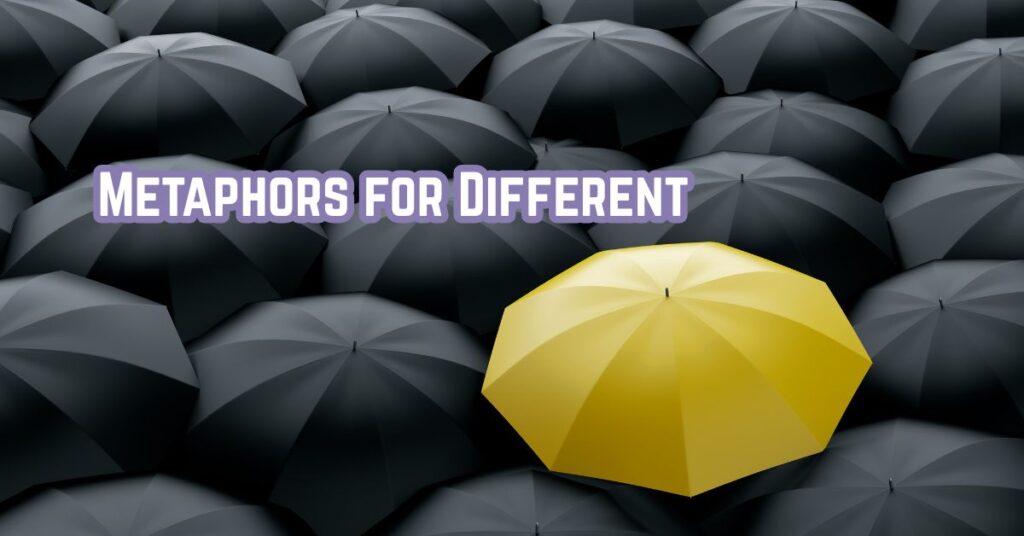

Understanding how to use metaphors for the concept of “different” is crucial for adding depth and color to your writing and speech. Metaphors allow us to express abstract ideas in more relatable and vivid terms. This article explores various metaphorical approaches to ‘different,’ providing examples and exercises to enhance your understanding and usage. Whether you’re an English language learner or a seasoned writer, mastering these metaphors will significantly improve your communication skills.
This guide is designed to benefit students, writers, educators, and anyone looking to enrich their vocabulary and expressive abilities. By delving into the nuances of metaphorical language, you’ll gain a more profound appreciation for the power of words and their capacity to convey complex meanings.
Table of Contents
- Introduction
- Definition of Metaphor for ‘Different’
- Structural Breakdown of Metaphors
- Types and Categories of Metaphors for ‘Different’
- Examples of Metaphors for ‘Different’
- Usage Rules for Metaphors
- Common Mistakes When Using Metaphors
- Practice Exercises
- Advanced Topics in Metaphor Usage
- Frequently Asked Questions
- Conclusion
Definition of Metaphor for ‘Different’
A metaphor is a figure of speech that directly compares two unlike things without using “like” or “as.” When we use metaphors for ‘different,’ we’re essentially describing something that deviates from the norm, stands in contrast to something else, or possesses unique characteristics. The function of these metaphors is to add emphasis, create imagery, and convey a deeper understanding of the concept of difference.
Metaphors for ‘different’ can be classified based on the aspect of difference they emphasize. For example, some metaphors highlight the deviation from the standard, while others focus on the contrast between two entities. The contexts in which these metaphors are used vary widely, ranging from everyday conversation to formal writing and literature. Understanding these nuances allows for more effective and impactful communication.
Structural Breakdown of Metaphors
The structure of a metaphor typically involves two key elements: the tenor and the vehicle. The tenor is the subject being described (in this case, ‘different’), and the vehicle is the object or concept used to represent the tenor. The connection between the tenor and vehicle is not literal but relies on shared qualities or associations.
For instance, if we say “He’s a black sheep,” the tenor is the individual who is different, and the vehicle is the ‘black sheep,’ which traditionally symbolizes someone who deviates from the norm within a group. The effectiveness of a metaphor depends on the audience’s ability to understand and relate to the connection between the tenor and the vehicle. A well-constructed metaphor can enhance understanding and create a more memorable impression. Conversely, a poorly chosen metaphor can confuse or mislead the audience.
Types and Categories of Metaphors for ‘Different’
Metaphors for ‘different’ can be categorized based on the specific aspect of difference they emphasize. Here are some common categories:
Deviation Metaphors
These metaphors emphasize the act of straying from the standard or norm. They often carry a connotation of being unusual or exceptional, sometimes even negative depending on the context. They are particularly useful when highlighting how something diverges from established patterns or expectations.
Contrast Metaphors
Contrast metaphors highlight the differences between two or more entities. They emphasize the opposing characteristics or qualities that set them apart. These metaphors are useful for illustrating distinctions and comparisons in a vivid and memorable way.
Unique Entity Metaphors
These focus on the singular and unparalleled nature of something different. They emphasize that the subject is one-of-a-kind and possesses qualities that are not found elsewhere. They are useful for celebrating individuality and exceptionalism.
Alien Metaphors
Alien metaphors describe something different as foreign, unfamiliar, or out of place. They often evoke a sense of strangeness or unfamiliarity. They are particularly useful when emphasizing the disconnect between the subject and its surroundings.
Evolution Metaphors
These metaphors portray the concept of ‘different’ as a result of change, development, or progress. They suggest that something has evolved or transformed into something distinct from its previous state. They are useful for illustrating growth, transformation, and adaptation.
Examples of Metaphors for ‘Different’
The following tables provide examples of metaphors for ‘different,’ categorized by their type. Each example includes the metaphor, its meaning, and an example sentence to illustrate its usage.
Table 1: Deviation Metaphors
This table showcases metaphors that highlight how something deviates from the norm, focusing on its unusual or exceptional nature.
| Metaphor | Meaning | Example Sentence |
|---|---|---|
| Black sheep | Someone who is different from the rest of the family or group. | He was always the black sheep of the family, pursuing art instead of business. |
| Odd duck | A strange or eccentric person. | She’s a bit of an odd duck, but she’s incredibly talented. |
| Square peg in a round hole | Someone who doesn’t fit into a particular situation or environment. | He felt like a square peg in a round hole at the corporate law firm. |
| Outlier | A data point that is significantly different from other data points. | The test results showed her as an outlier, far exceeding the average score. |
| Maverick | An independent-minded person who refuses to conform. | The CEO was known as a maverick in the industry, always challenging the status quo. |
| Nonconformist | Someone who does not conform to accepted beliefs or practices. | As a nonconformist, she refused to follow societal norms. |
| Rebel | A person who resists authority, control, or convention. | He was a rebel in his youth, always questioning authority. |
| Wild card | Someone or something whose behavior or effects are unpredictable. | Her unpredictable nature made her a wild card in the negotiations. |
| Lone wolf | A person who prefers to work alone and avoid social interaction. | He was a lone wolf, preferring to work on his projects independently. |
| Out of step | Not in harmony or agreement with others. | He always felt out of step with the rest of the team. |
| Offbeat | Unconventional and slightly strange. | She had an offbeat sense of humor that some people didn’t understand. |
| Against the grain | Contrary to the natural inclination or feeling of something. | His decision to quit his job went against the grain of his family’s expectations. |
| Atypical | Not representative of a type, group, or class. | Her performance was atypical for someone of her experience level. |
| Breaking the mold | Doing things differently than they have been done before. | The new startup was breaking the mold with its innovative approach. |
| A different breed | Of a different type or kind. | She was a different breed of politician, genuinely caring about her constituents. |
| Outside the box | Thinking in a new and different way. | To solve the problem, we need to think outside the box. |
| Unorthodox | Contrary to what is usual, traditional, or accepted. | His teaching methods were unorthodox, but highly effective. |
| Left field | Unexpected or unconventional. | His suggestion came from left field, but it turned out to be brilliant. |
| Misfit | A person whose behavior or attitude sets them apart from others in an uncomfortable way. | He always felt like a misfit in his hometown. |
| Outcast | A person who has been rejected or ostracized by their society or group. | She became an outcast after voicing her unpopular opinions. |
Table 2: Contrast Metaphors
This table shows metaphors that highlight differences by comparing two distinct entities, emphasizing their opposing characteristics.
| Metaphor | Meaning | Example Sentence |
|---|---|---|
| Night and day | Completely different. | Their personalities were night and day. |
| Oil and water | Incompatible; unable to mix or get along. | Their ideas clashed so much, they were like oil and water. |
| Chalk and cheese | Very different; not comparable. | The two brothers were like chalk and cheese in terms of their interests. |
| Apples and oranges | Fundamentally different and not suitable for comparison. | Comparing their skills is like comparing apples and oranges. |
| Black and white | Clearly different, with no middle ground. | The issue isn’t as black and white as it seems. |
| Good cop, bad cop | A negotiation technique involving two people with contrasting approaches. | They played good cop, bad cop to get the suspect to confess. |
| Yin and yang | Two complementary but opposite forces. | Their relationship was a balance of yin and yang. |
| Hot and cold | Showing contradictory feelings or behavior. | Her attitude towards him was hot and cold, leaving him confused. |
| Up and down | Experiencing both good and bad times. | Their marriage had its ups and downs, but they always stayed together. |
| Push and pull | Conflicting forces or influences. | There was a constant push and pull between tradition and innovation. |
| Heads or tails | A choice between two equally likely possibilities. | It was a heads or tails decision, with no clear right answer. |
| Sweet and sour | Having both pleasant and unpleasant qualities. | The experience was sweet and sour, with moments of joy and sadness. |
| Light and dark | Representing contrasting aspects, such as good and evil. | The novel explored the themes of light and dark within the human soul. |
| East and West | Representing different cultures and ideologies. | The conference aimed to bridge the gap between East and West. |
| Before and after | Showing a stark contrast between two states. | The renovation resulted in a dramatic before and after transformation. |
| Then and now | Comparing the past and the present to highlight changes. | Then and now, the city has undergone significant development. |
| Here and there | Referring to different locations or aspects. | The problems are scattered here and there, requiring a comprehensive solution. |
| This and that | Different items or aspects being considered. | We need to consider this and that before making a decision. |
| Inside and outside | Contrasting internal and external aspects. | The book explores the inside and outside of the character’s personality. |
| Above and below | Contrasting higher and lower positions or statuses. | The social hierarchy was clearly defined, with people positioned above and below. |
Table 3: Unique Entity Metaphors
This table presents metaphors that emphasize the singularity and unparalleled nature of something different, highlighting its unique qualities.
| Metaphor | Meaning | Example Sentence |
|---|---|---|
| One of a kind | Unique and unparalleled. | She was truly one of a kind, with a talent that couldn’t be replicated. |
| A rare bird | Someone who is unusual or exceptional. | He’s a rare bird in the industry, with both creativity and business acumen. |
| A diamond in the rough | Someone with great potential but lacking refinement. | He was a diamond in the rough, needing guidance to shine. |
| A hidden gem | Something valuable or special that is not widely known. | The small restaurant was a hidden gem, serving delicious and authentic cuisine. |
| A needle in a haystack | Something very difficult to find. | Finding the right candidate was like searching for a needle in a haystack. |
| A voice in the wilderness | Someone advocating for an unpopular cause. | He was a voice in the wilderness, warning about the dangers of climate change. |
| A breath of fresh air | Someone or something that is new and refreshing. | Her innovative ideas were a breath of fresh air in the stale corporate environment. |
| A shining star | Someone who is exceptionally talented or successful. | She was a shining star in the company, quickly rising through the ranks. |
| A league of their own | Significantly better or different from others. | Their team was in a league of their own, dominating the competition. |
| A class act | Someone who is elegant, stylish, and gracious. | She was a class act, always behaving with grace and dignity. |
| An original | Something that is not a copy or imitation. | His designs were original, unlike anything else on the market. |
| The exception to the rule | Someone or something that does not follow the general pattern. | He was the exception to the rule, succeeding despite the odds. |
| A singularity | Something unique and unparalleled. | Her talent represented a singularity in the world of music. |
| A true original | Authentically unique and not copied from others. | His artistic style was a true original, distinct from any influence. |
| A standout | Someone who is noticeably better or different from others. | She was a standout in the class, excelling in every subject. |
| A paragon | A perfect example of a particular quality or type. | He was a paragon of virtue, always acting with integrity. |
| An anomaly | Something that deviates from what is standard, normal, or expected. | The unusually warm weather was an anomaly for that time of year. |
| A phenomenon | Something remarkable or exceptional. | The singer’s success was a phenomenon, captivating audiences worldwide. |
| A marvel | Something that causes wonder or astonishment. | The engineering feat was a marvel of modern technology. |
| A treasure | Someone or something that is highly valued and cherished. | She was a treasure to the community, always helping those in need. |
Table 4: Alien Metaphors
This table provides examples where ‘different’ is described as something foreign, unfamiliar, or out of place, evoking a sense of estrangement.
| Metaphor | Meaning | Example Sentence |
|---|---|---|
| Fish out of water | Someone who is uncomfortable or out of place in a particular situation. | He felt like a fish out of water at the formal dinner. |
| Alien | Foreign or unfamiliar. | The customs of the new country felt completely alien to her. |
| Foreigner | Someone who is not native to a particular place or society. | As a foreigner, he struggled to understand the local customs. |
| Outsider | Someone who is not part of a particular group or society. | She always felt like an outsider in her own town. |
| Stranger | Someone who is not known or familiar. | He was a stranger in a strange land. |
| Exile | Someone who is forced to leave their country or home. | The artist lived in exile, far from his native land. |
| Lost in translation | Something that is not fully understood due to cultural or linguistic differences. | The humor was lost in translation, leaving the audience confused. |
| A world apart | Very different or distant. | Their lifestyles were a world apart, with vastly different values. |
| From another planet | Extremely different or unusual. | His ideas were so radical, they seemed to be from another planet. |
| Beyond comprehension | Impossible to understand. | The complexity of the theory was beyond comprehension for most people. |
| Uncharted territory | A place or situation that is unfamiliar or unexplored. | Exploring the new market was uncharted territory for the company. |
| Off the map | In a remote or isolated location. | The village was off the map, far from any major cities. |
| Otherworldly | Resembling something from another world. | The landscape had an otherworldly beauty. |
| A different universe | A completely different environment or situation. | Working in that company felt like being in a different universe. |
| A land unknown | An unfamiliar and unexplored place. | The new research area was a land unknown to most scientists. |
| Out of context | Not properly understood or evaluated because removed from its original setting. | His words were taken out of context, leading to misunderstandings. |
| An enigma | A person or thing that is mysterious, puzzling, or difficult to understand. | Her true intentions remained an enigma. |
| A closed book | Something that is difficult or impossible to understand. | The workings of the government were a closed book to the public. |
| A puzzle | Something that is difficult to understand or explain. | His behavior was a puzzle to everyone who knew him. |
| A mystery | Something that is difficult or impossible to understand or explain. | The disappearance of the ship remained a mystery. |
Table 5: Evolution Metaphors
This table lists metaphors that depict ‘different’ as a result of change, development, or progress, suggesting transformation and adaptation.
| Metaphor | Meaning | Example Sentence |
|---|---|---|
| A new leaf | A fresh start; a change in behavior or attitude. | He decided to turn over a new leaf and start exercising regularly. |
| A metamorphosis | A complete change of form or character. | The caterpillar underwent a metamorphosis into a butterfly. |
| A transformation | A significant change in form or appearance. | The city underwent a transformation with the construction of new buildings. |
| An evolution | A gradual process of change or development. | The company experienced an evolution in its marketing strategy. |
| A breakthrough | A significant advance or discovery. | The scientists achieved a breakthrough in cancer research. |
| A turning point | A moment when a significant change occurs. | The decision marked a turning point in his career. |
| A paradigm shift | A fundamental change in approach or underlying assumptions. | The new technology brought about a paradigm shift in the industry. |
| A sea change | A major transformation or shift. | The political landscape underwent a sea change after the election. |
| A quantum leap | A sudden and significant advance. | The new invention represented a quantum leap in technology. |
| A step forward | Progress or improvement. | The new policy was a step forward in environmental protection. |
| A growth spurt | A period of rapid growth or development. | The company experienced a growth spurt in its first year. |
| An upgrade | An improvement or enhancement. | The new software was an upgrade from the previous version. |
| A rebirth | A new beginning or revival. | The city experienced a rebirth after the economic crisis. |
| A new dawn | The beginning of a new era or phase. | The peace treaty marked a new dawn for the two nations. |
| A renaissance | A revival of interest in something that had been forgotten. | The neighborhood experienced a renaissance with the arrival of new businesses. |
| A blossoming | A state of flourishing or developing. | Her talent was blossoming under the guidance of her mentor. |
| A coming of age | The transition from childhood to adulthood. | The novel depicts the character’s coming of age. |
| A watershed moment | A turning point in history. | The election was a watershed moment for the country. |
| A new chapter | The beginning of a new phase or stage in life. | Moving to a new city marked a new chapter in her life. |
| A fresh perspective | A new way of looking at things. | The consultant brought a fresh perspective to the problem. |
Usage Rules for Metaphors
Using metaphors effectively requires understanding several key rules. First, ensure the metaphor is relevant and appropriate for the context. An incongruous metaphor can confuse or distract the audience. Second, be consistent with your metaphors. Mixing metaphors can create a disjointed and confusing message. Third, avoid clichés. Overused metaphors have lost their impact and can make your writing seem unoriginal. Instead, strive for fresh and creative comparisons.
Fourth, consider your audience. The effectiveness of a metaphor depends on their ability to understand the connection between the tenor and the vehicle. Choose metaphors that are familiar and relatable to your target audience. Finally, be mindful of cultural differences. Metaphors can have different meanings and connotations in different cultures. Ensure your metaphors are culturally sensitive and appropriate for your intended audience.
Common Mistakes When Using Metaphors
One common mistake is using mixed metaphors, where two or more incompatible metaphors are combined, creating confusion. For example:
Incorrect: “He grabbed the bull by the horns and nipped it in the bud.” (Mixing “grab the bull by the horns” and “nip it in the bud”)
Correct: “He grabbed the bull by the horns and tackled the problem head-on.”
Another common error is using clichéd metaphors, which lack originality and impact. For example:
Incorrect: “He was as cool as a cucumber.”
Correct: “He maintained an unflappable composure, like a seasoned diplomat in a crisis.”
A further mistake is using metaphors that are inappropriate for the context or audience. For example:
Incorrect: “The stock market is a rollercoaster of emotions.” (Too simplistic for a professional financial report)
Correct: “The stock market exhibits cyclical volatility, driven by investor sentiment and macroeconomic factors.”
Practice Exercises
Complete the following exercises to test your understanding of metaphors for ‘different’.
Exercise 1: Identify the Type of Metaphor
Identify the type of metaphor used in each sentence (Deviation, Contrast, Unique Entity, Alien, Evolution).
| Question | Answer |
|---|---|
| 1. She felt like a fish out of water in the new city. | Alien Metaphor |
| 2. He was the black sheep of the family, always questioning tradition. | Deviation Metaphor |
| 3. Their personalities were night and day, creating a dynamic partnership. | Contrast Metaphor |
| 4. She was a diamond in the rough, with untapped potential. | Unique Entity Metaphor |
| 5. The company underwent a metamorphosis, transforming its business model. | Evolution Metaphor |
| 6. He’s a bit of an odd duck, but incredibly talented. | Deviation Metaphor |
| 7. Their ideas were like oil and water, never mixing well. | Contrast Metaphor |
| 8. She was a breath of fresh air in the stale corporate environment. | Unique Entity Metaphor |
| 9. He turned over a new leaf and started exercising regularly. | Evolution Metaphor |
| 10. The customs of the new country felt completely alien to her. | Alien Metaphor |
Exercise 2: Complete the Metaphor
Complete the following sentences with an appropriate metaphor for ‘different’.
| Question | Answer |
|---|---|
| 1. He felt like a __________ in the formal setting. (Alien Metaphor) | Fish out of water |
| 2. She was the __________ of the team, always challenging the status quo. (Deviation Metaphor) | Maverick |
| 3. Their approaches were like __________ , completely incompatible. (Contrast Metaphor) | Apples and oranges |
| 4. He was a __________ , needing guidance to refine his skills. (Unique Entity Metaphor) | Diamond in the rough |
| 5. The company experienced a __________ in its marketing strategy. (Evolution Metaphor) | Transformation |
| 6. As a __________ , she refused to conform to societal norms. (Deviation Metaphor) | Nonconformist |
| 7. Their personalities were __________ , creating a unique dynamic. (Contrast Metaphor) | Night and day |
| 8. She was __________ in the industry, with both creativity and business acumen. (Unique Entity Metaphor) | A rare bird |
| 9. He decided to __________ and start a new life. (Evolution Metaphor) | Turn over a new leaf |
| 10. He felt like an __________ in his own town. (Alien Metaphor) | Outsider |
Exercise 3: Create Your Own Metaphor
Create your own metaphor for ‘different’ for each of the following scenarios.
1. Describing a student who excels in a subject that others find difficult.
Possible Answer: He’s a natural linguist in a sea of struggling learners.
2. Describing two companies with completely different business strategies.
Possible Answer: Their business models are parallel lines, never intersecting.
3. Describing someone who doesn’t fit into a particular social group.
Possible Answer: She’s a vibrant melody in a monotone chorus.
4. Describing a technology that has revolutionized an industry.
Possible Answer: It’s a digital tsunami, reshaping the landscape of the industry.
5. Describing a person who has undergone a significant personal transformation.
Possible Answer: He’s emerged from the chrysalis, a butterfly transformed.
Advanced Topics in Metaphor Usage
At an advanced level, metaphor usage involves understanding the cognitive dimensions of metaphor and how they influence thought and perception. This includes exploring conceptual metaphors, which are underlying mental structures that shape our understanding of abstract concepts. For example, the conceptual metaphor “ARGUMENT IS WAR” influences how we frame and engage in arguments.
Another advanced topic is the use of extended metaphors, where a single metaphor is developed and sustained throughout a text. This requires careful planning and execution to maintain consistency and avoid mixed metaphors. Furthermore, advanced learners can explore the use of dead metaphors (metaphors that have become so common that they are no longer recognized as metaphors) and how to revive them with fresh language and imagery.
Frequently Asked Questions
Q1: What is the difference between a metaphor and a simile?
A1: Both metaphors and similes compare two unlike things, but metaphors make a direct comparison without using “like” or “as,” while similes use “like” or “as” to indicate the comparison. For example, “He is a lion” (metaphor) vs. “He is like a lion” (simile).
Q2: How can I avoid using clichéd metaphors?
A2: To avoid clichés, strive for originality in your comparisons. Think about the specific qualities you want to emphasize and brainstorm fresh and unexpected ways to express them. Read widely and pay attention to how skilled writers use metaphors effectively.
Q3: What is a mixed metaphor, and how can I avoid it?
A3: A mixed metaphor combines two or more incompatible metaphors, creating confusion. To avoid mixed metaphors, carefully consider the imagery and
ideas you’re trying to convey, and ensure they align logically.
Q4: How do cultural differences affect the use of metaphors?
A4: Metaphors can have different meanings and connotations in different cultures. What may be a clear and effective metaphor in one culture could be confusing or even offensive in another. Always be mindful of your audience and the cultural context when using metaphors.
Q5: Can metaphors be used in technical writing?
A5: Yes, but sparingly and with caution. While technical writing generally aims for clarity and precision, metaphors can be used to explain complex concepts in a more accessible way. However, ensure the metaphor is accurate and doesn’t oversimplify or distort the information.
Conclusion
Mastering the use of metaphors for ‘different’ can significantly enhance your communication skills, adding depth, color, and impact to your writing and speech. By understanding the structural components of metaphors, exploring different categories, and practicing their application, you can effectively convey the nuances of difference in various contexts. Remember to be mindful of usage rules, avoid common mistakes, and consider your audience to ensure your metaphors are both effective and appropriate. Embrace the power of metaphorical language to express abstract ideas in more vivid and relatable terms, and elevate your communication to a new level.