
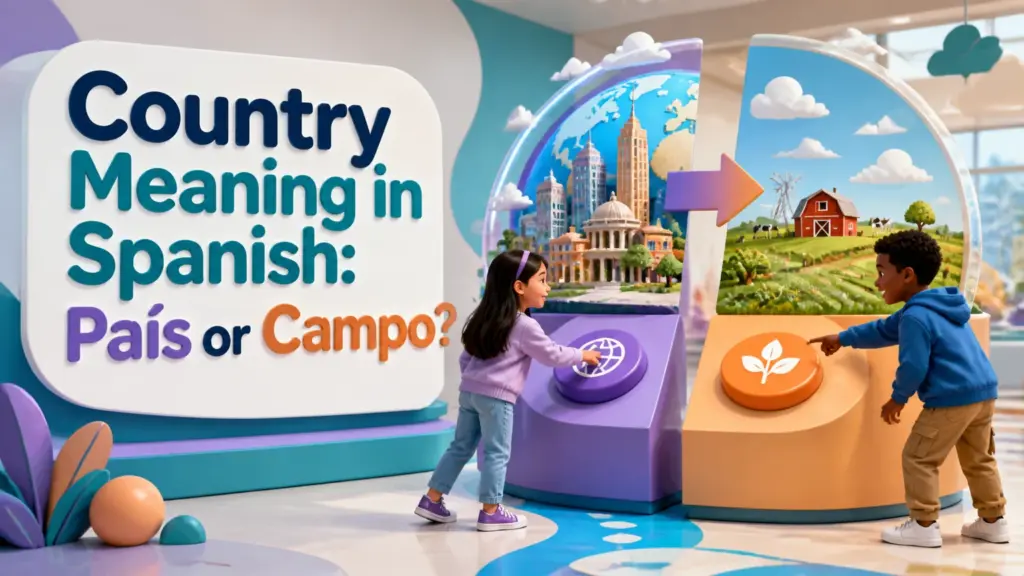

The country meaning in Spanish is usually país when “country” means a nation, sovereign state, or geographical territory. It is campo when “country” means the countryside or rural land. Other contexts require música country, patria, tierra natal, nacional, or rural, so the correct translation depends on the sentence.
Key Facts at a Glance
El país means a nation, state, or country on a map.
El campo means the countryside, rural land, or sometimes a physical field.
País is masculine and pluralizes as países, with the accent retained.
Country music is música country or el country, never usually música de país.
Patria means homeland or fatherland and carries a more emotional or formal tone.
Spanish normally translates adjectival “country” according to meaning, using nacional, rural, de campo, or rústico.
What Does “Country” Mean in Spanish?
“Country” has two primary Spanish translations: país for a nation and campo for rural surroundings. English uses one spelling for these separate meanings, while Spanish selects a different noun for each semantic context.
| English meaning | Spanish expression | Literal sense | Example |
|---|---|---|---|
| Nation or state | el país | Country on a map | España es un país europeo. |
| Countryside | el campo | Rural land | Mis abuelos viven en el campo. |
| Homeland | la patria | National homeland | Defendió a su patria. |
| Native land | la tierra natal | Place of birth | Volvió a su tierra natal. |
| Music genre | la música country | Country music | Escucho música country. |
The fastest rule is semantic rather than grammatical: ask whether the sentence refers to a political place, rural surroundings, emotional belonging, or music. “Which country is Peru?” requires país, while “I prefer living in the country” normally requires campo.
How Do You Choose Between País and Campo?
Choose país for governments, borders, citizenship, nationality, maps, economies, and international comparisons. Choose campo for farms, villages, open land, rural life, and places outside cities.
- Identify what “country” describes.
- Use país for a nation or state.
- Use campo for the countryside.
- Use nacional or de país when “country” modifies a noun.
- Check the article, adjective agreement, and preposition.
| English sentence | Correct Spanish | Meaning |
|---|---|---|
| Which country are you from? | ¿De qué país eres? | National origin |
| I live in the country. | Vivo en el campo. | Rural residence |
| She visited three countries. | Visitó tres países. | Nations visited |
| They moved to the countryside. | Se mudaron al campo. | Rural destination |
| Country roads are narrow. | Los caminos rurales son estrechos. | Rural roads |
A useful practitioner rule is to replace “country” mentally with nation or countryside. If “nation” fits, use país. If “countryside” fits, use campo.
When Does País Mean “Country”?
País means a country as a nation, state, or political territory. Spanish speakers use el país for borders, laws, national economies, citizenship, travel, and international affairs.
| English collocation | Natural Spanish | Example |
|---|---|---|
| Developing country | país en desarrollo | Es un país en desarrollo. |
| Developed country | país desarrollado | Canadá es un país desarrollado. |
| Foreign country | país extranjero | Trabaja en un país extranjero. |
| Home country | país de origen | Regresó a su país de origen. |
| Country risk | riesgo país | El riesgo país aumentó. |
| Country code | código de país | Escribe el código de país. |
| Neighboring country | país vecino | Portugal es un país vecino de España. |
| Host country | país anfitrión | El país anfitrión organizó el evento. |
Is País Masculine or Feminine?
País is a masculine noun, so use el país, un país, los países, and masculine singular or plural adjectives. The plural is países, not paíss or paises.
| Form | Correct Spanish | Translation |
|---|---|---|
| Definite singular | el país | the country |
| Indefinite singular | un país | a country |
| Definite plural | los países | the countries |
| Adjective singular | un país pequeño | a small country |
| Adjective plural | países pequeños | small countries |
| Possessive phrase | mi país | my country |
The accent in país marks a hiatus: the vowels are pronounced in separate syllables, pa-ís. The plural keeps the accent because pa-í-ses still requires the stressed í.
How Do You Pronounce País?
País is pronounced approximately pah-EES, with two syllables. The standard IPA transcription is /paˈis/, and the stress falls on the second syllable.
| Word | Syllables | IPA | Approximate guide |
|---|---|---|---|
| país | 2 | /paˈis/ | pah-EES |
| países | 3 | /paˈises/ | pah-EE-ses |
| campo | 2 | /ˈkampo/ | KAHM-poh |
| patria | 2 | /ˈpatɾja/ | PAH-tria |
| rural | 2 | /ruˈɾal/ | roo-RAL |
Writing pais without the tilde is a spelling error in standard Spanish. The written accent is not decorative: it tells the reader to separate a and í rather than treating them as one unstressed vowel sequence.
When Does Campo Mean “Country”?
Campo means the countryside, rural land, or an area outside an urban environment. Spanish uses el campo in expressions about farming, rural residence, nature, and agricultural work.
| English expression | Spanish translation | Natural example |
|---|---|---|
| The countryside | el campo | El campo está tranquilo. |
| In the country | en el campo | Vivimos en el campo. |
| To the country | al campo | Vamos al campo el domingo. |
| From the country | del campo | Traen verduras del campo. |
| Country life | la vida de campo | Prefiere la vida de campo. |
| Rural tourism | turismo rural | Reservaron una ruta de turismo rural. |
| Country house | casa de campo | Tienen una casa de campo. |
| Rural school | escuela rural | Ella trabaja en una escuela rural. |
Campo can also mean a literal field, area, or domain. For example, campo de fútbol means football or soccer field, while campo de estudio means field of study. Context determines whether the noun refers to countryside or a bounded area.
Is Campo the Same as Zona Rural?
Campo and zona rural overlap, but they differ in register and scope. Campo is common in everyday speech and can suggest landscape or rural lifestyle, while zona rural is more administrative, technical, and geographically precise.
| Expression | Register | Typical reference | Example |
|---|---|---|---|
| el campo | Everyday | Rural life or landscape | Quiero vivir en el campo. |
| zona rural | Formal | Classified rural area | La zona rural carece de transporte. |
| área rural | Technical | Planning or statistics | El área rural creció. |
| el interior | Regional | Inland areas, especially in parts of Latin America | Vive en el interior del país. |
| las afueras | Everyday | Outskirts of a city | Viven en las afueras. |
Do not automatically translate every use of “country” as campo. “A country has a president” refers to un país, while “a country road” refers to un camino rural.
How Does Spanish Translate “Country” as an Adjective?
Spanish translates adjectival “country” according to the relationship being described. Nacional means related to a nation, rural means related to the countryside, and de campo often describes a rural lifestyle, product, or setting.
| English phrase | Preferred Spanish | Why |
|---|---|---|
| Country code | código de país | Code assigned to a nation |
| Country flag | bandera nacional | Relates to a nation |
| Country roads | caminos rurales | Roads in rural areas |
| Country house | casa de campo | House in the countryside |
| Country style | estilo rústico | Rustic interior or design |
| Country life | vida rural or vida de campo | Rural lifestyle |
| Country food | comida campesina or comida tradicional rural | Rural culinary tradition |
| Countrywide | nacional or en todo el país | Across the nation |
The phrase country house illustrates why literal translation fails. Casa de país is not the normal expression for a rural home; use casa de campo, casa rural, or, in some regions, finca, depending on the property and local vocabulary.
What Is “Country Code” in Spanish?
Country code is usually código de país, especially for telephone, internet, or administrative contexts. A telephone country code can also be called prefijo internacional, which specifically refers to the dialing prefix.
| English term | Spanish term | Example |
|---|---|---|
| Country code | código de país | El código de país de México es +52. |
| International dialing code | prefijo internacional | Marca el prefijo internacional primero. |
| Internet country-code domain | dominio de nivel superior geográfico | .es es el dominio de España. |
| Country calling code | código telefónico del país | Confirma el código telefónico. |
The terms are related but not interchangeable in every technical document. +52 is a telephone calling code, while .mx is Mexico’s country-code top-level domain.
What Is “Country Music” in Spanish?
“Country music” is música country in Spanish. Speakers may also use country as a borrowed noun, as in Me gusta el country, but música de país is not the normal translation for the musical genre.
| English | Natural Spanish | Avoid |
|---|---|---|
| Country music | música country | música de país |
| Country singer | cantante de country | cantante de país |
| Country song | canción country | canción de país |
| Country festival | festival de música country | festival de país |
| Country-style music | música de estilo country | música estilo país |
The loanword country is pronounced approximately /ˈkantɾi/ in Spanish. The borrowed genre name does not mean that the music is “music from a country”; it names a specific tradition associated historically with the United States.
Can Country Be a Spanish Noun?
Country can function as a Spanish loanword in particular cultural and regional contexts. In most international Spanish, música country is clearer, while un country has an additional real-estate meaning in Argentina and Uruguay.
In Argentina and Uruguay, un country may refer to a gated suburban development, often with private amenities and controlled access. That meaning is regional, so a learner should not assume that country universally means an American-style rural property or music genre.
What Do Patria and Tierra Natal Mean?
Patria means homeland or fatherland and expresses collective, historical, or patriotic attachment. Tierra natal means native land or birthplace and usually focuses on personal origin rather than political loyalty.
| English idea | Spanish | Tone |
|---|---|---|
| My country, politically | mi país | Neutral |
| My homeland, emotionally | mi patria | Formal or patriotic |
| My native land | mi tierra natal | Personal and literary |
| Country of birth | país de nacimiento | Administrative |
| Country of origin | país de origen | Official or practical |
| Motherland | patria or tierra natal | Literary, historical, or emotional |
Compare Nací en Colombia, pero vivo en España with Siempre recordaré mi patria. The first gives factual residence and nationality information; the second expresses an emotional relationship with homeland.
A common mistake is using patria in a passport, hotel, or immigration form. Those contexts normally require país, nacionalidad, or país de nacimiento, because patria carries more emotional weight than administrative precision.
Which Spanish Expressions Fit Travel and Business?
Travelers usually need país, país de origen, código de país, turismo rural, and casa rural. Business users frequently need mercado nacional, riesgo país, economía del país, and operaciones internacionales.
| Situation | Useful Spanish | Example |
|---|---|---|
| Asking nationality | ¿De qué país eres? | Soy de Chile. |
| Asking origin naturally | ¿De dónde eres? | Soy de Perú. |
| Booking rural lodging | casa rural | Busco una casa rural para cuatro personas. |
| Planning countryside travel | turismo rural | El turismo rural creció en la región. |
| Entering a phone number | código de país | Selecciona el código de país. |
| Assessing sovereign risk | riesgo país | El informe analiza el riesgo país. |
| Selling domestically | mercado nacional | La empresa opera en el mercado nacional. |
| Importing goods | comercio internacional | Gestiona comercio internacional. |
Is “Which Country Are You From?” ¿De Qué País Eres?
¿De qué país eres? is correct and specifically asks for a country. ¿De dónde eres? is more conversational and can ask about a city, region, or country.
| English question | Spanish question | Expected answer |
|---|---|---|
| Which country are you from? | ¿De qué país eres? | Soy de Ecuador. |
| Where are you from? | ¿De dónde eres? | Soy de Quito. |
| What is your nationality? | ¿Cuál es tu nacionalidad? | Soy ecuatoriano. |
| Where do you live? | ¿Dónde vives? | Vivo en Madrid. |
Use ser de for origin and vivir en for current residence. Soy de México does not necessarily mean the speaker currently lives in Mexico.
What Grammar Rules Matter Most?
The main grammar rules are gender, number, articles, contractions, and adjective agreement. País and campo are both masculine, while patria, tierra, and música are feminine.
| Noun | Gender | Singular article | Plural | Agreement example |
|---|---|---|---|---|
| país | Masculine | el país | los países | países grandes |
| campo | Masculine | el campo | los campos | campos verdes |
| patria | Feminine | la patria | las patrias | patrias queridas |
| tierra | Feminine | la tierra | las tierras | tierras natales |
| música | Feminine | la música | Usually uncountable | música country |
The prepositions a and de contract with the masculine singular article el: al campo means “to the countryside,” and del campo means “from or of the countryside.” No contraction occurs before país beyond ordinary article use: de el país is incorrect, while del país is correct.
Why Is País Written With an Accent?
País carries a tilde because the accent separates a and í into two syllables. Without the tilde, the spelling does not represent the standard pronunciation or orthography of the noun.
Correct examples include:
- El país tiene tres regiones.
- Los países vecinos firmaron un acuerdo.
- ¿En qué país naciste?
- La economía del país cambió.
The accent remains in derived and plural forms where the stressed vowel still requires it. Learners often omit it when typing, but spell-checking and formal writing should restore país and países.
What Are the Most Common Translation Errors?
The most frequent errors come from translating the English word before identifying its sense. A literal translation can produce a grammatical sentence with the wrong meaning, particularly when “country” refers to countryside, music, or a compound noun.
| Incorrect or risky phrase | Correct Spanish | Problem |
|---|---|---|
| Amo el país, meaning nature | Amo el campo | Sounds like love for a nation |
| Música de país | Música country | Literal wording changes the genre |
| Casa de país | Casa de campo | Not the normal rural-home expression |
| Vivo en país, meaning countryside | Vivo en el campo | Missing article and wrong noun |
| Pais | País | Missing required accent |
| Voy en el campo | Voy al campo | Incorrect destination preposition |
| La país | El país | Incorrect grammatical gender |
Why Does “I Love the Country” Need Context?
“I love the country” has at least two meanings in English. Amo el país means “I love the nation,” while Amo el campo means “I love the countryside.” The political and rural interpretations are not interchangeable.
| Intended meaning | Spanish sentence | Likely interpretation |
|---|---|---|
| Love of a nation | Amo mi país. | Patriotism or national attachment |
| Love of rural nature | Amo el campo. | Affection for countryside |
| Enjoy rural living | Me encanta la vida de campo. | Lifestyle preference |
| Love of homeland | Amo mi patria. | Formal or patriotic feeling |
| Love of birthplace | Amo mi tierra natal. | Personal or literary attachment |
When the English sentence is ambiguous, add a possessive or descriptive phrase. Amo el campo y la tranquilidad rural removes doubt; Amo mi país y sus tradiciones clearly identifies national affection.
How Do Regional Differences Affect the Translation?
The core translations país and campo are understood across Spanish-speaking regions, but rural vocabulary, “country” as a loanword, and terms for property vary by country.
| Region | Common rural term | Special usage | Example |
|---|---|---|---|
| Spain | el campo, casa rural | Rural tourism is widely marketed | Alquilamos una casa rural. |
| Mexico | el campo, zona rural | Rancho may mean rural property | Vive en un rancho. |
| Argentina | el campo, quinta | Un country means gated development | Compró una casa en un country. |
| Uruguay | el campo, chacra | Country also denotes gated housing | Viven en una chacra. |
| Colombia | el campo, finca | Finca often means rural property | Pasaron el fin de semana en una finca. |
| Chile | el campo, parcela | Parcela can mean a rural plot | Tiene una parcela. |
Regional nouns should not replace the universal terms in international Spanish without checking context. Finca, rancho, chacra, and parcela describe specific types of property or land, not automatic equivalents for every use of “countryside.”
Which Translation Should You Use?
Use país for a nation, campo for countryside, música country for the genre, patria for emotional homeland, and nacional or rural for adjectival meanings. The correct choice follows the intended concept, not the English spelling.
| If “country” means… | Use… | Example |
|---|---|---|
| A nation on a map | país | Francia es un país. |
| Rural land | campo | Paseamos por el campo. |
| A national institution | nacional | El gobierno nacional anunció cambios. |
| A rural characteristic | rural or de campo | La escuela rural está lejos. |
| A homeland | patria or tierra natal | Regresó a su tierra natal. |
| A music genre | música country | Baila música country. |
The term país is not suitable for “countryside,” and campo is not suitable for a sovereign state. Spanish makes the semantic distinction explicit, which is why context must come before translation.
FAQ
How Do You Say “Country” in Spanish for a Passport?
Use país for a passport or official form. Common expressions include país de nacimiento, “country of birth,” país de nacionalidad, “country of nationality,” and país de residencia, “country of residence.” Use nacionalidad when the form asks for citizenship rather than the name of the country.
What Is the Opposite of Campo in Spanish?
The usual contrast with el campo is la ciudad, “the city,” or lo urbano, “the urban environment.” Rural and urbano are adjective pairs: zona rural contrasts with zona urbana. Las afueras means the outskirts, which may be suburban rather than genuinely rural.
How Do You Say “Country Girl” or “Country Boy”?
The translation depends on meaning. Chica del campo and chico del campo can mean a girl or boy from the countryside, while chica rural and chico rural sound more formal. If “country” means a music or fashion style, specify de estilo country rather than assuming a rural origin.
Is País the Same as “Nation”?
País commonly translates both “country” and “nation,” but nación can sound more formal, historical, or political. País is the normal everyday term for a state such as Italia or Japón. A translation involving identity, sovereignty, or historical people may require nación instead.
How Do You Say “My Country” in Spanish?
Use mi país for a neutral reference to the nation where you live or come from. Use mi patria for a formal or patriotic tone, and mi tierra natal for an emotional reference to the place where you were born. The three expressions differ mainly in register and emphasis.
Can Campo Mean “Field” Instead of “Countryside”?
Yes. Campo means “field” in several technical and physical contexts, including campo de fútbol, “soccer field,” and campo de estudio, “field of study.” The article and surrounding noun usually clarify the meaning. Vivo en el campo means “I live in the countryside,” not “I live in a field.”
The Bottom Line
The most common country meaning in Spanish is país for a nation and campo for the countryside. Use música country for the genre, patria or tierra natal for homeland, and nacional, rural, or de campo when “country” functions as a modifier. Ask whether the English sentence means nation, rural land, music, or homeland before choosing the Spanish expression.