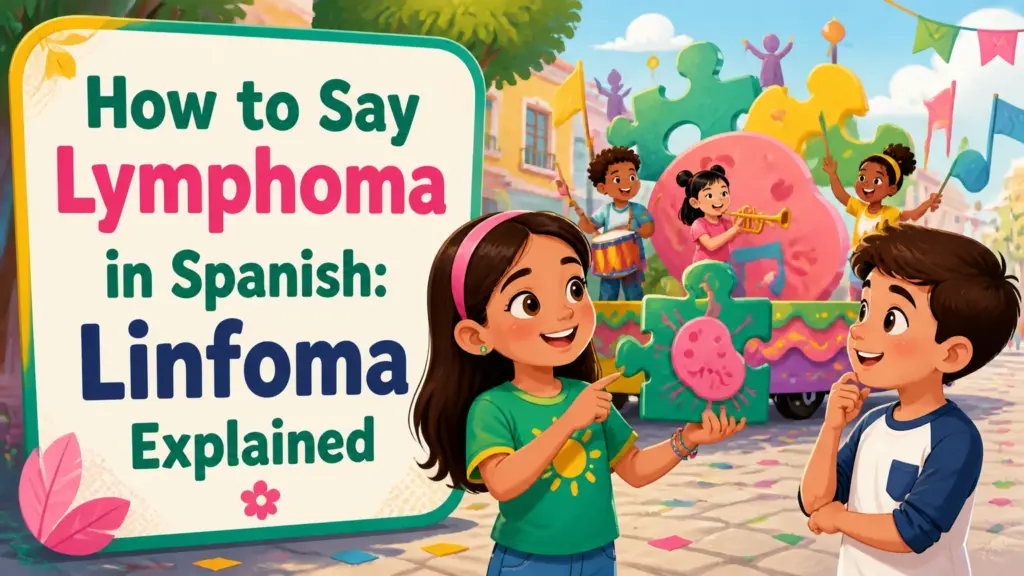

The Spanish word for lymphoma is linfoma. It is a masculine noun, so you say el linfoma for “the lymphoma” and los linfomas for “the lymphomas.” The word is pronounced approximately leen-FOH-mah, with the stress on fo.
Key Facts at a Glance
Lymphoma in Spanish is linfoma.
The correct singular article is el: el linfoma.
The plural is los linfomas, formed by adding -s.
Lymph node is ganglio linfático, not nervio or vena.
Hodgkin lymphoma is linfoma de Hodgkin.
Non-Hodgkin lymphoma is linfoma no Hodgkin.
What Is “Lymphoma” in Spanish?
“Lymphoma” translates directly to linfoma, a medical term used in hospitals, pathology reports, oncology clinics, and everyday conversations about the disease. The word refers to a cancer involving lymphocytes, a type of white blood cell associated with the immune system.
The broader anatomical phrase is el sistema linfático, meaning “the lymphatic system.” A lymph node is un ganglio linfático, while swollen lymph nodes are ganglios linfáticos inflamados or ganglios inflamados. Medical professionals may also use linfadenopatía, meaning lymphadenopathy, especially in a report.
In a sentence, Tengo linfoma means “I have lymphoma.” The formal sentence El médico sospecha un linfoma means “The doctor suspects lymphoma.” The word remains linfoma across Spanish-speaking countries, although the surrounding wording can vary by region and by level of formality.
How Do You Pronounce Linfoma?
Linfoma is pronounced approximately leen-FOH-mah, with three syllables: lin-fo-ma. The Spanish i has a steady sound similar to the vowel in the English word “machine,” and the final a is pronounced clearly.
A closer pronunciation guide is /linˈfo.ma/. The written accent is unnecessary because Spanish stress rules place emphasis on the second-to-last syllable in a word ending in a vowel, n, or s. The stress therefore falls naturally on fo.
English speakers sometimes reduce the final vowel or stress the first syllable. In a medical appointment, clear syllables matter more than an exact accent. Saying el lin-FO-ma will generally be understood.
Is Linfoma Masculine or Feminine?
Linfoma is masculine, so use el, un, and masculine adjectives with it: el linfoma, un linfoma agresivo, and el linfoma avanzado. The plural forms are los linfomas, unos linfomas, and los linfomas agresivos.
| English phrase | Correct Spanish | Grammar point |
|---|---|---|
| The lymphoma | El linfoma | Masculine singular |
| A lymphoma | Un linfoma | Masculine indefinite article |
| The lymphomas | Los linfomas | Masculine plural |
| An aggressive lymphoma | Un linfoma agresivo | Adjective agrees with noun |
| Indolent lymphomas | Linfomas indolentes | Plural adjective |
| My lymphoma | Mi linfoma | Possessive does not change for gender |
The ending -oma can mislead learners because some Spanish nouns ending in -a are feminine. Medical terms such as el linfoma, el hematoma, and el carcinoma are masculine. Memorizing the complete phrase el linfoma prevents article errors.
Can You Say La Linfoma?
No. Standard Spanish uses el linfoma, not la linfoma. A speaker may understand la linfoma, but the phrase is grammatically incorrect in standard medical Spanish.
How Do You Say the Main Types of Lymphoma?
The two major category names are linfoma de Hodgkin and linfoma no Hodgkin. “Hodgkin” remains a proper name, while no Hodgkin is the standard modern form for “non-Hodgkin.”
| English term | Spanish term | Example sentence |
|---|---|---|
| Lymphoma | Linfoma | El informe menciona un linfoma. |
| Hodgkin lymphoma | Linfoma de Hodgkin | Le diagnosticaron linfoma de Hodgkin. |
| Non-Hodgkin lymphoma | Linfoma no Hodgkin | El especialista estudia un linfoma no Hodgkin. |
| B-cell lymphoma | Linfoma de células B | Es un linfoma de células B. |
| T-cell lymphoma | Linfoma de células T | El resultado indica células T anormales. |
| Diffuse large B-cell lymphoma | Linfoma difuso de células B grandes | El diagnóstico especifica linfoma difuso de células B grandes. |
| Follicular lymphoma | Linfoma folicular | El linfoma folicular puede crecer lentamente. |
| Burkitt lymphoma | Linfoma de Burkitt | El hematólogo descartó linfoma de Burkitt. |
Older documents may use enfermedad de Hodgkin or linfogranulomatosis, but linfoma de Hodgkin is the clearest current term. A medical translator should preserve the diagnosis written by the treating team and avoid replacing a specific subtype with the broader word linfoma.
What Are “Indolent” and “Aggressive” Lymphoma in Spanish?
Indolent lymphoma is linfoma indolente or linfoma de bajo grado, while aggressive lymphoma is linfoma agresivo or linfoma de alto grado. These labels describe typical growth behavior, not a complete treatment plan or an individual person’s prognosis.
| English description | Spanish wording | Meaning |
|---|---|---|
| Slow-growing lymphoma | Linfoma de crecimiento lento | Plain-language description |
| Indolent lymphoma | Linfoma indolente | Clinical category |
| Low-grade lymphoma | Linfoma de bajo grado | Grade-related wording |
| Fast-growing lymphoma | Linfoma de crecimiento rápido | Plain-language description |
| Aggressive lymphoma | Linfoma agresivo | Clinical behavior |
| High-grade lymphoma | Linfoma de alto grado | Grade-related wording |
Treatment decisions depend on subtype, stage, symptoms, laboratory results, imaging, overall health, and prior treatment. The phrase agresivo does not by itself mean that treatment will fail, and indolente does not mean that medical follow-up is unnecessary.
How Do You Say Lymph Node and Related Terms?
Lymph node is ganglio linfático. The shorter term ganglio is common when the context is already clear, while glándula means gland and is not an accurate translation.
| English | Spanish | Use |
|---|---|---|
| Lymph node | Ganglio linfático | Anatomically precise term |
| Swollen lymph node | Ganglio linfático inflamado | Patient-friendly phrase |
| Enlarged lymph nodes | Ganglios linfáticos aumentados de tamaño | Formal clinical wording |
| Lymphadenopathy | Linfadenopatía | Report or specialist term |
| Neck lymph nodes | Ganglios del cuello | Everyday wording |
| Armpit lymph nodes | Ganglios de la axila | Axillary location |
| Groin lymph nodes | Ganglios de la ingle | Everyday wording |
| Lymphatic system | Sistema linfático | Body system |
| Spleen | Bazo | Organ often mentioned in staging |
| Bone marrow | Médula ósea | Hematology term |
A “lump” is usually bulto, protuberancia, or masa, depending on the context. A bulto is a physical finding, not a diagnosis. Saying Tengo un bulto en el cuello reports a symptom without claiming that the lump is lymphoma.
How Do You Say Common Lymphoma Symptoms?
Common symptom phrases include sudores nocturnos, fiebre persistente, pérdida de peso inexplicable, and ganglios inflamados. These symptoms have many possible causes, and their presence does not establish a lymphoma diagnosis.
| English symptom | Spanish translation | Natural patient sentence |
|---|---|---|
| Night sweats | Sudores nocturnos or sudoración nocturna | Tengo sudores nocturnos. |
| Persistent fever | Fiebre persistente | He tenido fiebre persistente. |
| Unexplained weight loss | Pérdida de peso inexplicable | He perdido peso sin explicación. |
| Swollen lymph nodes | Ganglios inflamados | Tengo los ganglios inflamados. |
| Fatigue | Cansancio or fatiga | Siento mucho cansancio. |
| Itching | Picazón, comezón, or prurito | Tengo picazón en la piel. |
| Shortness of breath | Falta de aire or dificultad para respirar | Tengo dificultad para respirar. |
The term síntomas B refers to a specific clinical grouping that commonly includes unexplained fever, drenching night sweats, and significant unexplained weight loss. A translator should not automatically label every fever or night sweat as a “B symptom,” because clinicians apply the term within a diagnostic and staging context.
What Spanish Terms Appear in a Lymphoma Diagnosis?
A lymphoma workup may include a biopsia, informe de anatomía patológica, inmunohistoquímica, tomografía computarizada, or PET-TC. The exact vocabulary varies between countries, but the underlying diagnostic steps are broadly similar.
| English term | Spanish medical term | Practical meaning |
|---|---|---|
| Biopsy | Biopsia | Tissue sample for examination |
| Excisional biopsy | Biopsia escisional | Removal of a whole node or lesion |
| Pathology report | Informe de anatomía patológica | Laboratory diagnosis |
| Immunohistochemistry | Inmunohistoquímica | Tests identifying cellular markers |
| CT scan | Tomografía computarizada or TAC | Cross-sectional imaging |
| PET scan | PET or tomografía por emisión de positrones | Metabolic imaging |
| Staging | Estadificación or estadiaje | Determining disease extent |
| Remission | Remisión | Disease signs decrease or disappear |
| Relapse | Recaída | Disease returns after improvement |
| Hematologist | Hematólogo or hematóloga | Blood-disease specialist |
| Oncologist | Oncólogo or oncóloga | Cancer specialist |
Estadificación is common in formal medical writing, while estadiaje appears frequently in clinical usage in parts of the Spanish-speaking world. Both terms can refer to determining whether disease affects one region, several regions, or organs outside the lymphatic system.
A pathology report may contain markers such as CD20, CD30, or células B. Those terms should remain exact in translation because a small wording change can alter the medical meaning. Patients should ask the healthcare team to explain the report rather than relying on an automatic translator.
How Do You Discuss Lymphoma Treatment in Spanish?
The principal treatment terms are quimioterapia, radioterapia, inmunoterapia, trasplante de células madre, and terapia CAR-T. The appropriate treatment depends on the confirmed lymphoma subtype and clinical assessment, so terminology should not be mistaken for a recommendation.
| English treatment term | Spanish term | Related phrase |
|---|---|---|
| Chemotherapy | Quimioterapia | Recibir quimioterapia |
| Radiation therapy | Radioterapia | Sesiones de radioterapia |
| Immunotherapy | Inmunoterapia | Tratamiento inmunoterapéutico |
| Monoclonal antibody | Anticuerpo monoclonal | Rituximab, a named medicine |
| Stem-cell transplant | Trasplante de células madre | Trasplante autólogo |
| Bone-marrow transplant | Trasplante de médula ósea | Related but not always identical |
| CAR T-cell therapy | Terapia CAR-T | Células T modificadas |
| Active surveillance | Vigilancia activa | Regular monitoring without immediate treatment |
The Spanish phrase ciclo de quimioterapia means chemotherapy cycle. Efectos secundarios means side effects, and supresión inmunitaria means immune suppression. A patient can ask ¿Cuáles son los efectos secundarios más frecuentes?, meaning “What are the most common side effects?”
What Does “Watch and Wait” Mean in Spanish?
“Watch and wait” is commonly translated as vigilancia activa or observación activa, not as a phrase suggesting neglect. For some slow-growing lymphomas, clinicians monitor symptoms, examinations, blood tests, and imaging before starting treatment.
A useful question is ¿Por qué recomiendan vigilancia activa en lugar de iniciar tratamiento ahora?, meaning “Why do you recommend active surveillance instead of starting treatment now?” Another is ¿Qué cambios indicarían que debo comenzar tratamiento?, meaning “What changes would indicate that I should begin treatment?”
The timing depends on disease behavior, symptoms, organ involvement, blood counts, and patient preferences. Vigilancia activa is not appropriate for every lymphoma, and the term should be interpreted by the treating hematology team.
How Can You Explain Lymphoma in Plain Spanish?
A plain-language explanation is: El linfoma es un tipo de cáncer que afecta a los linfocitos, unas células de defensa del sistema inmunitario. This means, “Lymphoma is a type of cancer that affects lymphocytes, immune-system defense cells.”
For a family conversation, you could say:
El médico encontró un linfoma, que es un cáncer del sistema linfático. Todavía necesitamos saber el subtipo y la etapa para entender el tratamiento.
That translates as: “The doctor found lymphoma, which is a cancer of the lymphatic system. We still need to know the subtype and stage to understand the treatment.”
For a more cautious discussion before confirmation, say:
Los médicos están investigando si podría tratarse de un linfoma. Aún no hay un diagnóstico definitivo.
This means: “The doctors are investigating whether it could be lymphoma. There is not yet a definitive diagnosis.”
The distinction between sospecha de linfoma and diagnóstico de linfoma is important. The first indicates a possibility; the second indicates that the medical team has established the diagnosis.
Which Spanish Phrases Help at a Medical Appointment?
The most useful phrases identify the diagnosis, request clarification, and establish who is responsible for interpretation. Patients should ask for a qualified medical interpreter when the discussion involves consent, biopsy results, medication risks, or treatment decisions.
- ¿Puede explicar qué significa linfoma en mi informe?
Can you explain what lymphoma means in my report? - ¿Qué subtipo de linfoma tengo?
What subtype of lymphoma do I have? - ¿El diagnóstico está confirmado por una biopsia?
Is the diagnosis confirmed by a biopsy? - ¿En qué etapa está la enfermedad?
What stage is the disease? - ¿Necesito una segunda opinión?
Do I need a second opinion? - Necesito un intérprete médico certificado.
I need a certified medical interpreter. - ¿Podemos revisar el informe de anatomía patológica?
Can we review the pathology report? - ¿Qué opciones de tratamiento existen?
What treatment options are available? - ¿Cuándo debo llamar al hospital?
When should I call the hospital? - ¿Puede escribir el nombre del medicamento?
Can you write down the name of the medicine?
The National Institutes of Health and other United States health agencies distinguish language assistance from informal interpretation for important medical communication. A bilingual family member can provide emotional support, but a qualified interpreter is safer for technical consent and treatment discussions.
Does the Translation Change by Spanish-Speaking Country?
The word linfoma does not materially change across Spanish-speaking countries. Regional differences mainly affect supporting terms, such as computadora versus ordenador, or quimioterapia pronunciation and local hospital abbreviations.
| Meaning | Mexico and much of Latin America | Spain usage |
|---|---|---|
| CT scan | TAC or tomografía | TC or TAC |
| Itching | Comezón or picazón | Picor or prurito |
| Doctor specializing in blood diseases | Hematólogo | Hematólogo |
| Medical record | Expediente clínico | Historia clínica |
| Appointment | Cita | Cita |
| Chemotherapy session | Sesión de quimioterapia | Sesión de quimioterapia |
Clinical documents often use international abbreviations, English-derived drug names, and Latin-based pathology terms. A translation should preserve medicine names, biomarker codes, and staging systems exactly, while translating the explanatory prose.
What Is the Difference Between Linfoma and Linfedema?
Linfoma means lymphoma, a cancer of lymphatic-system cells; linfedema means lymphedema, swelling caused by impaired lymph-fluid drainage. The words look similar but describe different conditions.
| Term | English meaning | Core distinction |
|---|---|---|
| Linfoma | Lymphoma | Cancer involving lymphocytes |
| Linfedema | Lymphedema | Swelling from lymph drainage impairment |
| Linfadenopatía | Lymphadenopathy | Enlarged or abnormal lymph nodes |
| Linfocito | Lymphocyte | A type of white blood cell |
| Ganglio linfático | Lymph node | Small immune-system structure |
This is a high-impact translation distinction. A person reporting swelling after surgery might have linfedema, while an imaging report might describe linfadenopatía. Neither word alone proves linfoma.
What Are Common Translation Mistakes?
The most common errors involve noun gender, anatomy, false friends, and excessive certainty. Use el linfoma, ganglio linfático, and sospecha de linfoma when the diagnosis has not been confirmed.
- Using “la linfoma”
Correct the article to el linfoma. - Translating lymph node as “glándula”
Use ganglio linfático. A gland is glándula, an anatomically different structure. - Confusing lymphoma with lymphedema
Use linfoma for the cancer and linfedema for lymph-related swelling. - Calling every lump lymphoma
Translate a nonspecific lump as bulto, masa, or ganglio inflamado, depending on the clinical finding. - Using “metástasis” automatically
Lymphoma can involve multiple organs, but the correct staging language depends on lymphoma classification. Do not add “metastasis” unless the original clinician uses that concept. - Translating a subtype too loosely
Preserve terms such as linfoma difuso de células B grandes and linfoma folicular rather than shortening them to linfoma.
A practitioner’s rule is simple: translate the finding first, the interpretation second, and the diagnosis only when the source document confirms it.
When Should You Use a Medical Interpreter?
Use a qualified medical interpreter for a new cancer diagnosis, pathology review, informed consent, chemotherapy instructions, emergency symptoms, medication reactions, and treatment-risk discussions. Machine translation can help with vocabulary, but it cannot reliably preserve clinical uncertainty or consent language.
Ask for an interpreter by saying:
¿Podría solicitar un intérprete médico de español para esta consulta?
If you are translating a written report, keep the original document beside the translation. Record the date, the country where the document was issued, the specialty of the clinician, and any abbreviations that remain untranslated.
An English-to-Spanish dictionary can confirm that lymphoma means linfoma, but it cannot determine whether a report’s lesión, masa, adenopatía, or infiltración represents cancer. That interpretation belongs to a qualified clinician or medical translator.
Frequently Asked Questions
Is “lymphoma” the same word in Spanish?
Yes. The standard Spanish translation is linfoma, and the medical meaning is the same. Spanish changes the surrounding grammar, however: use el linfoma in the singular and los linfomas in the plural. The term appears in clinical documents throughout Spain and Latin America.
How do you say “I have lymphoma” in Spanish?
Say Tengo linfoma. A more formal version is Me han diagnosticado un linfoma, meaning “I have been diagnosed with lymphoma.” If the diagnosis is not confirmed, say Los médicos sospechan que podría ser un linfoma, meaning “The doctors suspect it could be lymphoma.”
How do you say “lymphoma cancer” in Spanish?
The natural term is simply linfoma, because lymphoma already identifies a type of cancer. Cáncer de los ganglios linfáticos may help in plain conversation, but it is less precise because lymphoma can involve lymph nodes, blood, bone marrow, spleen, or other tissues.
How do you say “Hodgkin’s disease” in Spanish?
The current term is linfoma de Hodgkin. Older English documents may say “Hodgkin’s disease,” and older Spanish documents may use enfermedad de Hodgkin or linfogranulomatosis. For a current clinical conversation, linfoma de Hodgkin is the clearest wording.
How do you ask whether a lymph node is cancerous?
Say ¿Este ganglio podría ser canceroso? or, more naturally in a clinical appointment, ¿Qué indican los estudios sobre este ganglio? The second question avoids assuming cancer and invites the clinician to explain the examination, imaging, or biopsy results.
Should an online translation replace a doctor’s explanation?
No. An online translation can identify linfoma, but it cannot diagnose disease, interpret pathology, determine stage, or select treatment. Use the translation to prepare questions, then ask a clinician or qualified medical interpreter to explain the report and its implications.
The Bottom Line
The answer to how to say lymphoma in Spanish is linfoma. Use el linfoma, pronounce it approximately leen-FOH-mah, and use precise related terms such as linfoma de Hodgkin, linfoma no Hodgkin, and ganglio linfático. Translation can clarify language, but only a qualified healthcare professional can interpret a suspected or confirmed diagnosis.