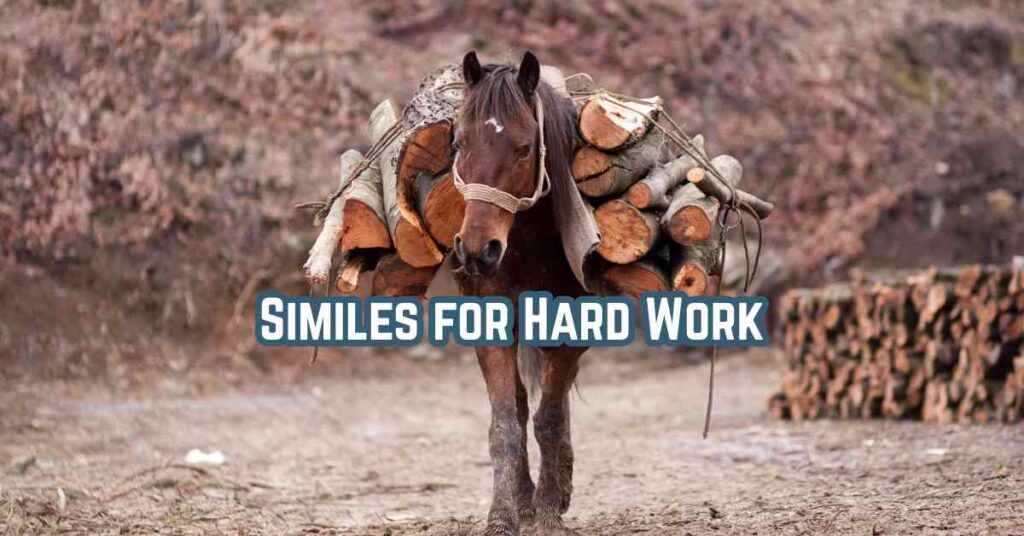

Understanding similes is crucial for enhancing your writing and communication skills. Similes, by comparing one thing to another using “like” or “as,” bring vivid imagery and deeper meaning to your language. This article delves into the use of similes specifically to describe hard work. Mastering this skill helps you express the intensity, dedication, and perseverance associated with diligent effort. This guide is perfect for students, writers, and anyone looking to enrich their vocabulary and descriptive abilities.
Whether you’re crafting compelling narratives, delivering impactful presentations, or simply aiming to articulate your thoughts more effectively, a strong grasp of similes will prove invaluable. This article provides a comprehensive exploration of similes for hard work, equipping you with the tools to paint powerful verbal pictures. By the end of this guide, you’ll be able to recognize, interpret, and utilize similes with confidence and creativity.
Table of Contents
- Definition of Simile
- Structural Breakdown of Similes
- Types of Similes Describing Hard Work
- Examples of Similes for Hard Work
- Usage Rules for Similes
- Common Mistakes with Similes
- Practice Exercises
- Advanced Topics in Similes
- Frequently Asked Questions (FAQ)
- Conclusion
Definition of Simile
A simile is a figure of speech that compares two unlike things using the words “like” or “as.” Its primary function is to create a vivid image or make a concept more understandable by drawing a parallel between the unfamiliar and the familiar. Similes add depth and color to language, making descriptions more engaging and memorable. They are a fundamental tool in both literature and everyday communication.
Unlike metaphors, which directly equate two things (e.g., “He is a lion”), similes acknowledge the difference between the two things being compared, highlighting their shared qualities. This explicit comparison allows for a more nuanced and relatable understanding. For instance, saying “He worked like a dog” doesn’t mean he *is* a dog, but rather that he worked with the same tireless dedication and effort often attributed to dogs.
Similes can be used in various contexts, from poetry and prose to casual conversations and business presentations. They serve to enhance clarity, evoke emotions, and create a lasting impression on the audience. Recognizing and using similes effectively is a key skill for anyone looking to improve their communication prowess. The power of a simile lies in its ability to transform a mundane statement into something memorable and impactful.
Structural Breakdown of Similes
The structure of a simile is quite simple, typically consisting of three key elements: the subject, the linking word, and the comparison. Understanding these components is vital for constructing effective and meaningful similes.
- Subject: This is the thing being described or compared. It’s the focus of the simile. For example, in the simile “He worked like a beaver,” the subject is “He.”
- Linking Word: This is the word that connects the subject to the comparison. The most common linking words are “like” and “as.” These words explicitly signal that a comparison is being made.
- Comparison: This is the thing to which the subject is being compared. It provides a point of reference and helps to create a vivid image. In the example “He worked like a beaver,” the comparison is “a beaver,” highlighting the subject’s industriousness.
The arrangement of these elements can sometimes vary, but the core structure remains consistent. For example, you might encounter similes structured as “as [adjective] as [comparison],” such as “as busy as a bee.” Regardless of the specific arrangement, the purpose remains the same: to draw a comparison between two distinct entities to enhance understanding and imagery. Recognizing this structure helps in both creating and interpreting similes effectively.
Types of Similes Describing Hard Work
Similes for hard work can be categorized based on the source of the comparison. These categories help to organize and understand the different ways in which hard work can be described using figurative language. Here are some common types:
Animal-Related Similes
These similes draw comparisons to animals known for their hard work, persistence, or strength. Examples include “worked like a dog,” “as busy as a bee,” and “as strong as an ox.” These comparisons often evoke a sense of tireless effort and dedication.
Machine-Related Similes
This category uses machines as a point of comparison, emphasizing the relentless and efficient nature of hard work. Examples include “worked like a machine,” “as tireless as a motor,” and “as constant as a clock.” These similes highlight the repetitive and unwavering aspects of labor.
Nature-Related Similes
These similes compare hard work to natural elements or phenomena, highlighting its enduring and powerful qualities. Examples include “worked like a river carving through stone,” “as persistent as rain,” and “as steady as a mountain.” These comparisons often emphasize the long-term impact and unyielding nature of diligent effort.
Abstract Similes
Abstract similes use abstract concepts to describe hard work, focusing on its intensity, dedication, or impact. Examples include “worked like a man possessed,” “as dedicated as a saint,” and “as focused as a laser beam.” These similes often convey the mental and emotional aspects of hard work.
General Similes
General similes are those that don’t neatly fit into the above categories but still effectively convey the idea of hard work. These might draw on common experiences or observations. Examples include “worked like there’s no tomorrow,” “as diligent as can be,” and “as committed as anyone could ask.”
Examples of Similes for Hard Work
This section provides a comprehensive list of similes used to describe hard work, organized by the categories discussed above. These examples are designed to illustrate the diverse ways in which similes can be used to convey the intensity, dedication, and impact of diligent effort.
General Similes for Hard Work
These similes capture the essence of hard work without relying on specific animal, machine, or nature-related comparisons. They are versatile and can be used in a variety of contexts to emphasize the effort and dedication involved.
The table below showcases 30 examples of general similes for hard work, illustrating their application in different scenarios.
| Simile | Example Sentence |
|---|---|
| Worked like there’s no tomorrow | She worked like there’s no tomorrow to meet the deadline. |
| As diligent as can be | He was as diligent as can be, always arriving early and staying late. |
| As committed as anyone could ask | The team was as committed as anyone could ask, pushing through every obstacle. |
| Worked like a man possessed | He worked like a man possessed, driven by an unwavering determination. |
| As tirelessly as possible | They worked as tirelessly as possible to complete the project on time. |
| Like he was trying to move mountains | He strained and sweated, like he was trying to move mountains. |
| As if his life depended on it | She approached the task as if her life depended on it, giving it her all. |
| Worked like a dog | He worked like a dog all day, barely taking a break. |
| As persistent as the day is long | She was as persistent as the day is long in her pursuit of excellence. |
| Like he was building the pyramids | He approached the task like he was building the pyramids, with immense effort. |
| As industrious as they come | She is as industrious as they come, always finding ways to improve efficiency. |
| Worked like a Trojan | He worked like a Trojan to finish the marathon, despite the pain. |
| As if she had a point to prove | She worked as if she had a point to prove, silencing all her doubters. |
| Like he was on a mission from God | He approached his work like he was on a mission from God, with unwavering focus. |
| As dedicated as a monk | He was as dedicated as a monk, sacrificing everything for his craft. |
| Worked like he was racing against time | He worked like he was racing against time, pushing himself to the limit. |
| As relentlessly as the tide | She pursued her goals as relentlessly as the tide, never giving up. |
| Like she was trying to change the world | She worked like she was trying to change the world, driven by her passion. |
| As tirelessly as a marathon runner | He worked as tirelessly as a marathon runner, pacing himself for the long haul. |
| Like he had fire in his belly | He approached his work like he had fire in his belly, full of energy and enthusiasm. |
| As focused as a laser beam | Her concentration was as focused as a laser beam, allowing her to complete the complex task. |
| Worked like a machine | He worked like a machine, churning out reports one after another. |
| As steady as a rock | Her determination was as steady as a rock, unwavering in the face of challenges. |
| Like she was climbing Mount Everest | She approached her career like she was climbing Mount Everest, one step at a time. |
| As consistently as the sunrise | He delivered results as consistently as the sunrise, always dependable. |
| Worked like a tireless ant | She worked like a tireless ant, diligently gathering resources for the team. |
| As meticulously as a surgeon | He approached the project as meticulously as a surgeon, ensuring every detail was perfect. |
| Like she was building a legacy | She worked like she was building a legacy, creating something that would last. |
| As diligently as a scholar | He researched the topic as diligently as a scholar, uncovering every relevant detail. |
| Worked like a busy signal | The phones worked like a busy signal at the call center during peak hours. |
Animal-Related Similes for Hard Work
Animal-related similes are effective because they tap into our common understanding of certain animals’ characteristics. These similes often highlight qualities such as diligence, strength, and perseverance.
Here are 30 examples of animal-related similes for hard work, each demonstrating how animal traits can be used to describe human effort.
| Simile | Example Sentence |
|---|---|
| As busy as a bee | She was as busy as a bee, flitting from one task to another. |
| Worked like a beaver | He worked like a beaver, tirelessly building his business from the ground up. |
| As strong as an ox | He was as strong as an ox, able to lift heavy equipment with ease. |
| Worked like a horse | She worked like a horse to provide for her family. |
| As persistent as an ant | He was as persistent as an ant, never giving up on his goals. |
| Worked like a pack mule | He worked like a pack mule, carrying heavy loads all day long. |
| As tireless as a worker bee | She was as tireless as a worker bee, contributing to the team’s success. |
| Worked like a dog | He worked like a dog, putting in long hours at the office. |
| As determined as a bulldog | She was as determined as a bulldog, refusing to let any obstacle stand in her way. |
| Worked like a tireless ant | She worked like a tireless ant, diligently gathering resources for the team. |
| As focused as a hawk | He was as focused as a hawk, spotting every detail in the project. |
| Worked like a spider spinning its web | She worked like a spider spinning its web, meticulously crafting her masterpiece. |
| As patient as a spider waiting for its prey | He was as patient as a spider waiting for its prey, biding his time for the perfect opportunity. |
| Worked like a busy signal | The phones worked like a busy signal at the call center during peak hours. |
| As quick as a cheetah | He completed the project as quick as a cheetah, meeting the tight deadline. |
| Worked like a diligent squirrel gathering nuts | She worked like a diligent squirrel gathering nuts, preparing for the upcoming season. |
| As steady as a tortoise | He approached the marathon as steady as a tortoise, pacing himself for the long haul. |
| Worked like a badger digging its sett | He worked like a badger digging its sett, determined to create a secure foundation. |
| As resilient as a cockroach | She was as resilient as a cockroach, bouncing back from every setback. |
| Worked like a tireless salmon swimming upstream | He worked like a tireless salmon swimming upstream, overcoming every challenge in his path. |
| As graceful as a swan but with the work ethic of a duck | She was as graceful as a swan but with the work ethic of a duck, elegant yet incredibly hardworking. |
| Worked like a honeybee in a hive | The team worked like a honeybee in a hive, each member contributing to the collective goal. |
| As vigilant as a guard dog | He was as vigilant as a guard dog, protecting the company’s interests. |
| Worked like a dolphin tirelessly swimming the ocean | She worked like a dolphin tirelessly swimming the ocean, exploring every opportunity for growth. |
| As adaptable as a chameleon | He was as adaptable as a chameleon, adjusting to every change in the market. |
| Worked like an eagle soaring to new heights | She worked like an eagle soaring to new heights, aiming for excellence in every endeavor. |
| As precise as a falcon diving for its prey | He was as precise as a falcon diving for its prey, executing every task with accuracy. |
| Worked like a penguin braving the Antarctic winter | She worked like a penguin braving the Antarctic winter, enduring hardship with resilience. |
| As nurturing as a mother hen | She was as nurturing as a mother hen, supporting her team every step of the way. |
| Worked like a lion hunting its prey | He worked like a lion hunting its prey, relentlessly pursuing his goals with unwavering focus. |
Machine-Related Similes for Hard Work
Machine-related similes emphasize efficiency, consistency, and relentlessness. They often evoke a sense of tireless and unwavering effort, highlighting the repetitive and often demanding nature of hard work.
Below are 25 examples of machine-related similes for hard work, illustrating how mechanical attributes can be used to describe human dedication.
| Simile | Example Sentence |
|---|---|
| Worked like a machine | He worked like a machine, churning out reports one after another. |
| As tireless as a motor | She was as tireless as a motor, working late into the night without complaint. |
| As constant as a clock | His dedication was as constant as a clock, always reliable and on time. |
| Worked like a well-oiled engine | The team worked like a well-oiled engine, each member contributing seamlessly. |
| As efficient as a conveyor belt | The production line was as efficient as a conveyor belt, processing items quickly and accurately. |
| Worked like a robot | He worked like a robot, completing repetitive tasks with unwavering precision. |
| As precise as a laser | Her focus was as precise as a laser, cutting through any distractions. |
| Worked like a power drill | He worked like a power drill, boring through any obstacle in his path. |
| As steady as a generator | Her energy was as steady as a generator, providing constant support to the team. |
| Worked like a printing press | He worked like a printing press, producing documents quickly and efficiently. |
| As reliable as a tractor | His commitment was as reliable as a tractor, always pulling through in tough situations. |
| Worked like a tireless assembly line | The factory worked like a tireless assembly line, producing goods around the clock. |
| As consistent as a metronome | Her work ethic was as consistent as a metronome, always maintaining a steady pace. |
| Worked like a computer | He worked like a computer, processing information quickly and accurately. |
| As automated as a factory | The process was as automated as a factory, minimizing human error and maximizing efficiency. |
| Worked like a hydraulic press | He worked like a hydraulic press, applying immense pressure to achieve his goals. |
| As smoothly as a gear | The project ran as smoothly as a gear, with each component working in perfect harmony. |
| Worked like a tireless pump | He worked like a tireless pump, constantly providing support and resources to the team. |
| As predictable as a programmed response | His reaction was as predictable as a programmed response, always consistent in his approach. |
| Worked like a finely calibrated instrument | She worked like a finely calibrated instrument, ensuring every detail was perfect. |
| As relentlessly as a jackhammer | She pursued her goals as relentlessly as a jackhammer, breaking through every obstacle. |
| Worked like a non-stop bottling machine | The factory worked like a non-stop bottling machine, filling and sealing products around the clock. |
| As efficiently as a data center | The team processed information as efficiently as a data center, handling vast amounts of data with ease. |
| Worked like a clockwork mechanism | He worked like a clockwork mechanism, completing tasks with precision and timing. |
| As relentlessly as a search engine | He pursued information as relentlessly as a search engine, leaving no stone unturned. |
Nature-Related Similes for Hard Work
Nature-related similes draw on the enduring and powerful qualities of the natural world to describe hard work. They often emphasize persistence, strength, and the long-term impact of diligent effort.
The table below presents 20 examples of nature-related similes for hard work, highlighting how elements of nature can be used to describe human endeavor.
| Simile | Example Sentence |
|---|---|
| Worked like a river carving through stone | He worked like a river carving through stone, slowly but surely shaping his career. |
| As persistent as rain | She was as persistent as rain, never giving up on her dreams. |
| As steady as a mountain | His resolve was as steady as a mountain, unshaken by challenges. |
| Worked like a tree growing roots | He worked like a tree growing roots, establishing a strong foundation for his business. |
| As resilient as bamboo in the wind | She was as resilient as bamboo in the wind, bending but never breaking. |
| Worked like the sun rising every day | He worked like the sun rising every day, consistently bringing light to the project. |
| As unstoppable as a forest fire | Her ambition was as unstoppable as a forest fire, consuming everything in its path. |
| Worked like a beaver building a dam | He worked like a beaver building a dam, constructing a solid and lasting structure. |
| As deep as the ocean | His dedication was as deep as the ocean, unfathomable and boundless. |
| Worked like a volcano erupting | He worked like a volcano erupting, unleashing a torrent of creativity and energy. |
| As relentless as the tide | She pursued her goals as relentless as the tide, never giving up. |
| Worked like a spring pushing through the earth | He worked like a spring pushing through the earth, breaking through barriers to achieve his goals. |
| As unyielding as granite | Her determination was as unyielding as granite, refusing to be swayed by opposition. |
| Worked like a whirlwind | He worked like a whirlwind, accomplishing tasks quickly and efficiently. |
| As constant as the seasons | His commitment was as constant as the seasons, always reliable and predictable. |
| Worked like a glacier slowly carving the land | She worked like a glacier slowly carving the land, making a lasting impact over time. |
| As powerful as a hurricane | His influence was as powerful as a hurricane, leaving a significant mark on the industry. |
| Worked like the wind shaping the dunes | He worked like the wind shaping the dunes, subtly but surely transforming the landscape. |
| As fertile as the earth | Her ideas were as fertile as the earth, producing a wealth of innovative solutions. |
| Worked like a seed growing into a tree | He worked like a seed growing into a tree, nurturing his skills and talents over time. |
Abstract Similes for Hard Work
Abstract similes use intangible concepts to describe hard work, often focusing on the intensity, dedication, or impact of the effort. These similes can convey a deeper emotional or psychological aspect of hard work.
Here are 20 examples of abstract similes for hard work, illustrating how conceptual ideas can be used to describe human effort.
| Simile | Example Sentence |
|---|---|
| Worked like a man possessed | He worked like a man possessed, driven by an unwavering determination. |
| As dedicated as a saint | He was as dedicated as a saint, sacrificing everything for his craft. |
| As focused as a laser beam | Her concentration was as focused as a laser beam, allowing her to complete the complex task. |
| Worked like he was on a mission from God | He approached his work like he was on a mission from God, with unwavering focus. |
| As committed as anyone could ask | The team was as committed as anyone could ask, pushing through every obstacle. |
| Worked like he was racing against time | He worked like he was racing against time, pushing himself to the limit. |
| As driven as a rocket | Her ambition was as driven as a rocket, propelling her towards success. |
| Worked like he had fire in his belly | He approached his work like he had fire in his belly, full of energy and enthusiasm. |
| As resolute as justice | Her determination was as resolute as justice, unwavering in the pursuit of fairness. |
| Worked like he was building a legacy | He worked like he was building a legacy, creating something that would last for generations. |
| As disciplined as a soldier | He was as disciplined as a soldier, following every instruction with precision. |
| Worked like he was solving the world’s problems | He worked like he was solving the world’s problems, tackling complex issues with dedication. |
| As passionately as an artist | She approached her craft as passionately as an artist, pouring her heart and soul into every piece. |
| Worked like he was fighting for his life | He worked like he was fighting for his life, giving every task his utmost effort. |
| As zealously as a convert | He embraced the new technology as zealously as a convert, eager to learn and implement. |
| Worked like he was chasing a dream | He worked like he was chasing a dream, driven by a vision of a better future. |
| As sincerely as a friend | He supported his colleagues as sincerely as a friend, always offering help and encouragement. |
| Worked like he was making history | He worked like he was making history, striving to leave a lasting impact on the world. |
| As tirelessly as hope | She persevered as tirelessly as hope, never losing faith in her abilities. |
| Worked like he was answering a calling | He worked like he was answering a calling, driven by a sense of purpose and dedication. |
Usage Rules for Similes
Using similes effectively requires adhering to certain rules to ensure clarity, relevance, and impact. Here are some key guidelines to follow:
- Ensure Relevance: The comparison should be relevant to the subject being described. The shared characteristic should be easily recognizable and meaningful.
- Avoid Clichés: While some common similes are effective, overuse can diminish their impact. Strive for originality and creativity.
- Maintain Clarity: The comparison should enhance understanding, not obscure it. The reader should easily grasp the connection between the subject and the comparison.
- Use Appropriate Tone: The tone of the simile should align with the overall tone of the writing. Avoid using humorous similes in serious contexts, and vice versa.
- Be Mindful of Cultural Context: Some comparisons may not resonate with all audiences due to cultural differences. Consider your audience when choosing similes.
Exceptions and Special Cases: While these rules provide a general framework, there are exceptions. Sometimes, breaking a rule can be effective if done intentionally and for a specific purpose. For instance, a deliberately absurd simile can be used for comedic effect. However, it’s essential to master the rules before attempting to break them.
Common Mistakes with Similes
Using similes incorrectly can detract from your writing. Here are some common mistakes to avoid:
- Mixing Metaphors and Similes: Confusing similes with metaphors is a frequent error. Remember that similes use “like” or “as” to make a comparison, while metaphors directly equate two things.
- Using Ineffective Comparisons: The comparison should be meaningful and relevant. Avoid comparisons that are vague, confusing, or nonsensical.
- Overusing Similes: Too many similes can clutter your writing and diminish their impact. Use them sparingly and strategically.
- Using Clichéd Similes: Overused similes can make your writing sound unoriginal. Try to come up with fresh and creative comparisons.
Here are some examples of correct and incorrect usage:
| Incorrect | Correct | Explanation |
|---|---|---|
| He worked like a rock. | He worked like a machine. | “A rock” doesn’t inherently imply hard work, while “a machine” does. |
| She was as diligent as a cloud. | She was as diligent as a bee. | “A cloud” doesn’t convey diligence, while “a bee” is commonly associated with hard work. |
| He worked like there. | He worked like there’s no tomorrow. | The original sentence is grammatically incorrect and lacks a clear comparison. |
Practice Exercises
Test your understanding of similes with these practice exercises. Each exercise focuses on a different aspect of simile usage, from identifying similes to creating your own.
Exercise 1: Identifying Similes
Identify the similes in the following sentences:
| Question | Answer |
|---|---|
| 1. He worked like a horse to finish the project on time. | like a horse |
| 2. She was as busy as a bee, flitting from one task to another. | as busy as a bee |
| 3. The team worked like a well-oiled engine to meet the deadline. | like a well-oiled engine |
| 4. He was as strong as an ox, able to lift heavy objects with ease. | as strong as an ox |
| 5. She approached the task as if her life depended on it. | as if her life depended on it |
| 6. He worked like a tireless machine, never taking a break. | like a tireless machine |
| 7. The project ran as smoothly as a gear, with each component working in harmony. | as smoothly as a gear |
| 8. She was as persistent as rain, never giving up on her dreams. | as persistent as rain |
| 9. He worked like a river carving through stone, slowly but surely making progress. | like a river carving through stone |
| 10. She was as focused as a laser beam, able to concentrate on the task at hand. | as focused as a laser beam |
Exercise 2: Completing Similes
Complete the following similes with appropriate comparisons:
| Question | Answer |
|---|---|
| 1. He worked as | 1. He worked as . |
| 2. She was as as she prepared her presentation. | |
| 3. The team collaborated like to achieve their goals. | |
| 4. His dedication was as during the challenging project. | |
| 5. She pushed herself like to reach the finish line. |
Exercise 3: Writing Your Own Similes
Write a sentence using a simile to describe hard work for each of the following scenarios:
| Scenario | Your Simile |
|---|---|
| 1. A student studying for an important exam. | |
| 2. A construction worker building a skyscraper. | |
| 3. An entrepreneur launching a new business. | |
| 4. A volunteer organizing a charity event. | |
| 5. A software developer coding a complex program. |
Advanced Topics in Similes
For those looking to deepen their understanding of similes, here are some advanced topics to explore:
- Extended Similes: These are longer, more detailed similes that develop the comparison over several sentences or paragraphs.
- Implied Similes: In this type, the “like” or “as” is omitted, but the comparison is still evident.
- Similes in Different Genres: How similes are used in poetry, prose, drama, and other forms of writing.
- The Evolution of Similes: Tracing the historical use and development of similes in literature.
Exploring these advanced topics will help you appreciate the versatility and power of similes in enhancing your writing and communication.
Frequently Asked Questions (FAQ)
What is the difference between a simile and a metaphor?
A simile compares two things using “like” or “as,” while a metaphor directly equates them without using these words. For example, “He is as strong as an ox” (simile) versus “He is an ox” (metaphor).
Why are similes important in writing?
Similes enhance clarity, add vividness, and make writing more engaging. They help readers understand complex ideas by relating them to familiar concepts.
How can I avoid using clichéd similes?
Strive for originality by thinking creatively and looking for unique points of comparison. Try to avoid the first simile that comes to mind and brainstorm alternatives.
Can a simile be too long?
Yes, a simile can be too long if it becomes convoluted or distracts from the main point. Keep similes concise and focused to maximize their impact.
Are similes only used in creative writing?
No, similes can be used in various forms of writing, including business communication, journalism, and academic papers, to enhance clarity and engagement.
Conclusion
Mastering the art of using similes is a valuable skill for anyone looking to improve their communication. By understanding the structure, usage rules, and common mistakes associated with similes, you can effectively enhance your writing and speaking. Whether you’re crafting compelling narratives, delivering impactful presentations, or simply aiming to articulate your thoughts more effectively, a strong grasp of similes will prove invaluable. Embrace the power of figurative language and watch your words come to life.