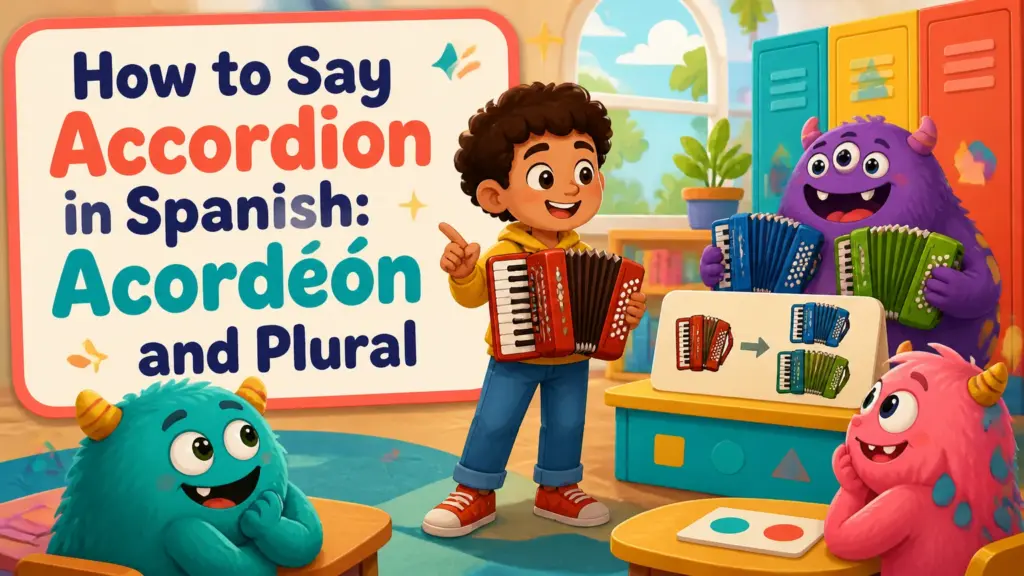

The Spanish word for “accordion” is el acordeón. It is a masculine noun, and the singular spelling requires an acute accent on the final ó; the plural is los acordeones, without an accent mark.
Key Facts at a Glance
- Accordion in Spanish: el acordeón
- Plural: los acordeones
- Gender: masculine
- Pronunciation: approximately “ah-kor-deh-ON”
- Accent rule: the singular ends in stressed -ón; the plural changes to -ones
- Accordion player: el acordeonista or la acordeonista
What Is “Accordion” in Spanish?
Acordeón is the standard Spanish translation for the portable bellows-driven instrument called an accordion in English. Spanish speakers use the noun in conversations about music, instrument shops, orchestras, folk traditions, and regional genres such as Mexican norteño and Colombian vallenato.
The complete dictionary form is el acordeón, not simply acordeón when a sentence requires an article. Spanish articles communicate grammatical gender and number, so the article changes according to whether the speaker means one instrument or several:
- el acordeón: the accordion
- un acordeón: an accordion
- los acordeones: the accordions
- unos acordeones: some accordions
The word comes through German Akkordeon, which is related to Akkord, meaning “chord.” That history reflects the instrument’s ability to produce chords, although Spanish learners do not need the etymology to use the modern word correctly.
How Do You Pronounce Acordeón?
Acordeón is pronounced approximately ah-kor-deh-ON, with the strongest stress on the final syllable. The Spanish r is normally a short tap, and the final ó receives the main stress.
A useful syllable breakdown is:
a-cor-de-ón
English speakers commonly make two pronunciation errors. First, they may pronounce the word like “accordion” with the English vowel pattern. Second, they may stress the first or middle syllable. Spanish places the emphasis at the end because the written accent marks the stressed ó.
The sound is not identical across all Spanish-speaking regions. The vowels remain relatively stable, but the r may sound slightly different depending on the speaker’s accent. Clear vowel pronunciation matters more than producing a perfect regional r.
| Spanish form | Approximate pronunciation | Stress | English meaning |
|---|---|---|---|
| acordeón | ah-kor-deh-ON | final syllable | accordion |
| acordeones | ah-kor-deh-OH-nes | penultimate syllable | accordions |
| acordeonista | ah-kor-deh-oh-NEES-tah | fourth syllable from start | accordion player |
| acordeonista | ah-kor-deh-oh-NEES-tah | same in masculine and feminine | accordionist |
Why Does Acordeón Have an Accent?
The accent in acordeón marks the stressed final syllable and shows that the word is pronounced acorde-ÓN. Spanish words ending in a vowel, n, or s normally receive natural stress on the next-to-last syllable, so the final stress in acordeón must be written with an accent.
The plural is acordeones, not acordeónes. When the plural ending -es is added, the stress moves naturally to the next-to-last syllable: acor-de-O-nes. Because the word follows ordinary Spanish stress rules in the plural, the accent mark disappears.
| Form | Correct spelling | Why |
|---|---|---|
| Singular | acordeón | Final stress requires ó |
| Singular with article | el acordeón | Masculine singular noun |
| Plural | acordeones | Stress follows regular plural pronunciation |
| Incorrect plural | acordeóns | Spanish normally uses -es after this ending |
| Incorrect singular | acordeon | Omits the required written accent |
Is Acordeón Masculine or Feminine?
Acordeón is masculine, so use el, un, este, and masculine singular adjectives with it. The correct phrases are el acordeón rojo and un acordeón nuevo, not la acordeón or una acordeón in standard general Spanish.
Examples include:
- El acordeón es pesado. The accordion is heavy.
- Compré un acordeón pequeño. I bought a small accordion.
- Este acordeón tiene buen sonido. This accordion has a good sound.
- Necesito una correa para el acordeón. I need a strap for the accordion.
- El acordeón colombiano es importante en el vallenato. The Colombian accordion is important in vallenato.
Adjectives agree with the noun, not with the person playing it. A woman can say mi acordeón nuevo, because acordeón remains masculine. The player’s gender affects words such as el acordeonista or la acordeonista, not the instrument’s grammatical gender.
What Is the Plural of Acordeón?
The plural of acordeón is acordeones. Spanish adds -es to nouns ending in a stressed vowel followed by n, and the accent mark is removed because the plural has regular stress.
Use los acordeones for “the accordions” and unos acordeones for “some accordions.” The plural noun can refer to different instruments, a collection of instruments, or several players’ instruments.
| English phrase | Spanish phrase | Grammar point |
|---|---|---|
| the accordion | el acordeón | masculine singular |
| an accordion | un acordeón | indefinite masculine article |
| the accordions | los acordeones | masculine plural |
| some accordions | unos acordeones | indefinite masculine plural |
| my accordion | mi acordeón | possessive does not change gender |
| my accordions | mis acordeones | possessive changes for number |
Correct sentences include Los acordeones están en el escenario, meaning “The accordions are on the stage,” and La tienda vende acordeones de botones, meaning “The store sells button accordions.”
How Do You Say “Play the Accordion” in Spanish?
The most natural translation is tocar el acordeón, which literally means “to play the accordion.” Spanish uses tocar for playing musical instruments, so jugar el acordeón is incorrect in this context because jugar usually means “to play” games or sports.
Useful verb forms include:
- Toco el acordeón. I play the accordion.
- Ella toca el acordeón. She plays the accordion.
- ¿Sabes tocar el acordeón? Do you know how to play the accordion?
- Mi hermano está aprendiendo a tocar el acordeón. My brother is learning to play the accordion.
- Quiero aprender a tocar el acordeón. I want to learn to play the accordion.
- Toca el acordeón muy bien. He or she plays the accordion very well.
The phrase keeps the definite article el. Spanish commonly uses an article with musical instruments after tocar: tocar la guitarra, tocar el piano, and tocar el acordeón.
How Do You Say “Accordion Player” in Spanish?
An accordion player is un acordeonista or una acordeonista. The noun acordeonista has the same ending for all genders; the article identifies whether the player is masculine or feminine.
- El acordeonista toca música norteña. The accordion player plays norteño music.
- La acordeonista ganó el concurso. The female accordion player won the competition.
- Conocimos a varios acordeonistas. We met several accordion players.
The word acordeonero also appears in some regional contexts, especially when referring to a traditional or professional accordion musician. Acordeonista is the broader, safer term for general Spanish.
What Are the Main Accordion Types in Spanish?
Spanish names for accordion types depend on the instrument’s keyboard or button layout. The most useful terms are acordeón de teclas, acordeón de botones, and acordeón diatónico.
| English type | Spanish term | Defining feature | Common context |
|---|---|---|---|
| Piano accordion | acordeón de teclas | Piano-style right-hand keyboard | Classical, pop, European traditions |
| Button accordion | acordeón de botones | Buttons for melody or bass | Folk and regional music |
| Diatonic accordion | acordeón diatónico | Different notes can sound on push and pull | Norteño, vallenato, Cajun music |
| Chromatic accordion | acordeón cromático | Full chromatic note system | Classical, musette, jazz |
| Digital accordion | acordeón digital | Electronic sound generation | Headphone practice and amplified performance |
The term acordeón de teclas is more precise than translating “piano accordion” as acordeón de piano, although both may be understood. A tecla is a key, while a botón is a button.
What Are the Main Accordion Parts in Spanish?
The central bellows are el fuelle, the keyboard is el teclado, and a button is el botón. Other useful terms include la lengüeta for reed, la válvula for valve, la correa for strap, and el registro for register or tone-control mechanism.
| English part | Spanish term | Function |
|---|---|---|
| Bellows | el fuelle | Moves air through the instrument |
| Key | la tecla | Activates a note on a keyboard model |
| Button | el botón | Activates notes or chords |
| Reed | la lengüeta | Vibrates to produce the tone |
| Valve | la válvula | Controls air entering a reed chamber |
| Strap | la correa | Supports the instrument on the player |
| Keyboard | el teclado | Right-hand key arrangement |
| Bass buttons | los botones de bajo | Left-hand bass and chord controls |
These terms help when describing a repair, asking for a replacement part, or explaining how a musician performs. For example, El fuelle tiene una fuga means “The bellows have a leak,” while Necesito una correa nueva means “I need a new strap.”
How Is the Accordion Used in Spanish-Speaking Music?
The accordion has especially strong associations with regional music in Mexico, Colombia, and parts of South America. The instrument’s Spanish name remains acordeón, but its type, tuning, and playing style vary by tradition.
In Mexican música norteña, the diatonic button accordion commonly appears with bajo sexto, bass, drums, and vocals. In Colombian vallenato, the accordion is a defining melodic instrument, usually discussed alongside the caja vallenata and guacharaca.
| Musical context | Spanish phrase | Typical association |
|---|---|---|
| Norteño music | el acordeón norteño | Northern Mexico and Mexican-American communities |
| Vallenato | el acordeón vallenato | Colombia’s Caribbean region |
| Regional Mexican music | el acordeón de botones | Diatonic button instruments |
| European folk music | el acordeón diatónico | Folk dance and traditional ensembles |
| Classical performance | el acordeón cromático | Concert repertoire and transcriptions |
A regional adjective does not change the noun’s gender: el acordeón vallenato, el acordeón norteño, and el acordeón diatónico all use el.
What Should You Say in a Spanish Instrument Shop?
To ask for an accordion, say Busco un acordeón, meaning “I am looking for an accordion.” To specify the type, add a phrase such as de teclas, de botones, or diatónico.
| Situation | Natural Spanish | English meaning |
|---|---|---|
| Asking for an instrument | Busco un acordeón. | I am looking for an accordion. |
| Asking about price | ¿Cuánto cuesta este acordeón? | How much does this accordion cost? |
| Requesting a button model | Quiero un acordeón de botones. | I want a button accordion. |
| Asking about size | ¿Qué tamaño tiene? | What size is it? |
| Asking about condition | ¿Está afinado el acordeón? | Is the accordion tuned? |
| Asking about repair | ¿Reparan acordeones? | Do you repair accordions? |
| Asking about sound | ¿Puedo probar el acordeón? | Can I try the accordion? |
¿Cuánto cuesta un acordeón? is the standard price question. Avoid translating “How much is an accordion?” word for word as ¿Cuánto es un acordeón?, because Spanish normally uses costar for an item’s price.
Is Acordeón the Same in Spain and Latin America?
Yes, acordeón is the standard word in both Spain and Latin America. Regional differences usually concern musical style, instrument design, or genre labels rather than the basic noun.
A speaker in Colombia may discuss el acordeón vallenato, while a speaker in Mexico may say el acordeón norteño. In Spain, acordeón may appear in discussions of conservatory study, folk music, or orchestral performance. The spelling, gender, and plural remain the same.
Acordeón Compared With Related Instruments
Acordeón means accordion, not harmonica, concertina, or bandoneón. Those instruments may share free-reed technology or a bellows, but Spanish uses separate nouns for each.
| English instrument | Spanish term | Main distinction |
|---|---|---|
| Accordion | acordeón | Bellows, keys or buttons, multiple reed chambers |
| Harmonica | armónica | Mouth-blown instrument without bellows |
| Concertina | concertina | Compact bellows instrument with buttons on both ends |
| Bandoneon | bandoneón | Compact button accordion associated with tango |
| Organ | órgano | Keyboard instrument with pipes or electronic sound generation |
The similar-looking word bandoneón can confuse learners because it is an accordion-family instrument. If the intended instrument is the tango instrument, say bandoneón, not acordeón.
What Are the Most Common Spelling Mistakes?
The most common mistake is writing acordeon without the accent. The unaccented form does not show the standard Spanish stress and is incorrect in careful written Spanish.
| Incorrect form | Correct form | Problem |
|---|---|---|
| acordeon | acordeón | Missing written accent |
| la acordeón | el acordeón | Incorrect grammatical gender |
| acordeóns | acordeones | Incorrect plural ending |
| los acordeón | los acordeones | Singular noun after plural article |
| jugar el acordeón | tocar el acordeón | Wrong verb for musical performance |
| accordionista | acordeonista | Untranslated English spelling |
A missing accent may be tolerated in informal digital writing, especially where keyboards lack Spanish settings, but it remains a spelling error in formal text, subtitles, educational materials, and professional translation.
Expert Usage Rules
- Use the article: Say el acordeón when referring to the instrument as a noun phrase.
- Use tocar: Musical instruments are generally played with tocar, not jugar.
- Keep the accent singular: Write acordeón, but pluralize as acordeones.
- Separate the instrument from the player: Acordeón names the object; acordeonista names the musician.
- Specify the type when needed: Acordeón de botones is clearer than simply acordeón in a specialist conversation.
FAQ About Saying “Accordion” in Spanish
How do you say “an accordion” in Spanish?
Say un acordeón. The indefinite article un shows that acordeón is masculine, and the written accent remains on the final ó. For example, Compré un acordeón means “I bought an accordion.”
How do you say “accordion music” in Spanish?
Say música de acordeón for “accordion music.” You can also specify a genre, such as música norteña con acordeón for “norteño music with accordion” or música de acordeón vallenato for vallenato accordion music.
How do you say “accordion lesson” in Spanish?
Say clase de acordeón or lección de acordeón. Clase de acordeón is the more natural everyday phrase. For example, Tengo una clase de acordeón mañana means “I have an accordion lesson tomorrow.”
How do you say “accordion case” in Spanish?
Say estuche para acordeón or maleta para acordeón. Estuche usually means a protective case, while maleta can refer to a larger carrying case or bag. The exact term may vary by country and product style.
Is acordeón used figuratively in Spanish?
Yes. In some contexts, acordeón can describe something that expands and contracts, referring to the instrument’s bellows. The figurative use depends on the country and sentence, so learners should use the literal musical meaning first.
What is the shortest correct answer?
The shortest correct answer is acordeón, or el acordeón when the definite article is included. Remember the accent on ó in the singular and the plural form acordeones.
The Bottom Line
To answer how to say accordion in Spanish, use el acordeón. The noun is masculine, the singular requires the accent in acordeón, and the plural is los acordeones. For related phrases, say tocar el acordeón for “play the accordion” and acordeonista for “accordion player.”