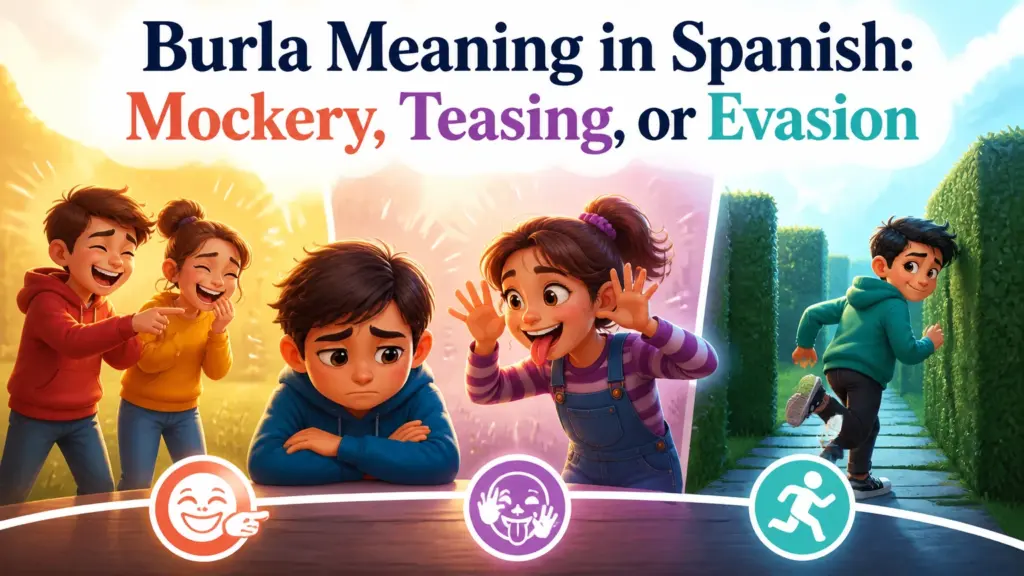

Burla is a Spanish feminine noun that usually means mockery, teasing, ridicule, taunt, or a prank, depending on intent and context. The related verb burlar can also mean to trick, evade, bypass, or outmaneuver, while burlarse de means to make fun of someone or something.
Key Facts at a Glance
- La burla is grammatically feminine, so the correct article is la, not el.
- Burla can describe friendly teasing, cruel ridicule, imitation, or a deceptive act.
- Burlarse de alguien means “to make fun of someone,” and the preposition de is required.
- Broma usually means a joke or prank, while chiste usually means a joke told to make people laugh.
- Burlar la ley means “to evade or circumvent the law,” not “to laugh at the law.”
- Burla is pronounced approximately BOOR-lah, with stress on the first syllable.
What Does Burla Mean in Spanish?
Burla means an expression, action, imitation, or situation that ridicules someone, makes them look foolish, or treats them with contempt. English translations include mockery, taunt, teasing, ridicule, jeer, prank, and occasionally joke, but the correct choice depends on whether the act is playful, insulting, deceptive, or ironic.
The noun comes from burlar, a verb associated with mocking or deceiving. The Spanish dictionary tradition distinguishes the mocking sense from the evasive sense: a person can burlarse de un compañero, while a runner can burlar a un defensor. These sentences share a word family but describe different actions.
How Do You Pronounce Burla?
Burla is pronounced approximately BOOR-lah, represented in the International Phonetic Alphabet as [ˈbuɾ.la] in many Spanish varieties. The r is a short tap, similar to the single r in Spanish pero, rather than the strongly rolled sound in perro.
The plural is burlas. Common forms include:
- una burla, a mockery or taunt
- la burla, the mockery
- varias burlas, several taunts or jokes
- hacer burlas, to make mocking gestures or remarks
Spanish speakers use burla in both formal and informal contexts. Newspapers may describe political burlas, while friends may use burla for harmless teasing.
Can Burla Be Playful?
Burla can be playful when the speakers share trust, the target accepts the joke, and the behavior does not cause humiliation. The same expression can become offensive when it attacks appearance, disability, accent, social status, trauma, or another sensitive trait.
Context determines the emotional force more strongly than the noun alone. Tone of voice, facial expression, relationship, repetition, and the target’s reaction all matter. A phrase such as Qué burla may describe a funny imitation, whereas Eso fue una burla cruel clearly identifies harm.
Common Types of Burla
| Spanish expression | Closest English meaning | Typical intent | Example context |
|---|---|---|---|
| burla inocente | playful teasing | shared amusement | Friends imitate a familiar phrase |
| burla pesada | cruel mockery | humiliation or bullying | A group repeatedly targets one student |
| burla pública | public ridicule | embarrassment before others | A host mocks a guest on television |
| burla del destino | twist or irony of fate | unexpected reversal | A firefighter loses a home to fire |
| burla política | political satire or mockery | criticism through humor | A cartoon imitates a government leader |
| burla de sí mismo | self-mockery | humor directed at oneself | Someone jokes about their own mistake |
A useful practical test asks three questions: Who is the target? Can the target freely object? What happens if the behavior continues? If the answer involves unequal power, public embarrassment, or repeated unwanted attention, burla is more likely to mean ridicule than friendly teasing.
What Does Burlarse de Mean?
Burlarse de means “to make fun of,” “to mock,” or “to ridicule” someone or something. The reflexive verb requires the preposition de, so Spanish uses Me burlé de él, not me burlé a él or me burlé con él when the meaning is “I made fun of him.”
The construction changes according to the subject and tense:
| Spanish form | English meaning | Grammar detail |
|---|---|---|
| Me burlo de mí mismo | I make fun of myself | Present, first person |
| Te burlaste de ella | You made fun of her | Preterite, second person |
| Se burlaban de nosotros | They used to mock us | Imperfect, third-person plural |
| No te burles de él | Do not make fun of him | Negative command |
| ¿Por qué se burlan de eso? | Why are they mocking that? | Present, third-person plural |
Pronouns can appear before a conjugated verb or attach to an infinitive or gerund: No te burles, vas a burlarte de mí, and están burlándose de ella. The object after de may be a person, group, accent, belief, mistake, rule, or situation.
Hacer Burla and Burlarse de
Hacer burla often emphasizes the act of making a mocking gesture, imitation, or remark, while burlarse de directly identifies the person or thing being mocked. The distinction is not absolute, and speakers often use both expressions for overlapping situations.
- Los niños hicieron burla de su compañero.
The children mocked their classmate. - Se burlaron de mi pronunciación.
They made fun of my pronunciation. - Deja de hacer burla.
Stop making mocking gestures or remarks. - Le hicieron burla por su acento.
They teased or mocked him because of his accent.
The noun phrase hacer burla may sound more physical when the context involves exaggerated facial expressions, imitation, or gestures. Burlarse de is the safer structure when you need to state the target.
What Does the Verb Burlar Mean Without Se?
Burlar without the reflexive pronoun usually means “to evade,” “outwit,” “bypass,” or “get around,” although it can also mean “to mock” in certain contexts. The object tells you which meaning applies: a person may be mocked, while a defender, guard, control, or law is typically evaded or outmaneuvered.
| Expression | Meaning | Natural translation |
|---|---|---|
| Burlar a la policía | evade the police | Outrun or elude the police |
| Burlar un control | bypass a checkpoint or control | Get past a security check |
| Burlar la ley | circumvent the law | Evade or get around the law |
| Burlar a un defensor | outmaneuver a defender | Beat a defender in sport |
| Burlar las expectativas | defy expectations | Surprise people’s expectations |
Compare these sentences:
- El ladrón burló a la policía.
The thief eluded the police. - El ladrón se burló de la policía.
The thief mocked the police.
The first sentence describes evasion. The second describes ridicule. The presence of se plus de is therefore grammatically and semantically significant.
What Does Burla del Destino Mean?
Burla del destino means “a twist of fate,” “an irony of fate,” or “a cruel joke played by destiny.” The phrase describes an outcome that unexpectedly reverses a person’s plans, often producing irony rather than literal humor.
For example:
Fue una burla del destino que el experto en seguridad perdiera sus documentos.
It was a twist of fate that the security expert lost his documents.
The phrase does not normally mean that destiny is literally laughing. It personifies fate as though fate had arranged an ironic or unfair joke. English translations should favor twist of fate or irony of fate when the outcome is serious.
A related expression is una burla del destino, while el destino se burló de él literally says that destiny mocked him. Both forms can describe tragedy, irony, or a painful reversal.
Burla vs. Broma vs. Chiste
Burla targets or ridicules someone or something, broma usually describes a playful joke or practical joke, and chiste usually means a joke with a humorous story, setup, or punchline. The terms overlap, but replacing one with another can change the speaker’s apparent attitude.
| Spanish term | Primary meaning | Usual target | Typical risk |
|---|---|---|---|
| burla | mockery or ridicule | Person, group, rule, situation | Can humiliate |
| broma | joke or prank | Friend, group, situation | Usually harmless, sometimes deceptive |
| chiste | joke or gag | Audience rather than victim | Usually low personal risk |
| mofa | derision or scorn | Person, institution, belief | Strongly negative |
| sarcasmo | sarcastic remark | Person or situation | Meaning depends on tone |
Examples show the distinction more clearly:
- Le gasté una broma a mi hermano.
I played a prank on my brother. - Contó un chiste sobre abogados.
He told a joke about lawyers. - Se burló de mi forma de hablar.
He made fun of the way I speak. - El artículo era una mofa del discurso oficial.
The article was a derisive parody of the official speech.
A broma can become a burla if the prank humiliates someone or continues after they object. A chiste can contain burla when its punchline ridicules a particular person or group.
Which Spanish Word Should You Choose?
| Your intended meaning | Best word or phrase | Example |
|---|---|---|
| Harmless practical joke | broma | Fue una broma. |
| Funny story with a punchline | chiste | Te voy a contar un chiste. |
| Mocking someone’s accent | burlarse de | Se burló de mi acento. |
| Open contempt or derision | mofa | La campaña fue una mofa. |
| Laughing at someone | reírse de | No te rías de él. |
| Ironic reversal | burla del destino | Qué burla del destino. |
The safest beginner rule is simple: use broma for a general joke or prank, chiste for a told joke, and burlarse de when someone actively mocks a target.
How Is Burla Different From Reírse de?
Reírse de alguien means “to laugh at someone,” while burlarse de alguien means “to make fun of or mock someone.” The first focuses on laughter; the second implies a deliberate act of ridicule that may involve words, imitation, gestures, or social pressure.
The expressions can describe the same event but emphasize different evidence:
- Todos se rieron de su error.
Everyone laughed at his mistake. - Todos se burlaron de su error.
Everyone mocked his mistake.
Someone can reírse de a situation without intending harm. Someone who se burla de another person usually directs an active performance toward that person or their characteristic. The distinction is practical, not absolute, because Spanish speakers may use reírse de for clearly cruel laughter.
When Does Burla Become Offensive?
Burla becomes offensive when the target does not consent, the behavior causes humiliation, or a power imbalance makes refusal difficult. Repetition, public exposure, discriminatory content, and attacks on immutable characteristics make the negative meaning especially strong.
A friendly joke usually has reciprocal participation. A hostile burla tends to produce silence, discomfort, avoidance, or a demand to stop. In schools and workplaces, repeated targeted mockery may qualify as bullying or harassment depending on local policy and the conduct involved.
The phrase burla pesada explicitly signals that the joke has crossed a social boundary. Burla cruel, burla malintencionada, and humillación are even stronger descriptions.
Practical Examples by Situation
Spanish speakers use burla differently in conversations, sports, politics, literature, and security contexts. Identifying the target and the verb form usually reveals whether the translation should be mockery, teasing, evasion, or irony.
| Situation | Spanish sentence | Natural English translation |
|---|---|---|
| Friendly teasing | Mi hermana me hace burla por mi sombrero. | My sister teases me about my hat |
| Cruel ridicule | La burla constante lo hizo abandonar el equipo. | The constant mockery made him leave the team |
| Accent mockery | Se burlaron de mi acento. | They made fun of my accent |
| Self-directed humor | Me burlo de mis propios errores. | I make fun of my own mistakes |
| Sports | El delantero burló al defensor. | The forward beat the defender |
| Security | El grupo burló el control de seguridad. | The group bypassed security |
| Fate | Fue una burla del destino. | It was a twist of fate |
| Serious warning | Esto no es de burla. | This is serious |
Self-mockery is often socially safer because the speaker controls the target. However, me burlo de mí mismo does not automatically make every topic harmless, especially when the statement invites others to repeat a sensitive insult.
Is No Ser de Burla a Common Expression?
No ser de burla means “to be serious,” “not to be taken lightly,” or “not to be a joke.” The expression can describe a danger, amount of money, responsibility, threat, or consequence that deserves attention.
Examples include:
- La multa no es de burla.
The fine is no joke. - El problema no es de burla.
The problem is serious. - Tiene una responsabilidad que no es de burla.
He has a responsibility that is not something to take lightly.
The expression is often emphatic rather than literal. It does not necessarily accuse anyone of mocking the situation. English speakers should translate the full meaning, not the individual words.
Common Grammar and Translation Errors
The most frequent errors involve the preposition after burlarse, confusion between burlar and burlarse, and translating every instance of burla as “joke.” Correcting the grammatical structure first makes the intended meaning easier to identify.
| Incorrect form | Correct form | Reason |
|---|---|---|
| Me burlé a él | Me burlé de él | Burlarse requires de |
| Me burlé con él | Me burlé de él | Con means “with,” not the mocked target |
| Burló de la policía | Burló a la policía | Non-reflexive burlar takes a direct object |
| Es una broma cruel | Es una burla cruel | Burla better expresses targeted ridicule |
| El chiste se burló de mí | El chiste se burló de mí or El chiste se burló de mi situación | A joke can mock, but the target must be clear |
| La burla means joke always | Context-dependent translation | English “joke” can understate hostility |
One counterintuitive point matters: burlar a una persona and burlarse de una persona are not interchangeable. The first can mean outwit or evade that person; the second means mock that person.
Another practitioner rule is to translate the social act, not the dictionary headword. If someone imitates an accent to humiliate a speaker, “mock” is more accurate than “joke,” even if bystanders laugh.
Which Alternatives Fit the Context?
Mofa is the strongest general alternative for open derision, chanza often describes light or witty joking, and tomadura de pelo commonly means a hoax, wind-up, or situation in which someone is being made a fool of. Regional preferences affect naturalness.
| Expression | Approximate meaning | Strength or register | Example |
|---|---|---|---|
| mofa | derision, scorn | Strong, formal or literary | Una mofa de la autoridad |
| chanza | jest, light joke | Literary or regional | Lo dijo en tono de chanza |
| tomadura de pelo | practical joke, hoax | Informal, common in Spain | Esto es una tomadura de pelo |
| cachondeo | joking around, ridicule | Informal, especially Spain | Todo era cachondeo |
| ridículo | ridicule, absurdity | Broad and often negative | Quedó en ridículo |
| sátira | satire | Artistic or political criticism | Una sátira del gobierno |
Latin American speakers may understand all these expressions, but frequency and tone vary by country. Tomadura de pelo is particularly associated with Spain, while broma is a broadly understood everyday choice across the Spanish-speaking world.
What Does Burla Mean in Text Messages?
In text messages, burla usually signals mockery or a mocking comment, while broma more clearly signals harmless joking. Because written messages remove facial expression and voice, a phrase such as era una burla may require clarification about whether the sender meant teasing, sarcasm, or an insult.
Useful replies include:
- ¿Lo dices en broma o en serio?
Are you joking or serious? - No sé si es una burla.
I do not know whether it is mockery. - Era una broma, no quería ofenderte.
It was a joke; I did not mean to offend you. - No me gusta que te burles de mí.
I do not like you making fun of me.
Emoji, relationship, and previous conversation can soften burla, but none guarantees that the recipient will interpret it as friendly.
FAQ
Is burla a bad word in Spanish?
Burla is not automatically a bad word, but it often carries a negative meaning when a person is the target. The noun can describe friendly teasing, satire, or self-mockery, yet burla pesada, burla cruel, and repeated burlas clearly indicate harmful ridicule. Use broma for a safer general reference to a joke.
Does burla mean “prank”?
Burla can mean “prank” when the action tricks someone for amusement, but broma is usually the more natural Spanish word for a harmless prank. If the prank humiliates its target, Spanish speakers may describe it as una burla rather than una broma. Context determines the translation.
How do you say “stop making fun of me” in Spanish?
The standard translation is “Deja de burlarte de mí” or “No te burles de mí.” Deja de burlarte de mí directly means “stop making fun of me,” while No te burles de mí means “do not make fun of me.” Both use the required structure burlarse de.
Can burla describe political satire?
Yes, burla can describe political satire or ridicule directed at a politician, institution, policy, or public statement. Spanish may also use sátira, mofa, or parodia, depending on whether the work criticizes through humor, expresses contempt, or imitates a recognizable source.
What is the opposite of burla?
The opposite depends on the intended contrast: respect, sincerity, praise, or seriousness can oppose burla. In a social situation, respeto contrasts with mockery; in a joking situation, seriedad contrasts with a joke; in an artistic context, a straightforward portrayal may contrast with satire or parody.
Is burlarse reflexive?
Yes, burlarse is a pronominal or reflexive-form verb that normally requires de before its target. The basic pattern is subject + pronoun + conjugated verb + de + target, as in Ella se burla de su hermano, meaning “She makes fun of her brother.” The form is not equivalent to non-reflexive burlar.
The Bottom Line
Burla meaning in Spanish changes with context: it can mean mockery, teasing, ridicule, a prank, or an ironic twist of fate. The safest distinctions are broma for a generally harmless prank, chiste for a told joke, burlarse de for actively making fun of a target, and burlar for evading or outmaneuvering someone or something.