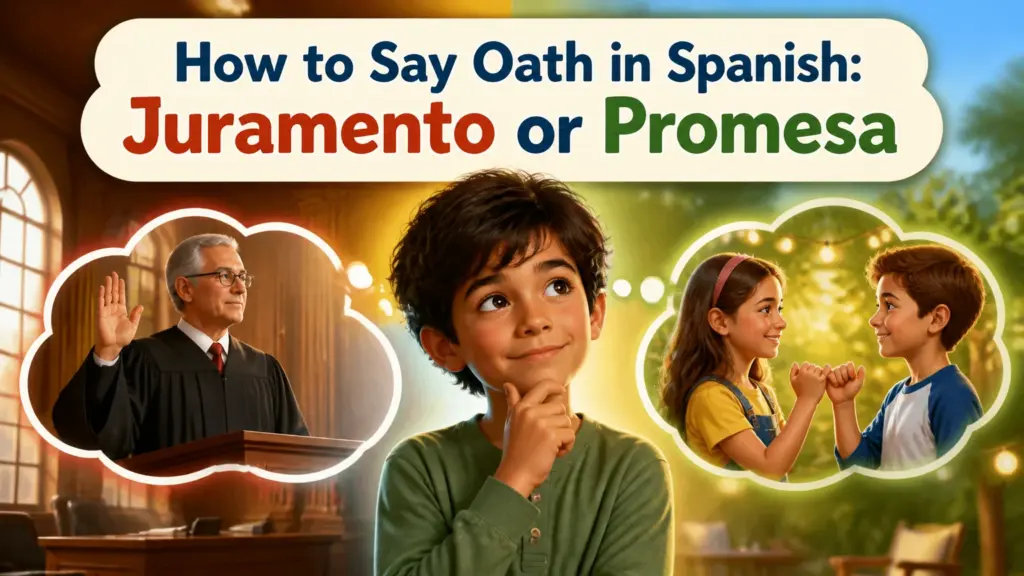

The standard Spanish word for “oath” is el juramento, pronounced approximately hoo-rah-MEN-toh. Use juramento for a solemn oath, promesa for a secular promise or affirmation, and votos for many religious or wedding vows. The correct choice depends on whether the setting is legal, political, religious, medical, military, or conversational.
Key Facts at a Glance
- El juramento is the standard masculine noun for “oath.”
- Jurar means “to swear” or “to take an oath.”
- Prometer means “to promise,” and la promesa is the common secular alternative.
- Bajo juramento means “under oath.”
- Declaración jurada means “sworn statement” or “affidavit,” not simply “oath.”
- Votos usually means “vows,” especially in weddings and religious ceremonies.
What Is “Oath” in Spanish?
Oath translates most directly as juramento, a masculine noun used for a solemn promise, often made publicly or under legal, religious, moral, or institutional authority. The plural is juramentos, as in los juramentos de los testigos, meaning “the witnesses’ oaths.”
The related verb is jurar:
- Juro decir la verdad. = I swear to tell the truth.
- El testigo prestó juramento. = The witness took an oath.
- El funcionario juró su cargo. = The official took the oath of office.
Spanish also uses promesa when the speaker makes a serious commitment without religious language. In official settings, the institution may offer a choice between jurar and prometer, but the wording varies by country and ceremony.
How Do You Pronounce Juramento?
Juramento is pronounced approximately hoo-rah-MEN-toh, with the stress on men: ju-ra-MEN-to. In the International Phonetic Alphabet, a broad approximation is /xu.ɾaˈmen.to/.
The first sound, written j in Spanish, is a strong breathy or raspy sound. It resembles the sound in Spanish jamón, although the exact pronunciation varies: speakers in much of Spain may use a stronger friction sound, while many Latin American speakers use a softer one.
Do not stress the first syllable. JÚramento is incorrect for standard pronunciation; juraMÉNto is closer.
When Should You Use Juramento or Promesa?
Use juramento when the commitment is explicitly an oath, especially in court, public office, military tradition, or a religious setting. Use promesa when the language is secular, personal, or institutionally framed as an affirmation rather than a sworn oath.
| English concept | Spanish term | Typical setting | Example |
|---|---|---|---|
| Oath | el juramento | Court, office, religion | Prestó el juramento. |
| Promise | la promesa | Personal or secular commitment | Hizo una promesa solemne. |
| To swear | jurar | Legal, formal, emphatic speech | Juro decir la verdad. |
| To promise | prometer | Neutral commitment | Prometo decir la verdad. |
| Vow or vows | el voto / los votos | Marriage or religion | Intercambiaron sus votos. |
| Sworn statement | declaración jurada | Legal or administrative document | Firmó una declaración jurada. |
The distinction is not perfectly identical in every legal system. Some institutions use juramento as the name of the ceremony while permitting the participant to answer with prometo for a secular affirmation.
Is Juramento Masculine or Feminine?
Juramento is masculine, so use el, un, este, and su in masculine agreement:
- el juramento oficial
- un juramento solemne
- este juramento
- su juramento
Promesa is feminine:
- la promesa oficial
- una promesa solemne
- esta promesa
A frequent translation error is writing la juramento. The correct form is always el juramento when referring to the noun.
How Do You Say “I Swear” in Spanish?
“I swear” is juro, the first-person singular present form of jurar. In formal testimony, the natural phrase is often Sí, lo juro, meaning “Yes, I swear,” while an informal emphatic statement may simply be Te lo juro, meaning “I swear to you.”
| English phrase | Spanish translation | Register or use |
|---|---|---|
| I swear | Juro | Formal or emphatic |
| Yes, I swear | Sí, lo juro | Oath or strong affirmation |
| I swear to tell the truth | Juro decir la verdad | Legal formula |
| I swear by my mother | Juro por mi madre | Personal emphasis |
| I swear to you | Te lo juro | Informal conversation |
| Do you swear? | ¿Jura usted? | Formal, usted form |
| Do you promise? | ¿Promete usted? | Secular alternative |
Spanish normally places the infinitive after jurar: juro decir, juró cumplir, or juramos respetar. The construction jurar que introduces a complete clause: Juro que no lo hice, meaning “I swear I did not do it.”
How Do You Say “Under Oath” in Spanish?
“Under oath” is bajo juramento. The phrase describes a person who is legally required to give truthful testimony or information.
Examples include:
- El testigo declaró bajo juramento.
The witness testified under oath. - La declaración fue realizada bajo juramento.
The statement was made under oath. - El acusado no está obligado a declarar bajo juramento.
The accused is not required to testify under oath.
For a document, Spanish usually prefers declaración jurada, which literally means “sworn declaration.” In some jurisdictions, manifestación jurada, acta jurada, or affidávit may appear, but these are not interchangeable in every administrative system.
What Is an Affidavit in Spanish?
An affidavit is usually una declaración jurada, not un juramento. A juramento is the oath or solemn commitment; a declaración jurada is the written statement made and signed under that commitment.
| English document term | Common Spanish equivalent | Function |
|---|---|---|
| Affidavit | Declaración jurada | Written sworn statement |
| Sworn statement | Declaración bajo juramento | Statement made under oath |
| Notarized statement | Declaración notarial | Statement formalized by a notary |
| Oath | Juramento | Solemn promise or legal undertaking |
| Affiant | Declarante | Person making the declaration |
| Notary public | Notario público | Official who may authenticate documents |
Document terminology depends on the receiving authority. A translated affidavit for immigration, court, or property purposes should follow the destination country’s prescribed form rather than a literal dictionary equivalent.
What Is the Spanish Court Oath?
A common courtroom formula is ¿Jura usted decir la verdad, toda la verdad y nada más que la verdad?, meaning “Do you swear to tell the truth, the whole truth, and nothing but the truth?” A secular version replaces jura with promete.
The expected answers are:
- Sí, lo juro. = Yes, I swear.
- Sí, lo prometo. = Yes, I promise.
The exact formula is not universal across all Spanish-speaking countries. Courts may use a statutory script, a local procedural formula, or a short confirmation. The English courtroom wording should therefore not be inserted into a legal translation unless the relevant jurisdiction uses that wording.
Useful legal vocabulary includes:
| English term | Spanish term | Meaning or limitation |
|---|---|---|
| Witness | Testigo | Person giving testimony |
| Testimony | Testimonio | Evidence given by a witness |
| False testimony | Falso testimonio | Untruthful testimony |
| Perjury | Perjurio | False statement under oath in systems using this term |
| Judge | Juez / jueza | Judicial official |
| Sworn evidence | Prueba bajo juramento | Evidence given under oath |
| Legal warning | Advertencia legal | Notice of consequences |
Legal consequences for false testimony differ by country, offense, court, and procedural status. Spain, Mexico, Argentina, and other Spanish-speaking jurisdictions do not share one universal penalty or one universal statutory definition, so a translation should not promise a specific prison term without naming the applicable law.
How Are Official and Political Oaths Expressed?
An oath of office is commonly juramento del cargo, juramento del puesto, or juramento de toma de posesión, depending on the institution and country. The broader ceremony may be called toma de posesión, meaning “assumption of office.”
Examples:
- Prestó juramento como alcalde.
He or she took the oath as mayor. - El juramento del cargo tuvo lugar el lunes.
The oath of office took place on Monday. - Prometió cumplir fielmente sus funciones.
He or she promised to perform the duties faithfully. - La toma de posesión se celebró en el ayuntamiento.
The inauguration or assumption of office was held at city hall.
In Spain, jura del cargo is common in formal administrative contexts. In Latin America, wording can vary between juramento, promesa, and phrases based on asumir el cargo. The official institution’s published formula outranks a general translation guide.
How Do You Say the Hippocratic Oath?
The Hippocratic Oath is el juramento hipocrático. The adjective hipocrático agrees with the masculine noun juramento.
Example:
- Los médicos pronunciaron el juramento hipocrático.
The doctors recited the Hippocratic Oath.
Modern medical ceremonies may use an adapted professional pledge rather than the ancient Hippocratic text. The Declaration of Geneva, adopted by the World Medical Association, is a modern physician’s pledge and should not automatically be translated as juramento hipocrático.
| English reference | Spanish term | Current use |
|---|---|---|
| Hippocratic Oath | Juramento hipocrático | Historical or ceremonial medical oath |
| Declaration of Geneva | Declaración de Ginebra | Modern physician pledge |
| Medical ethics | Ética médica | Professional principles |
| Professional pledge | Compromiso profesional | Secular institutional wording |
This distinction matters in academic, medical, and historical translations. A university ceremony may use juramento hipocrático as a traditional label even when the spoken text is a modern adaptation.
How Do You Say Military or School Pledge?
A military or ceremonial oath to the flag is commonly juramento a la bandera. In Spain, the ceremony is often called jura de bandera, while a school or civic event may use promesa a la bandera.
Examples:
- Participó en la jura de bandera.
He or she took part in the flag oath ceremony. - Los cadetes hicieron el juramento a la bandera.
The cadets made the oath to the flag. - La escuela organizó una promesa a la bandera.
The school organized a pledge to the flag.
The expression changes with the country and the institution. Jura de bandera has a strong ceremonial and military association in Spain; juramento a la bandera is more transparent across regions, but the receiving institution’s official name remains preferable.
Are Wedding Vows Called Juramentos in Spanish?
Wedding vows are usually votos matrimoniales, votos de boda, or simply votos. Juramentos is grammatically possible in a solemn religious context, but it is not the most natural everyday translation for English “wedding vows.”
Examples:
- Los novios intercambiaron sus votos matrimoniales.
The couple exchanged their wedding vows. - Escribieron sus propios votos de boda.
They wrote their own wedding vows. - La ceremonia incluyó promesas de fidelidad.
The ceremony included promises of fidelity.
In religious writing, voto can mean a vow made to God or a religious commitment. In ordinary marriage language, votos refers to the promises exchanged during the ceremony. Translators should avoid juramento unless the source specifically emphasizes an oath, sacred covenant, or formal religious vow.
What Does Jurar Por Mean?
Jurar por means “to swear by” or “to swear on,” and por is the required preposition before the person, object, or value invoked.
Examples:
- Juro por mi madre.
I swear on my mother’s life. - Juro por Dios que digo la verdad.
I swear to God that I am telling the truth. - Juró por su honor que cumpliría el acuerdo.
He or she swore on his or her honor that the agreement would be fulfilled.
The construction jurar que has a different grammatical function. It introduces the content of the oath:
- Juro que es verdad. = I swear that it is true.
- Juro por mi familia que es verdad. = I swear on my family that it is true.
Do not use jurar a for “swear by” in these examples. The preposition a can occur in other constructions, but it does not replace por in this meaning.
Does Jurar Mean to Use Profanity?
Jurar means “to swear” in the oath sense, but English “swear” can also mean to use profanity. For profanity, Spanish uses different expressions, including decir palabrotas, decir groserías, insultar, or maldecir, depending on the action.
| English meaning | Spanish expression | Example |
|---|---|---|
| Take an oath | Jurar | Juró decir la verdad. |
| Use swear words | Decir palabrotas | El niño dice palabrotas. |
| Use vulgar language | Decir groserías | No digas groserías. |
| Curse someone | Maldecir a alguien | Lo maldijo durante la discusión. |
| Insult someone | Insultar a alguien | Insultó al árbitro. |
| Make a solemn promise | Hacer una promesa solemne | Hizo una promesa solemne. |
Context normally resolves the meaning. Juro que no fui yo means “I swear it was not me,” not “I use profanity that I was not me.”
Which Spanish Oath Term Fits Each Situation?
The following table provides a practical selection rule. The safest term is the one used in the official text when a court, government office, school, or religious organization supplies a prescribed formula.
| Situation | Recommended Spanish | Avoid as the default | Reason |
|---|---|---|---|
| General translation of oath | El juramento | La juramento | Standard masculine noun |
| Court witness oath | Juramento judicial | Voto judicial | Legal testimony context |
| Secular court affirmation | Promesa | Automatically using jurar | Neutral institutional wording |
| Oath of office | Juramento del cargo | Juramento de oficina | Cargo means official position |
| Affidavit | Declaración jurada | Juramento alone | Written document, not only the promise |
| Hippocratic Oath | Juramento hipocrático | Votos médicos | Established medical name |
| Wedding vows | Votos matrimoniales | Juramentos de boda | Natural ceremonial usage |
| Flag ceremony in Spain | Jura de bandera | Literal juramento de la bandera in every context | Established Spanish label |
| Personal emphatic statement | Te lo juro | Formal prestar juramento | Conversational register |
What Changes Between Spain and Latin America?
The core words juramento, jurar, promesa, and declaración jurada are widely understood throughout the Spanish-speaking world. The main differences involve institutional labels, legal formulas, and ceremonial vocabulary rather than the basic translation.
| Meaning or ceremony | Spain | Latin America | Translation note |
|---|---|---|---|
| Oath of office | Jura del cargo | Juramento del cargo | Both are understandable |
| Assumption of office | Toma de posesión | Toma de posesión | Broadly shared term |
| Flag oath | Jura de bandera | Juramento a la bandera | Military context varies |
| Affidavit | Declaración jurada | Declaración jurada | Widely recognized |
| Public notary | Notario | Notario público | Legal role and powers vary |
| Formal “you swear” | ¿Jura usted…? | ¿Jura usted…? | Register is shared |
| Religious vows | Votos | Votos | Common across regions |
A notable false assumption is that one country’s legal formula can be copied into another country’s paperwork. Translation establishes meaning, but it does not establish legal validity, compliance, or the correct procedural wording.
How Much Do Oath Services Cost and How Long Do They Take?
Translating the word oath costs nothing, but administering or notarizing an oath can involve fees and appointments. A typical notarial service may cost approximately $30-$150, while a witness oath inside an ordinary court proceeding may carry no separate fee; actual prices depend on the country, city, document, and service provider.
| Service | Typical direct cost | Typical duration | Main variable |
|---|---|---|---|
| Dictionary translation | $0 | 1 minute | No official service involved |
| Court witness oath | $0 separate fee | 1-2 minutes | Court procedure |
| Notarial sworn statement | $30-$150 | 15-45 minutes | Country and document length |
| Certified translation | $30-$150 per page in many markets | 1-5 business days | Language pair and certification |
| Citizenship ceremony | Usually included in the process | 10-60 minutes | Government schedule |
| Ceremony appointment | Variable | Weeks to months | Immigration or institutional backlog |
These are typical planning ranges, not universal prices. A notary may charge for document review, signatures, copies, travel, or certification separately. Government citizenship processes can take months, but the spoken oath itself is usually brief.
Common Mistakes When Translating “Oath”
Mistake 1: Using the wrong article
Write el juramento, not la juramento. The noun is masculine even though many English speakers associate solemn promises with feminine nouns such as promesa.
Mistake 2: Translating every vow as juramento
Use votos matrimoniales for wedding vows and votos religiosos for many religious vows. Select juramento when the source text specifically describes a formal oath rather than a set of ceremonial promises.
Mistake 3: Confusing an affidavit with an oath
Use declaración jurada for the document and juramento for the solemn undertaking. A literal translation that calls the entire affidavit juramento may be understandable but legally imprecise.
Mistake 4: Assuming promesa is always informal
Promesa can be highly formal. Courts, public institutions, and secular ceremonies may use prometer specifically to avoid religious language.
Mistake 5: Treating jurar as profanity
Use decir palabrotas, decir groserías, or maldecir for profanity and cursing. Jurar normally refers to making an oath or emphatically asserting something.
Mistake 6: Translating legal formulas without checking jurisdiction
A court in Spain may use a different prescribed formula from a court in Mexico or Argentina. For legal filing, reproduce the destination authority’s terminology instead of relying on a generic bilingual phrasebook.
Practical Sentence Templates
These templates cover the most common uses of the word:
- The oath was solemn.
El juramento fue solemne. - She took an oath.
Ella prestó juramento. - He swore to tell the truth.
Él juró decir la verdad. - The witness testified under oath.
El testigo declaró bajo juramento. - I swear it is true.
Juro que es verdad. - I promise to comply.
Prometo cumplir. - They signed a sworn statement.
Firmaron una declaración jurada. - The official took the oath of office.
El funcionario prestó juramento del cargo. - The couple exchanged wedding vows.
La pareja intercambió sus votos matrimoniales. - She swore on her honor.
Juró por su honor.
Frequently Asked Questions
Is “oath” always translated as juramento?
No. Juramento is the default translation, but the best term depends on the context. Use promesa for a secular affirmation, votos for wedding or religious vows, and declaración jurada for an affidavit or sworn written statement.
What is the difference between juramento and jura?
Juramento is the general noun for an oath. Jura can refer to the act or ceremony of swearing an oath, especially in expressions such as jura de bandera in Spain. The two words overlap, but they are not equally natural in every phrase.
How do you say “oath of allegiance” in Spanish?
“Oath of allegiance” is usually juramento de lealtad or juramento de fidelidad. In citizenship contexts, official terminology may instead use jura, promesa de fidelidad, or a country-specific formula. Check the receiving government’s wording before using it in an application.
How do you say “by oath” in Spanish?
“By oath” can be translated as bajo juramento when it means that information is given under oath. If “by” identifies the thing invoked, use jurar por, as in jurar por Dios or jurar por su honor.
Can juramento describe a personal promise?
Yes, especially when the promise is solemn, emphatic, or invokes an authority, sacred value, or personal honor. In ordinary conversation, promesa or te lo juro is often more natural, depending on whether the speaker is making a commitment or emphasizing that a statement is true.
What is the shortest correct translation?
The shortest standard translation is juramento. If the intended phrase is “I swear,” use juro. If the intended phrase is “under oath,” use bajo juramento. If the intended phrase is “sworn statement,” use declaración jurada.
The Bottom Line
The answer to how to say oath in Spanish is el juramento. Use jurar for the verb, bajo juramento for “under oath,” promesa for a secular affirmation, declaración jurada for an affidavit, and votos for wedding or religious vows. For official documents and ceremonies, confirm the destination country’s prescribed wording before submitting a translation.