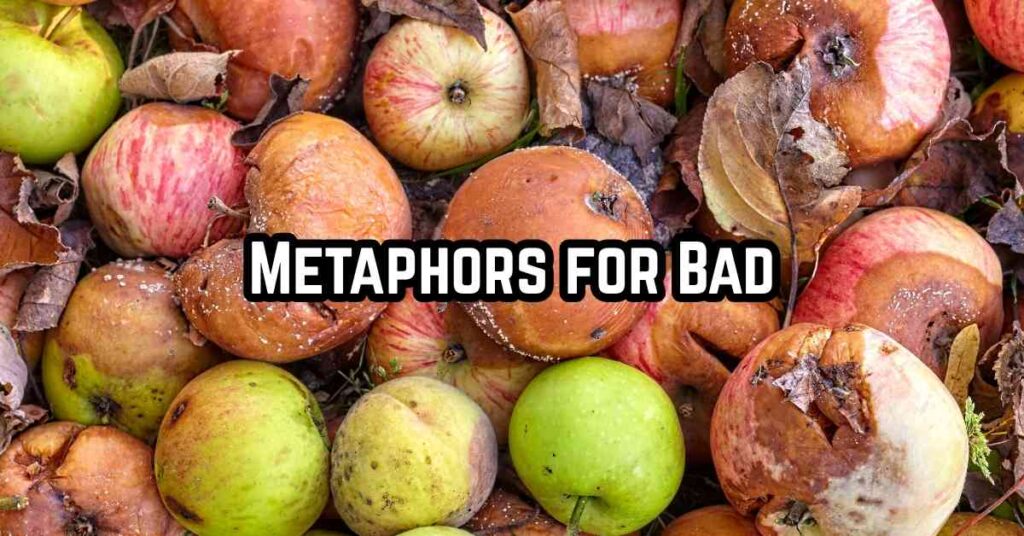

Understanding metaphors is crucial for mastering the nuances of the English language. Metaphors allow us to express abstract or complex ideas in more relatable and vivid ways. This article focuses specifically on metaphors used to describe something “bad,” equipping you with a wide range of expressive options beyond simple negative adjectives. This guide is beneficial for English learners of all levels, from beginners wanting to expand their vocabulary to advanced speakers aiming to refine their figurative language skills. By exploring these metaphors, you’ll gain a deeper appreciation for the richness and versatility of English.
Learning about metaphors for “bad” not only enhances your understanding of figurative language but also improves your communication skills. It allows you to convey disapproval, dissatisfaction, or negativity in a more nuanced and impactful manner. This comprehensive guide provides definitions, examples, and practice exercises to help you master this essential aspect of English expression.
Table of Contents
- Introduction
- Definition of Metaphors for “Bad”
- Structural Breakdown of Metaphors
- Types and Categories of Metaphors for “Bad”
- Examples of Metaphors for “Bad”
- Usage Rules for Metaphors
- Common Mistakes with Metaphors
- Practice Exercises
- Advanced Topics in Metaphors
- Frequently Asked Questions
- Conclusion
Definition of Metaphors for “Bad”
A metaphor is a figure of speech that directly compares two unrelated things, asserting that they are the same for the purpose of creating a vivid image or conveying a deeper meaning. Metaphors for “bad” are used to describe something negative, undesirable, or of poor quality by comparing it to something else that is inherently negative. Instead of simply saying something is “bad,” we use a metaphor to paint a more evocative picture, making the description more impactful and memorable. The effectiveness of a metaphor lies in its ability to transfer the qualities of one thing to another, thereby enriching our understanding and perception.
Function: Metaphors for “bad” function to express negativity, disapproval, or poor quality in a more nuanced and imaginative way. They allow speakers and writers to avoid simplistic descriptions and instead provide a richer, more engaging portrayal of the subject at hand. By drawing a comparison between the subject and something inherently negative, these metaphors evoke specific feelings or associations in the listener or reader.
Contexts: Metaphors for “bad” are used in a wide array of contexts, including literature, everyday conversation, business, and politics. They can be used to describe everything from a poorly executed plan to a corrupt government. The specific metaphor chosen will depend on the precise nuance the speaker or writer wishes to convey and the overall tone of the communication. Understanding the context is crucial for interpreting the meaning and impact of the metaphor.
Structural Breakdown of Metaphors
The basic structure of a metaphor involves two key elements: the tenor and the vehicle. The tenor is the subject being described, while the vehicle is the thing to which the subject is being compared. In metaphors for “bad,” the vehicle will always be something negative or undesirable.
For example, in the metaphor “His argument was a house of cards,” the tenor is “his argument,” and the vehicle is “a house of cards.” The metaphor suggests that his argument is fragile and easily collapses, just like a house of cards. The strength of a metaphor lies in the connection between the tenor and the vehicle and the shared qualities that are being highlighted.
Metaphors can be explicit or implicit. An explicit metaphor directly states the comparison, often using words like “is,” “as,” or “like.” An implicit metaphor implies the comparison without explicitly stating it. For instance, “The project was sinking rapidly” is an implicit metaphor for failure, comparing the project to a sinking ship without using words like “as” or “like.” Understanding the difference between explicit and implicit metaphors is essential for interpreting their intended meaning.
Types and Categories of Metaphors for “Bad”
Metaphors for “bad” can be categorized based on the types of negative concepts they draw upon. Here are some common categories:
Decay and Deterioration
These metaphors compare the subject to something that is rotting, decaying, or falling apart. They often suggest that the subject is losing its value, quality, or integrity. Examples include “a crumbling empire,” “a rotten apple,” and “a tarnished reputation.” These metaphors are particularly effective in conveying a sense of decline or corruption.
Darkness and Shadow
These metaphors associate the subject with darkness, shadows, or obscurity. They often suggest that the subject is hidden, sinister, or lacking in clarity. Examples include “a dark secret,” “a shadowy figure,” and “a clouded judgment.” These metaphors are useful for conveying a sense of mystery, danger, or moral ambiguity.
Illness and Disease
These metaphors compare the subject to an illness, disease, or infection. They often suggest that the subject is harmful, contagious, or debilitating. Examples include “a cancer on society,” “a spreading epidemic of corruption,” and “a sick joke.” These metaphors are powerful in conveying a sense of harm, destruction, or moral decay.
Obstacle and Hindrance
These metaphors portray the subject as a barrier, obstacle, or impediment. They suggest that the subject is preventing progress, success, or happiness. Examples include “a stumbling block,” “a roadblock to progress,” and “a thorn in my side.” These metaphors are effective in conveying frustration, difficulty, or resistance.
Storm and Chaos
These metaphors compare the subject to a storm, tempest, or chaotic event. They often suggest that the subject is disruptive, destructive, or out of control. Examples include “a perfect storm of bad luck,” “a whirlwind of controversy,” and “a sea of troubles.” These metaphors are useful for conveying a sense of upheaval, turmoil, or disaster.
Examples of Metaphors for “Bad”
Here are some extensive examples of metaphors for “bad,” organized by category:
Decay and Deterioration Examples
The following table illustrates metaphors related to decay and deterioration, showing how they are used to express negativity.
| Metaphor | Explanation | Example Sentence |
|---|---|---|
| A crumbling empire | Suggests a once-powerful entity is declining. | The company was becoming a crumbling empire, riddled with debt and mismanagement. |
| A rotten apple | Indicates one bad element can spoil the whole group. | He was a rotten apple in the team, bringing down morale with his constant negativity. |
| A tarnished reputation | Implies that someone’s good name has been damaged. | The scandal left his political career with a tarnished reputation. |
| A rusty machine | Suggests something is not functioning properly due to disuse. | Her skills were like a rusty machine; she needed to practice to get them back in shape. |
| A decaying friendship | Implies that a relationship is deteriorating. | Their friendship was like a decaying friendship, weakened by years of neglect. |
| A withering plant | Suggests something is losing its vitality. | Without support, his confidence was like a withering plant. |
| A moth-eaten garment | Indicates something is old, damaged, and worthless. | The treaty was like a moth-eaten garment, full of loopholes and outdated clauses. |
| A broken vase | Suggests something precious is irreparably damaged. | Their relationship was like a broken vase, shattered beyond repair. |
| A moldy loaf | Implies something is contaminated and unusable. | His ideas were like a moldy loaf, stale and unwelcome. |
| A corroded pipe | Suggests something is being eaten away gradually. | The foundation of their agreement was like a corroded pipe, inevitably leading to collapse. |
| A faded photograph | Indicates something is losing its clarity and vibrancy. | Her memories of that time were like a faded photograph, indistinct and incomplete. |
| A warped record | Suggests something is distorted and not functioning correctly. | His perception of reality was like a warped record, playing the wrong tune. |
| A splintered beam | Implies something is broken and weakened. | The organization’s structure was like a splintered beam, threatening to collapse under pressure. |
| A crumbling facade | Suggests that an outward appearance is hiding something bad. | The politician’s charm was like a crumbling facade, concealing his corrupt practices. |
| A tarnished dream | Indicates a once-bright hope has been ruined. | His ambition was like a tarnished dream, dimmed by repeated failures. |
| A withered hope | Suggests hope has died or faded away. | After the devastating loss, her hope was like a withered hope, barely clinging to life. |
| A dissolving alliance | Implies that a partnership is falling apart. | The coalition was like a dissolving alliance, torn apart by internal disagreements. |
| A decomposing body | Suggests complete and utter decay. | The project was like a decomposing body, a grim reminder of wasted resources. |
| A decaying structure | Implies a building or organization is failing. | Their company felt like a decaying structure, in dire need of renovation. |
| A crumbling wall | Suggests a barrier is failing | His resistance was like a crumbling wall, ready to be broken down. |
| A tarnished legacy | Implies that a previous good reputation is no more. | His actions left a tarnished legacy, a stain on his family’s name. |
| A rotten tree | Indicates a source of corruption and instability. | The corrupt official was a rotten tree, poisoning the entire system. |
| A rusted lock | Suggests something is stuck and unusable. | Her creativity felt like a rusted lock, impossible to open. |
Darkness and Shadow Examples
The following table illustrates metaphors related to darkness and shadow, showing how they evoke feelings of mystery, fear, and uncertainty.
| Metaphor | Explanation | Example Sentence |
|---|---|---|
| A dark secret | Implies something hidden and sinister. | He carried a dark secret that haunted him for years. |
| A shadowy figure | Suggests someone is mysterious and possibly dangerous. | The informant was a shadowy figure, always lurking in the background. |
| A clouded judgment | Indicates that someone’s decision-making is impaired. | His emotions led to a clouded judgment, causing him to make a rash decision. |
| A murky past | Suggests a history that is unclear and potentially troubling. | The old house had a murky past, filled with rumors and unanswered questions. |
| A pitch-black future | Implies a future full of uncertainty and negativity. | Without a plan, her future looked like a pitch-black future. |
| A twilight zone | Suggests a place between reality and unreality. | The negotiations entered a twilight zone, where nothing seemed certain. |
| A shaded deal | Implies that something is not entirely ethical or transparent. | The business transaction was like a shaded deal, raising suspicions of corruption. |
| A darkened soul | Suggests someone has become morally corrupted. | The war had left him with a darkened soul, devoid of empathy. |
| A black mark | Indicates a stain on someone’s reputation. | The scandal left a black mark on his otherwise impeccable career. |
| A shadow of doubt | Implies uncertainty and suspicion. | There was a shadow of doubt hanging over the investigation. |
| A gray area | Suggests a situation where the rules are unclear. | The legality of the practice fell into a gray area. |
| A veil of secrecy | Implies something is being deliberately hidden. | The project was conducted under a veil of secrecy. |
| A world of shadows | Suggests a hidden and dangerous environment. | He operated in a world of shadows, where trust was nonexistent. |
| A dark cloud | Implies that something negative is looming. | A dark cloud hung over their future after the failure of the business. |
| A night of despair | Suggests a time of great sadness and hopelessness. | She went through a night of despair after losing her job. |
| A bottomless pit | Suggests an endless amount of something bad. | The corruption was like a bottomless pit, impossible to fill. |
| A descent into darkness | Implies a gradual decline into negativity. | His actions marked a descent into darkness, as he became more ruthless. |
| A hidden agenda | Suggests secret and often malicious motives. | He seemed to have a hidden agenda, making it difficult to trust him. |
| A dark omen | Implies a sign of future misfortune. | The strange events seemed like a dark omen. |
| A shaded past | Suggests a past full of secrets and negativity. | His family had a shaded past, filled with rumors and unanswered questions. |
| A black hole | Suggests something that consumes everything around it. | The failing business was like a black hole, consuming all their resources. |
| A darkened room | Suggests a place of sadness and mourning. | After the loss, their house felt like a darkened room. |
| A shadowed path | Implies a dangerous or uncertain journey. | He chose a shadowed path, knowing the risks involved. |
Illness and Disease Examples
The following table illustrates metaphors related to illness and disease, showing how they convey a sense of harm, contamination, and moral decay.
| Metaphor | Explanation | Example Sentence |
|---|---|---|
| A cancer on society | Implies something is spreading and destroying society. | Corruption was a cancer on society, eating away at its core values. |
| A spreading epidemic of corruption | Suggests that corruption is rapidly increasing. | There was a spreading epidemic of corruption in the government. |
| A sick joke | Indicates something is inappropriate and offensive. | His comment was a sick joke, completely insensitive to the situation. |
| A virulent strain of hatred | Suggests that hatred is powerful and contagious. | The politician spread a virulent strain of hatred among his supporters. |
| A plague of dishonesty | Implies that dishonesty is widespread and destructive. | The company suffered from a plague of dishonesty. |
| A festering wound | Suggests that a problem is getting worse over time. | The conflict was like a festering wound, never properly addressed. |
| A toxic relationship | Implies a relationship that is harmful and damaging. | The friendship was like a toxic relationship, filled with negativity and jealousy. |
| A contagious lie | Suggests a lie that is easily spread and believed. | The rumor was like a contagious lie, spreading rapidly through the office. |
| A diseased mind | Suggests a mind that is corrupted or unstable. | His actions suggested a diseased mind, filled with twisted thoughts. |
| A breakdown of trust | Suggests a loss of confidence and faith. | There was a breakdown of trust among the team members. |
| A moral sickness | Implies a widespread lack of ethical behavior. | The country suffered from a moral sickness. |
| A creeping paralysis | Suggests a gradual loss of ability to function. | The bureaucracy was like a creeping paralysis, slowing down all progress. |
| A chronic problem | Implies a long-lasting and difficult issue. | The company faced a chronic problem with low employee morale. |
| A social virus | Suggests something that spreads quickly and harms society. | Fake news became a social virus, infecting public opinion. |
| A cancerous policy | Implies a policy that is destructive and harmful. | The new legislation was like a cancerous policy, destroying small businesses. |
| A sick society | Suggests a society that is morally corrupted and unhealthy. | The greed within the government made it feel like a sick society. |
| A festering resentment | Implies a resentment that is growing and causing harm. | There was a festering resentment between the two departments. |
| A tainted reputation | Suggests a reputation that has been damaged by scandal. | His involvement in the scandal led to a tainted reputation. |
| A terminal case | Implies a situation that is beyond recovery. | The business seemed like a terminal case, beyond any hope of revival. |
| A malignant influence | Suggests someone has a negative and harmful effect. | His presence in the group was a malignant influence. |
| A festering wound | Suggests an unresolved issue that is causing pain. | Their disagreement was like a festering wound, never properly addressed. |
| A sick joke | Suggests something inappropriate or offensive. | His comment was a sick joke, completely insensitive to the situation. |
| A poisoned atmosphere | Implies a negative and harmful environment. | The office had a poisoned atmosphere due to constant conflict. |
Obstacle and Hindrance Examples
The following table illustrates metaphors related to obstacles and hindrances, showing how they convey frustration, difficulty, and resistance.
| Metaphor | Explanation | Example Sentence |
|---|---|---|
| A stumbling block | Implies something that prevents progress. | Lack of funding was a stumbling block to the project’s success. |
| A roadblock to progress | Suggests something is completely stopping progress. | Bureaucracy was a roadblock to progress. |
| A thorn in my side | Indicates something that is constantly annoying. | His constant complaining was a thorn in my side. |
| A dead end | Suggests a situation with no solution or escape. | The investigation led to a dead end. |
| A brick wall | Implies an impenetrable barrier. | Trying to convince him was like talking to a brick wall. |
| A hurdle to overcome | Suggests a challenge that needs to be addressed. | The language barrier was a hurdle to overcome. |
| A bottleneck in the process | Implies a point where progress is slowed down. | The approval process was a bottleneck in the process. |
| A barrier to entry | Suggests something that makes it difficult to start. | High startup costs were a barrier to entry for new businesses. |
| A mountain to climb | Implies a difficult challenge to overcome. | Getting the project approved was like a mountain to climb. |
| An uphill battle | Suggests a struggle that is difficult and tiring. | Trying to change the company culture was an uphill battle. |
| A tight spot | Implies a difficult situation. | The company was in a tight spot due to the economic downturn. |
| A sticky situation | Suggests a messy and awkward problem. | He found himself in a sticky situation after the misunderstanding. |
| A trap | Implies a dangerous situation with hidden risks. | The deal was like a trap, with hidden clauses designed to cheat them. |
| A snag in the plan | Suggests a small problem that could cause delays. | There was a snag in the plan when the supplier went out of business. |
| A logjam | Implies a situation where progress is blocked. | The negotiations reached a logjam. |
| A slippery slope | Suggests a situation that will lead to worse problems. | Compromising on ethics is a slippery slope. |
| A quagmire | Implies a difficult and complicated situation. | The project became a quagmire of bureaucracy and red tape. |
| A maze | Suggests a confusing and difficult path. | Navigating the legal system was like wandering through a maze. |
| A locked door | Implies an obstacle that prevents access. | His lack of experience was like a locked door. |
| A broken bridge | Suggests an irreparably damaged relationship. | After the argument, their friendship was like a broken bridge. |
| A tangled web | Implies a complicated and confusing situation. | The corruption scandal was like a tangled web. |
| A pitfall | Suggests a hidden danger or trap. | He warned them about the pitfalls of the investment. |
| A minefield | Suggests a dangerous and unpredictable situation. | The political landscape was like a minefield. |
Storm and Chaos Examples
The following table illustrates metaphors related to storms and chaos, showing how they convey a sense of upheaval, turmoil, and disaster.
| Metaphor | Explanation | Example Sentence |
|---|---|---|
| A perfect storm of bad luck | Implies a combination of negative events. | They faced a perfect storm of bad luck, with everything going wrong at once. |
| A whirlwind of controversy | Suggests a sudden and intense uproar. | The announcement created a whirlwind of controversy. |
| A sea of troubles | Implies an overwhelming amount of problems. | He found himself in a sea of troubles after the business failed. |
| A tempestuous relationship | Suggests a relationship filled with conflict and drama. | Their relationship was like a tempestuous relationship. |
| A chaotic scene | Implies a situation of complete disorder. | The accident created a chaotic scene. |
| A stormy debate | Suggests a heated and emotional argument. | The proposal led to a stormy debate. |
| A turbulent time | Implies a period of instability and uncertainty. | The country was going through a turbulent time. |
| A volcanic eruption of anger | Suggests a sudden and intense outburst of anger. | His frustration resulted in a volcanic eruption of anger. |
| A flood of complaints | Implies a large number of grievances. | The company received a flood of complaints. |
| A raging fire | Implies something is spreading quickly and destructively. | The rumor spread like a raging fire. |
| A state of anarchy | Suggests a situation where there is no order or control. | The city descended into a state of anarchy. |
| A landslide of criticism | Implies a large amount of negative feedback. | The new policy received a landslide of criticism. |
| A tsunami of emotions | Suggests an overwhelming surge of feelings. | She was hit by a tsunami of emotions. |
| A breakdown of order | Suggests a loss of control and structure. | There was a breakdown of order after the power outage. |
| A period of upheaval | Implies a time of great change and disruption. | The company went through a period of upheaval. |
| A maelstrom of confusion | Suggests a situation of intense chaos and bewilderment. | The new regulations created a maelstrom of confusion. |
| A hurricane of emotions | Suggests an intense and destructive emotional experience. | She felt a hurricane of emotions after the breakup. |
| A tumultuous relationship | Suggests a relationship full of ups and downs. | Their partnership was like a tumultuous relationship. |
| A perfect storm of errors | Implies a combination of mistakes leading to disaster. | The project failed due to a perfect storm of errors. |
| A tidal wave of problems | Suggests an overwhelming surge of difficulties. | They were hit by a tidal wave of problems. |
| A hailstorm of criticism | Suggests a barrage of negative feedback. | His performance received a hailstorm of criticism. |
| A stormy night | Suggests a time of great difficulty and uncertainty. | After the failure, it felt like a stormy night. |
| A sea of despair | Suggests a situation of great sadness and hopelessness. | He was lost in a sea of despair. |
Usage Rules for Metaphors
Using metaphors effectively involves understanding several key rules:
- Clarity: The metaphor should be understandable and relevant to the context. Avoid using obscure or confusing comparisons.
- Consistency: Maintain a consistent tone and imagery throughout the metaphor. Mixing metaphors can create a confusing or comical effect.
- Originality: While common metaphors can be effective, strive for originality to make your writing more engaging and memorable.
- Appropriateness: Choose metaphors that are appropriate for the audience and the subject matter. Avoid using metaphors that are offensive or insensitive.
- Conciseness: Use metaphors sparingly and purposefully. Overusing metaphors can make your writing seem cluttered and confusing.
It’s also important to consider the cultural context of the metaphor. Metaphors can have different meanings or associations in different cultures. Be mindful of these differences to avoid miscommunication or offense.
Common Mistakes with Metaphors
Here are some common mistakes to avoid when using metaphors:
- Mixed Metaphors: Combining incongruous metaphors, creating a nonsensical image.
- Incorrect: “Let’s nip it in the bud before it snowballs.” (Mixing “nip it in the bud” and “snowballs”)
- Correct: “Let’s nip it in the bud before it becomes a bigger problem.”
- Clichés: Overusing tired and unoriginal metaphors.
- Incorrect: “He was as cool as a cucumber.”
- Correct: “He remained calm and collected under pressure.”
- Inappropriate Tone: Using metaphors that are not suitable for the context.
- Incorrect: “The funeral was a real circus.” (Disrespectful in this context)
- Correct: “The funeral was a somber occasion.”
Mixing metaphors can create a confusing or humorous effect, which is often unintentional. Clichés lack impact and originality, making your writing seem uninspired. Inappropriate tone can offend or alienate your audience.
Practice Exercises
Test your understanding of metaphors for “bad” with these exercises:
Exercise 1: Identify the Metaphor
Identify the metaphor in each sentence and explain its meaning.
| Question | Answer |
|---|---|
| 1. The project became a sinking ship. | The metaphor is “a sinking ship.” It means the project is failing and likely to collapse. |
| 2. His argument was a house of cards. | The metaphor is “a house of cards.” It means the argument is fragile and easily collapses. |
| 3. Corruption is a cancer on society. | The metaphor is “a cancer on society.” It means corruption is spreading and destroying society. |
| 4. The negotiations were a minefield. | The metaphor is “a minefield.” It means the negotiations were dangerous and unpredictable. |
| 5. Her past was a murky swamp. | The metaphor is “a murky swamp.” It means her past was unclear and potentially troubling. |
| 6. The company was a crumbling empire. | The metaphor is “a crumbling empire.” It means the company is declining and losing its power. |
Exercise 2: Complete the Metaphor
Complete the following sentences with an appropriate metaphor for “bad.”
| Question | Answer |
|---|---|
| 1. The new policy was ________, causing widespread dissatisfaction. | The new policy was a disaster, causing widespread dissatisfaction. |
| 2. His lies were ________, impossible to untangle. | His lies were a tangled web, impossible to untangle. |
| 3. The project turned into ________, consuming all our resources. | The project turned into a black hole, consuming all our resources. |
| 4. The relationship was ________, filled with constant arguments. | The relationship was a battleground, filled with constant arguments. |
| 5. The situation became ________, with no easy solutions. | The situation became a quagmire, with no easy solutions. |
| 6. The scandal left ________ on his reputation. | The scandal left a stain on his reputation. |
Exercise 3: Create Your Own Metaphor
Create your own metaphor for “bad” to describe the following situations:
| Situation | Metaphor |
|---|---|
| 1. A failed business venture | The business venture was a house of cards in a hurricane. |
| 2. A corrupt government official | The corrupt official was a venomous snake in the grass. |
| 3. A broken promise | The broken promise was a shattered mirror, reflecting only disappointment. |
| 4. An ineffective solution | The ineffective solution was a band-aid on a gaping wound. |
| 5. A toxic work environment | The toxic work environment was a poisoned well, contaminating everyone who drank from it. |
| 6. A misguided attempt at help | The misguided attempt at help was a cure that killed the patient. |
Advanced Topics in Metaphors
For advanced learners, consider these topics:
- Extended Metaphors: Developing a metaphor over several sentences or paragraphs.
- Submerged Metaphors: Subtle metaphors that are not immediately apparent.
- Dead Metaphors: Metaphors that have become so common that they are no longer recognized as metaphors (e.g., “leg of a table”).
- Cognitive Metaphors: Exploring how metaphors shape our understanding of abstract concepts.
Understanding these advanced concepts can help you use metaphors with greater precision and impact. Experiment with different types of metaphors to enhance your writing and communication skills.
Frequently Asked Questions
What is the difference between a metaphor and a simile?
A metaphor directly equates two things, while a simile uses “like” or “as” to make a comparison. For example, “He is a lion” (metaphor) vs. “He is like a lion” (simile).
How can I avoid using clichés?
Strive for originality by finding fresh and unique comparisons. Think about the specific qualities you want to convey and look for less common ways to express them.
Can a metaphor be too complex?
Yes, a metaphor should be clear and understandable. If the comparison is too obscure or convoluted, it will lose its effectiveness.
How do I know if a metaphor is appropriate?
Consider your audience, the context, and the tone of your communication. Avoid metaphors that are offensive, insensitive, or irrelevant.
Is it okay to mix metaphors for comedic effect?
Yes, mixing metaphors can be used intentionally for humor. However, be sure that the comedic effect is deliberate and appropriate for the situation.
Conclusion
Mastering metaphors for “bad” is an essential skill for anyone looking to enhance their English language proficiency. By understanding the structure, types, and usage rules of these metaphors, you can express negativity and disapproval with greater nuance and impact. Practice the exercises provided in this guide and continue to explore the rich world of figurative language. With dedication and effort, you’ll be well on your way to becoming a more effective and expressive communicator.