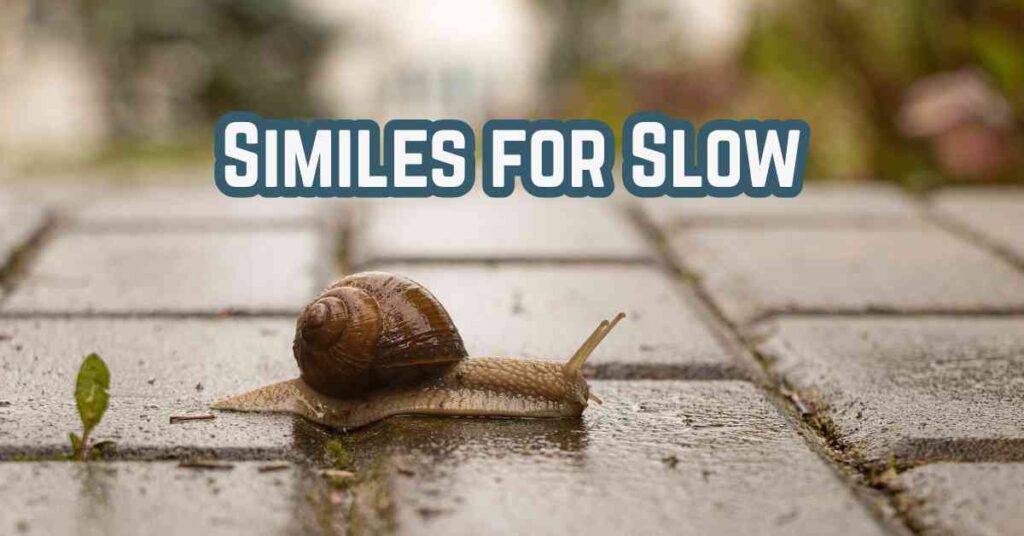

Understanding similes is crucial for enhancing your descriptive writing and comprehension skills. Similes, which compare two unlike things using “like” or “as,” add color and depth to language. This article focuses specifically on similes that describe slowness, exploring their various forms, meanings, and applications. Whether you’re a student, writer, or English language learner, this guide will equip you with the knowledge and tools to effectively use similes for “slow” in your writing and speech.
This comprehensive guide will break down the structure of similes, provide numerous examples, and offer practical exercises to solidify your understanding. By the end of this article, you’ll be able to identify, interpret, and create compelling similes that vividly depict slowness in various contexts.
Table of Contents
- Introduction
- Definition of Simile
- Structural Breakdown of Similes
- Categories of Similes for Slow
- Examples of Similes for Slow
- Usage Rules for Similes
- Common Mistakes When Using Similes
- Practice Exercises
- Advanced Topics in Similes
- Frequently Asked Questions
- Conclusion
Definition of Simile
A simile is a figure of speech that directly compares two different things using the words “like” or “as.” The purpose of a simile is to create a vivid image or enhance understanding by drawing a parallel between the dissimilar items. Similes are essential tools in descriptive writing and figurative language, adding color, depth, and clarity to communication.
Unlike metaphors, which imply a direct equivalence, similes explicitly state the comparison. For instance, “He is a lion” is a metaphor, while “He is like a lion” is a simile. The use of “like” or “as” signals the comparison, making the statement less assertive and more illustrative. Similes are versatile and can be used to describe virtually anything, from physical attributes to abstract concepts.
In the context of describing slowness, similes can be particularly effective. They allow writers to evoke a sense of gradual movement, lethargy, or lack of urgency by comparing the subject to something inherently slow. These comparisons can range from the pace of a snail to the gradual erosion caused by time, offering a rich palette of descriptive possibilities.
Structural Breakdown of Similes
Similes, at their core, follow a simple structure. Understanding this structure is key to both identifying and creating effective similes. The typical structure of a simile includes three main components: the subject, the linking word (like or as), and the object of comparison.
- Subject: This is the thing being described. It could be a person, object, or idea.
- Linking Word: This is either “like” or “as,” connecting the subject to the object of comparison.
- Object of Comparison: This is the thing the subject is being compared to. It should share a quality with the subject that is being emphasized.
For example, in the simile “He moved like a snail,” “He” is the subject, “like” is the linking word, and “a snail” is the object of comparison. This structure clearly illustrates how the person’s movement resembles the slowness of a snail. The quality of slowness is what links the subject and the object.
Another example: “The process was as slow as molasses in winter.” Here, “The process” is the subject, “as” is the linking word (used twice in this construction), and “molasses in winter” is the object of comparison. The simile highlights the sluggishness of the process by comparing it to the viscous nature of molasses in cold temperatures.
Understanding this structural framework allows you to deconstruct existing similes to understand their meaning and create your own. By identifying the subject, linking word, and object of comparison, you can grasp the intended comparison and its effect on the reader.
Categories of Similes for Slow
Similes for “slow” can be categorized based on the types of objects used for comparison. These categories help to organize and understand the different nuances of slowness that can be conveyed. Here are some common categories:
- Animal-Based Similes: These similes use animals known for their slow movement, such as snails, turtles, and sloths.
- Object-Based Similes: These similes compare the subject to slow-moving or static objects, like molasses, glaciers, or drying paint.
- Process-Based Similes: These similes relate the subject to processes that are inherently slow, such as erosion, aging, or the movement of tectonic plates.
- Nature-Based Similes: This category includes similes that draw comparisons to natural elements known for their slowness, such as the flow of sap in winter or the growth of a tree.
- Abstract-Based Similes: These similes use abstract concepts, like time or dreams, to convey a sense of slowness.
By understanding these categories, you can better appreciate the range of comparisons available and choose the most appropriate simile to convey the desired level and type of slowness. Each category offers unique imagery and connotations, allowing for precise and evocative descriptions.
Examples of Similes for Slow
The following sections provide extensive examples of similes for “slow,” organized by the categories discussed above. Each example is designed to illustrate the diverse ways in which slowness can be depicted using figurative language.
Similes Based on Animals
Animal-based similes are a common and effective way to describe slowness. By comparing the subject to animals known for their slow pace, writers can immediately convey a sense of sluggishness or lack of speed. The following table provides a variety of examples:
The table below provides a comprehensive list of similes based on animals that illustrate slowness. These examples use various animals known for their slow movement or deliberate pace, offering a vivid and relatable way to describe sluggishness or lack of speed.
| Simile | Explanation |
|---|---|
| As slow as a snail | Snails are known for their extremely slow movement. |
| Like a turtle in molasses | Combines the slowness of a turtle with the added resistance of molasses. |
| As sluggish as a sloth | Sloths are known for their incredibly slow movements and sedentary lifestyle. |
| Moving like a tortoise | Tortoises are land-dwelling turtles known for their slow and steady pace. |
| As leisurely as a grazing cow | Cows grazing in a field move at a very relaxed and unhurried pace. |
| Acting like a three-toed sloth | Highlights the deliberate and unhurried nature of a three-toed sloth’s actions. |
| As slow as a caterpillar crawling | Caterpillars move slowly and deliberately, making this a fitting comparison. |
| Like watching a snail race | Implies an event is incredibly slow and unexciting. |
| As steady as an ant carrying a crumb | Focuses on the slow but persistent and unwavering pace of an ant. |
| Crawling like a beetle on its back | Suggests slow, awkward, and inefficient movement. |
| Proceeding like a tired snail after rain | Evokes a sense of exhaustion and slow progress after a heavy rain. |
| As unhurried as a lizard basking in the sun | Lizards basking in the sun are typically still and relaxed, emphasizing a lack of urgency. |
| Moving like a spider spinning its web | Highlights the slow, meticulous, and deliberate actions of a spider. |
| As gradual as a chameleon changing color | Chameleons change color slowly, representing a gradual and subtle process. |
| Like a worm inching along the ground | Worms move by inching, which is a very slow and deliberate form of locomotion. |
| As laid-back as a manatee swimming | Manatees are slow-moving and peaceful creatures, suggesting a relaxed pace. |
| Moving like a tired turtle climbing a hill | Combines the slowness of a turtle with the added difficulty of climbing a hill. |
| Acting as deliberately as a heron stalking prey | Herons move with slow, calculated steps when hunting, emphasizing carefulness and patience. |
| As slow as molasses being poured by a turtle | This combines two similes to emphasize extreme slowness. |
| As patient as a spider waiting for its prey | Captures the stillness and lack of immediate action of a spider waiting. |
| Moving like an earthworm through dirt | Suggests slow, laborious progress. |
| As unhurried as a grazing snail | Highlights the relaxed and unhurried pace of a snail while eating. |
| Like a hibernating bear waking up | Suggests a slow and gradual awakening or return to activity. |
| As deliberate as a tortoise crossing the road | Emphasizes the careful and unhurried pace of a tortoise. |
| Moving like a snail carrying its home | Highlights the slow and burdened movement of a snail. |
| As steady as a snail’s trail | Focuses on the consistent and unwavering pace of a snail. |
| Crawling like a wounded snail | Evokes a sense of vulnerability and slow, painful movement. |
| Like watching paint dry on a snail’s shell | Combines two slow processes for maximum emphasis. |
| As inactive as a dormant snail | Suggests a state of complete inactivity and slowness. |
Similes Based on Objects
Object-based similes use inanimate objects to convey slowness. These objects are often characterized by their immobility, resistance to movement, or gradual change over time. The following table provides examples:
The following table showcases similes based on objects that illustrate slowness. These examples employ various inanimate objects known for their immobility, resistance to movement, or gradual change over time, providing a different perspective on describing sluggishness or lack of speed.
| Simile | Explanation |
|---|---|
| As slow as molasses | Molasses is a thick, viscous liquid that moves very slowly. |
| Like a glacier moving | Glaciers move extremely slowly over long periods. |
| As slow as drying paint | Paint drying is a notoriously slow process. |
| Moving like treacle | Treacle, similar to molasses, is a thick syrup that flows slowly. |
| As gradual as the shifting of tectonic plates | Tectonic plates move imperceptibly slowly. |
| Like a rusty cog turning | A rusty cog turns slowly and with difficulty. |
| As sluggish as a dial-up internet connection | Dial-up internet is known for its slow speed. |
| Moving like cold honey | Cold honey is thick and flows slowly. |
| As imperceptible as the movement of a sundial’s shadow | The shadow on a sundial moves so slowly it’s hard to notice. |
| Like a wind-up toy running out of power | A wind-up toy slows down as its power diminishes. |
| As slow as a dripping faucet | A dripping faucet releases water one drop at a time. |
| Moving like a broken escalator | A broken escalator is stationary and slow to navigate. |
| As gradual as the erosion of a stone | Erosion is a slow process that wears away stone over time. |
| Like a grandfather clock ticking | Grandfather clocks tick at a slow and steady pace. |
| As unresponsive as a frozen computer screen | A frozen computer screen is unresponsive and slow to react. |
| Moving like a loaded barge upstream | A loaded barge moves slowly against the current. |
| As delayed as a train on a single track | Trains on single tracks often experience delays. |
| Like a conveyor belt at a snail’s pace | Emphasizes the slowness of a conveyor belt. |
| As gradual as the fading of a photograph | Photographs slowly fade over time when exposed to light. |
| Moving like a rusty swing set | A rusty swing set moves slowly and creakingly. |
| As slow as a manual typewriter | Manual typewriters require slow, deliberate action. |
| Like a broken record skipping | A skipping record gets stuck and repeats, creating a slow, halting rhythm. |
| As unresponsive as a dial tone | A dial tone can sometimes be unresponsive, creating a delay. |
| Moving like a paperweight | Paperweights are heavy and stationary. |
| As gradual as the accumulation of dust | Dust accumulates slowly and imperceptibly. |
| Like a wind-up clock losing its spring | A clock with a weakening spring slows down. |
| As sluggish as old machinery | Old machinery often operates slowly and inefficiently. |
| Moving like a statue coming to life | Statues are inanimate and would move very slowly if they came to life. |
| As gradual as the weathering of rock | Weathering is a slow process that breaks down rocks over time. |
| Like a rusty hinge trying to open | A rusty hinge creaks and moves slowly. |
Similes Based on Processes
Process-based similes compare the subject to processes that are inherently slow or gradual. These similes often emphasize the passage of time or the accumulation of small changes. Here’s a table illustrating this category:
The following table presents similes based on processes that illustrate slowness. These examples draw comparisons to activities or changes that are inherently slow, gradual, or require significant time to complete, providing a nuanced way to describe sluggishness or lack of speed.
| Simile | Explanation |
|---|---|
| As slow as watching grass grow | Watching grass grow is a metaphor for extreme slowness. |
| Like waiting for water to boil | Waiting for water to boil can feel like a long time. |
| As gradual as the aging process | Aging is a slow and continuous process. |
| Moving like the development of a photograph in a darkroom | Developing a photograph is a slow and careful process. |
| As imperceptible as the movement of a shadow | Shadows move so slowly they are hard to notice. |
| Like watching sap rise in winter | Sap rises slowly in winter, indicating a slow awakening of life. |
| As drawn out as a court trial | Court trials can be lengthy and time-consuming. |
| Moving like the tide coming in | The tide comes in gradually over several hours. |
| As prolonged as a drawn-out sigh | A drawn-out sigh is a slow and extended exhalation. |
| Like watching a plant germinate | Germination is a slow and patient process. |
| As lengthy as a political debate | Political debates can be long and drawn out. |
| Moving like the hands of a clock | The hands of a clock move slowly and continuously. |
| As gradual as the change of seasons | The change of seasons occurs gradually over several weeks. |
| Like waiting for a response from customer service | Waiting for customer service can feel like a long time. |
| As long as a congressional hearing | Congressional hearings can be very lengthy. |
| Moving like the plot of a slow-burn movie | Slow-burn movies develop their plot gradually. |
| As delayed as a software update | Software updates often take a long time to install. |
| Like waiting for a government decision | Government decisions can take a long time to be made. |
| As slow as continental drift | Continental drift is an incredibly slow geological process. |
| Moving like the process of erosion | Erosion is a slow and gradual wearing away of surfaces. |
| As gradual as the development of a skill | Mastering a new skill takes time and consistent effort. |
| Like watching a building being constructed | Construction is a slow, step-by-step process. |
| As prolonged as a sunset | Sunsets occur gradually over a period of time. |
| Moving like the formation of a stalactite | Stalactites form very slowly over thousands of years. |
| As delayed as a package in transit | Packages can sometimes experience transit delays. |
| Like waiting for a lottery drawing | Waiting for lottery results can feel like a long time. |
| As lengthy as a root canal | Root canals can be long and uncomfortable procedures. |
| Moving like the formation of a pearl | Pearls form slowly over several years. |
| As gradual as the change from day to night | The transition from day to night is a gradual process. |
| Like waiting for a watched pot to boil | Emphasizes the impatience and perceived slowness of waiting. |
Similes Based on Natural Elements
Similes based on natural elements draw comparisons to aspects of nature that are known for their slowness or gradual change. These can include geological formations, weather patterns, or the growth of plants. Here’s a table of examples:
The following table showcases similes based on natural elements that illustrate slowness. These examples draw comparisons to aspects of nature that are known for their slow pace or gradual change, providing a different perspective on describing sluggishness or lack of speed.
| Simile | Explanation |
|---|---|
| As slow as the rising of the sun on a cloudy day | The sun rises slowly when obscured by clouds. |
| Like the creeping of ivy up a wall | Ivy grows slowly and steadily up surfaces. |
| As gradual as the formation of canyons | Canyons form over millions of years through erosion. |
| Moving like the flow of lava | Lava flows slowly and deliberately. |
| As imperceptible as the weathering of mountains | Mountains weather slowly over vast periods of time. |
| Like the slow drip of water in a cave | Water drips slowly in caves, forming stalactites and stalagmites. |
| As unhurried as a river meandering through a plain | Rivers meander slowly and gently across flat land. |
| Moving like the formation of coal | Coal formation takes millions of years. |
| As gradual as sediment settling in a lake | Sediment settles slowly and steadily at the bottom of a lake. |
| Like the slow unfurling of a fern | Ferns unfurl gradually over several days. |
| As relaxed as a cloud drifting in the sky | Clouds drift slowly and peacefully. |
| Moving like the thawing of ice in spring | Ice thaws gradually as temperatures rise. |
| As gradual as the changing of leaf colors in autumn | Leaf colors change slowly over several weeks. |
| Like the slow growth of coral reefs | Coral reefs grow very slowly over centuries. |
| As unhurried as the spreading of roots underground | Roots spread slowly and steadily through the soil. |
| Moving like the slow current of a deep ocean | Deep ocean currents move very slowly. |
| As gradual as the decomposition of a fallen tree | Decomposition is a slow and natural process. |
| Like the slow trickle of a mountain stream | Mountain streams trickle slowly down slopes. |
| As relaxed as the surface of a still lake | The surface of a still lake is calm and unmoving. |
| Moving like the slow progress of a forest fire | While destructive, forest fires often spread slowly. |
| As gradual as the formation of a gemstone | Gemstones form slowly under immense pressure. |
| Like the slow erosion of a shoreline | Shorelines erode gradually over time. |
| As unhurried as the growth of a giant sequoia | Sequoias grow slowly over thousands of years. |
| Moving like the slow ascent of a hot air balloon | Hot air balloons rise slowly and gently. |
| As gradual as the return of vegetation after a volcanic eruption | Vegetation returns slowly after a devastating event. |
| Like the slow accumulation of snow on a mountaintop | Snow accumulates gradually over the winter months. |
| As unhurried as the flow of a glacier | Glaciers flow slowly over long periods of time. |
| Moving like the slow expansion of a desert | Deserts expand gradually over many years. |
| As gradual as the formation of a sand dune | Sand dunes form slowly through wind and sand accumulation. |
| Like the slow descent of fog in a valley | Fog descends slowly and gradually. |
Similes Based on Abstract Concepts
Abstract-based similes use concepts that aren’t tangible to describe slowness. These often relate to time, thought processes, or emotional states. Here are some examples:
The following table showcases similes based on abstract concepts that illustrate slowness. These examples draw comparisons to intangible ideas or states of being that are associated with a slow pace or gradual progression, providing another layer of depth to describing sluggishness or lack of speed.
| Simile | Explanation |
|---|---|
| As slow as a dream fading from memory | Dreams fade gradually and are difficult to recall. |
| Like time standing still | Time seems to move slowly in certain situations. |
| As gradual as the healing of a deep wound | Wounds heal slowly over time. |
| Moving like a thought struggling to form | Thoughts can be slow to materialize. |
| As prolonged as a drawn-out goodbye | Goodbyes can be slow and emotional. |
| Like the slow realization of a mistake | Realizing a mistake can take time. |
| As unhurried as a carefully considered decision | Careful decisions are made deliberately. |
| Moving like the gradual acceptance of change | Accepting change can be a slow process. |
| As gradual as the development of trust | Trust is built slowly over time. |
| Like the slow unraveling of a mystery | Mysteries often unfold gradually. |
| As drawn out as a legal argument | Legal arguments can be long and complex. |
| Moving like the slow recovery from illness | Recovering from illness takes time and patience. |
| As unhurried as the pursuit of knowledge | Learning is a lifelong process. |
| Like the slow process of grieving | Grieving takes time and emotional energy. |
| As gradual as the fading of a memory | Memories fade slowly over time. |
| Moving like the slow growth of a relationship | Relationships develop gradually. |
| As unhurried as the contemplation of a complex problem | Complex problems require careful thought. |
| Like the slow process of learning a new language | Language learning takes time and effort. |
| As drawn out as a difficult negotiation | Negotiations can be lengthy and challenging. |
| Moving like the slow process of forgiving someone | Forgiveness takes time and understanding. |
| As gradual as the healing of emotional wounds | Emotional wounds heal slowly. |
| Like the slow process of building confidence | Confidence is built gradually. |
| As unhurried as the search for meaning in life | Finding meaning takes time and reflection. |
| Moving like the slow process of adapting to a new environment | Adaptation takes time and adjustment. |
| As drawn out as a complex philosophical debate | Philosophical debates can be lengthy and intricate. |
| Like the slow process of overcoming fear | Overcoming fear takes courage and time. |
| As gradual as the development of wisdom | Wisdom comes with age and experience. |
| Moving like the slow process of finding inner peace | Finding inner peace takes time and self-reflection. |
| As unhurried as the exploration of one’s own potential | Exploring potential takes time and effort. |
| Like the slow process of reconciling with the past | Reconciliation can be a long and difficult journey. |
Usage Rules for Similes
Using similes effectively requires understanding the rules that govern their construction and application. While similes offer creative freedom, adhering to certain guidelines ensures clarity and impact. Here are key rules to follow:
- Clarity of Comparison: The comparison between the subject and the object should be clear and easily understood. Avoid obscure or overly complex comparisons that may confuse the reader.
- Relevance: The object of comparison should share a relevant quality with the subject. The shared quality should be the basis of the comparison and contribute to the overall meaning.
- Originality: While common similes can be effective, strive for originality to make your writing more engaging. Avoid clichés and overused comparisons.
- Context: The simile should be appropriate for the context in which it is used. Consider the tone, audience, and purpose of your writing when choosing a simile.
- Avoid Mixed Metaphors/Similes: Don’t combine unrelated images or ideas in a single simile, as this can lead to confusion and a lack of clarity.
For instance, comparing a slow-moving person to a “snail” is clear, relevant, and widely understood. However, comparing them to something obscure, like “a quark moving through a magnetic field,” might be confusing for most readers. The simile should enhance understanding, not hinder it.
Also, avoid using similes that contradict the intended meaning. For example, saying “He was as slow as a speeding bullet” is nonsensical because it combines contradictory ideas. Proper usage ensures that the simile effectively conveys the intended meaning and enhances the overall quality of the writing.
Common Mistakes When Using Similes
Even experienced writers sometimes make mistakes when using similes. Being aware of these common errors can help you avoid them and improve your writing. Here are some frequent mistakes to watch out for:
- Using Clichés: Overused similes like “as slow as molasses” can make your writing sound unoriginal. Try to find fresh and creative comparisons.
- Mixing Metaphors and Similes: Confusing metaphors with similes can lead to grammatical errors. Remember that similes use “like” or “as,” while metaphors imply a direct equivalence.
- Inappropriate Comparisons: Choosing an object of comparison that doesn’t logically relate to the subject can create confusion. Ensure the comparison is relevant and meaningful.
- Overusing Similes: Too many similes in a short passage can make your writing feel cluttered and distracting. Use them sparingly and strategically.
- Lack of Clarity: If the reader can’t understand the comparison, the simile fails. Make sure the connection between the subject and object is clear.
Here are some examples of incorrect and correct usage:
| Incorrect | Correct | Explanation |
|---|---|---|
| He was as slow as molasses in January, which is like a lead balloon. | He was as slow as molasses in January. | Avoid combining multiple unrelated comparisons. |
| She is a snail, moving slowly through the day. | She is like a snail, moving slowly through the day. | Maintain consistency; if you start with a simile, keep it a simile. |
| The process was as slow as a fast car. | The process was as slow as a snail. | Ensure the comparison aligns with the intended meaning. |
| He used similes like a machine gun. | He used similes frequently. | Avoid overusing similes within a small context. |
| The project’s pace was as slow as a quantum entanglement. | The project’s pace was as slow as a snail. | Choose comparisons with clear, understandable meanings. |
Practice Exercises
To solidify your understanding of similes for “slow,” complete the following exercises. These exercises will help you practice identifying, interpreting, and creating effective similes.
- Exercise 1: Identify the Simile
Identify the simile in each sentence and explain what it means.
| Question | Answer |
|---|---|
| 1. The traffic moved as slow as a snail on a hot day. | Simile: “as slow as a snail on a hot day.” Meaning: The traffic was moving very slowly. |
| 2. His progress was like watching paint dry. | Simile: “like watching paint dry.” Meaning: His progress was imperceptible and tedious. |
| 3. The old computer was as sluggish as a dial-up modem. | Simile: “as sluggish as a dial-up modem.” Meaning: The computer was very slow and unresponsive. |
| 4. The gears of justice turn as slow as glaciers. | Simile: “as slow as glaciers.” Meaning: The legal process is extremely slow. |
| 5. The project advanced like a tortoise in the mud. | Simile: “like a tortoise in the mud.” Meaning: The project’s progress was slow and difficult. |
| 6. Her recovery was as gradual as the changing
seasons. |
Simile: “as gradual as the changing seasons.” Meaning: Her recovery was a slow and progressive process. |
- Exercise 2: Complete the Simile
Complete each sentence with an appropriate simile for “slow.”
| Question | Answer |
|---|---|
| 1. The old car moved ____________________. | The old car moved like a tired horse. |
| 2. The meeting dragged on, feeling ____________________. | The meeting dragged on, feeling as long as a lunar cycle. |
| 3. His response was ____________________. | His response was as slow as a dial-up connection. |
| 4. The project’s progress was ____________________. | The project’s progress was like watching a glacier move. |
| 5. The news spread ____________________. | The news spread as slowly as word-of-mouth in a remote village. |
- Exercise 3: Create Your Own Simile
Write a sentence using a simile to describe slowness in the following scenarios:
| Scenario | Example |
|---|---|
| 1. Describe the speed of a very old computer. | The old computer processed information as slow as a snail climbing a mountain. |
| 2. Describe the pace of a long and boring lecture. | The lecture progressed as slowly as watching paint dry on a cloudy day. |
| 3. Describe the movement of someone extremely tired. | He moved as slowly as a sloth after a long nap. |
| 4. Describe the rate at which a rumor spread in a small town. | The rumor spread as slow as sap flowing in winter. |
| 5. Describe the time it takes to get a response from a bureaucracy. | Getting a response from the bureaucracy was as slow as waiting for a glacier to melt. |
Advanced Topics in Similes
For those looking to deepen their understanding of similes, there are several advanced topics to explore. These topics delve into the nuances of simile construction, interpretation, and application, allowing for more sophisticated and effective use of figurative language.
- Subtleties of Comparison: Explore the subtle differences in meaning conveyed by different linking words. For example, “like” suggests a general resemblance, while “as” can imply a more precise equivalence.
- Cultural and Contextual Significance: Investigate how cultural background and context influence the interpretation of similes. Some comparisons may be more relevant or meaningful to certain audiences.
- Similes in Literature and Poetry: Analyze how famous authors and poets use similes to create vivid imagery and convey complex emotions. Pay attention to the specific comparisons they choose and the effect they have on the reader.
- Creating Extended Similes: Learn how to develop a single simile over multiple sentences or paragraphs to create a more elaborate and impactful comparison.
- Combining Similes with Other Figures of Speech: Experiment with blending similes with other literary devices, such as metaphors, personification, and hyperbole, to create richer and more layered writing.
By delving into these advanced topics, you can refine your skills and unlock the full potential of similes as a powerful tool for expression and communication. This deeper understanding will allow you to craft more nuanced, evocative, and memorable writing.
Frequently Asked Questions
This section addresses some frequently asked questions about similes, particularly in the context of describing slowness. These questions and answers provide additional clarity and practical guidance.
- Q: What is the difference between a simile and a metaphor?
- A: A simile compares two things using “like” or “as,” while a metaphor implies a direct equivalence without using those words. For example, “He is like a lion” is a simile, while “He is a lion” is a metaphor.
- Q: Why are similes useful in writing?
- A: Similes add color, depth, and clarity to writing by creating vivid images and enhancing understanding through comparison. They can make your descriptions more engaging and memorable.
- Q: How can I avoid using clichés when creating similes?
- A: Strive for originality by thinking outside the box and finding fresh, unexpected comparisons. Consider specific details and unique qualities of the subject you’re describing.
- Q: Can I use similes in formal writing?
- A: Yes, but use them judiciously. Ensure the similes are appropriate for the tone and audience of your writing. Avoid overly casual or informal comparisons.
- Q: How do I choose the best simile to describe slowness?
- A: Consider the specific type of slowness you want to convey. Do you want to emphasize gradual movement, lethargy, or lack of urgency? Choose an object of comparison that aligns with that particular nuance.
- Q: What if a reader doesn’t understand my simile?
- A: Ensure the comparison is clear and relevant. If necessary, provide additional context or explanation to help the reader understand the intended meaning.
Conclusion
Mastering similes for “slow” can significantly enhance your descriptive writing and communication skills. By understanding the structure, categories, and usage rules of similes, you can create vivid and impactful comparisons that effectively convey the nuances of slowness. Whether you’re describing the pace of a project, the movement of a person, or the passage of time, similes offer a powerful tool for adding depth and color to your writing.
Remember to practice creating and identifying similes, and be mindful of common mistakes. As you continue to refine your skills, you’ll be able to use similes with greater confidence and precision, enriching your writing and captivating your audience. The ability to craft compelling similes is a valuable asset for any writer, speaker, or language enthusiast.