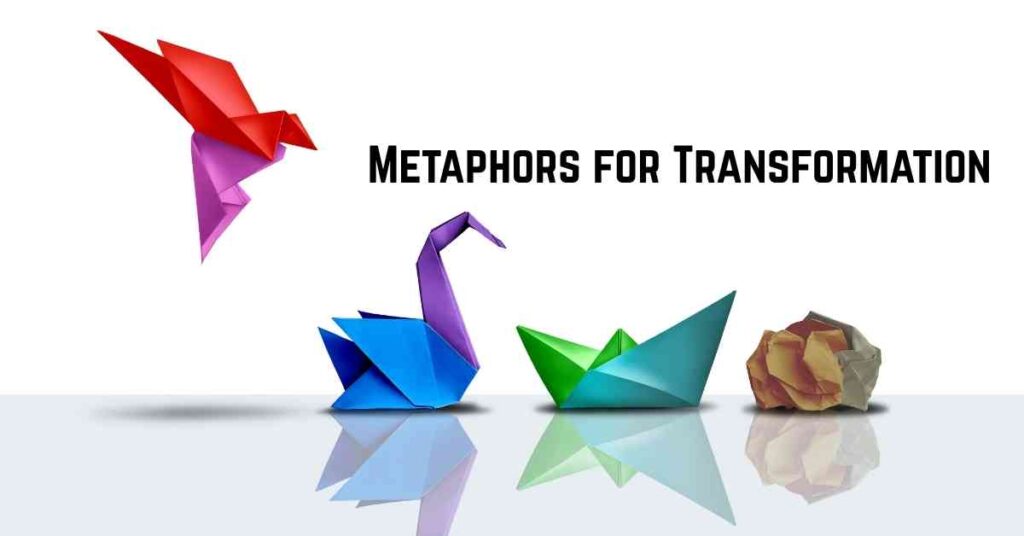

Understanding metaphors is crucial for mastering the nuances of the English language. Metaphors for transformation, in particular, provide a vivid and relatable way to describe change, growth, and evolution. This article delves into the fascinating world of these metaphors, exploring their structure, types, and usage. Whether you’re an ESL student, a seasoned writer, or simply curious about language, this guide will equip you with the knowledge to effectively use and interpret metaphors for transformation.
Table of Contents
- Introduction
- Definition of Metaphors for Transformation
- Structural Breakdown
- Types and Categories
- Examples
- Usage Rules
- Common Mistakes
- Practice Exercises
- Advanced Topics
- FAQ
- Conclusion
Introduction
Metaphors are powerful tools that allow us to understand abstract concepts by relating them to more concrete and familiar ones. When used to describe transformation, metaphors can vividly illustrate the process of change, making it more relatable and understandable. Mastering the use of these metaphors enhances both your comprehension and expression in English. This article will provide a comprehensive overview of metaphors for transformation, covering their definition, types, structural elements, usage rules, and common mistakes, along with practice exercises to solidify your understanding.
Definition of Metaphors for Transformation
A metaphor for transformation is a figure of speech that describes a change or process of becoming by comparing it to something else. It suggests a likeness or analogy between the transformation and the metaphorical subject, without using “like” or “as” (which would make it a simile). These metaphors help us visualize abstract concepts like growth, change, and evolution by relating them to tangible or relatable experiences. The core function of a metaphor for transformation is to provide a new perspective on a change, often highlighting its nature, impact, or significance.
Metaphors are not literal; they are imaginative comparisons that invite the reader or listener to make connections and draw inferences. They enrich language, making it more expressive and engaging. In the context of transformation, metaphors can convey the depth, complexity, and emotional impact of change in a way that literal language often cannot.
Structural Breakdown
The structure of a metaphor for transformation typically involves two key components: the tenor and the vehicle. The tenor is the subject being described (the transformation itself), and the vehicle is the object or concept to which it is being compared. The vehicle provides a new lens through which to view the tenor. Understanding this structural relationship is crucial for both creating and interpreting metaphors effectively.
For example, in the metaphor “He blossomed into a confident speaker,” the tenor is the person’s transformation into a confident speaker, and the vehicle is the act of blossoming, typically associated with flowers. The metaphor suggests that the person’s development was natural, beautiful, and progressive, similar to the unfolding of a flower’s petals.
Effective metaphors also rely on shared characteristics between the tenor and the vehicle. These shared characteristics create the basis for the comparison and allow the metaphor to resonate with the audience. In the example above, the shared characteristic is the idea of gradual, positive development.
Types and Categories
Metaphors for transformation can be categorized based on the type of change they describe. Here are some common categories:
Metamorphosis Metaphors
These metaphors describe a dramatic and fundamental change in form or nature, often suggesting a complete alteration of identity or essence. They often draw upon images of insects or mythical creatures undergoing significant physical or spiritual changes. Metamorphosis metaphors are powerful because they highlight the radical nature of the transformation.
Growth and Development Metaphors
These metaphors focus on gradual and progressive change, emphasizing the process of maturation and improvement. They often use imagery from nature, such as plants growing or seeds sprouting, to illustrate the unfolding of potential over time. These metaphors underscore the organic and incremental nature of development.
Process and Change Metaphors
These metaphors describe transformations as a series of stages or steps, highlighting the dynamic and ongoing nature of change. They may use imagery from journeys, construction, or cooking to illustrate the process. These metaphors emphasize the active and iterative aspects of transformation.
Renewal and Rebirth Metaphors
These metaphors describe transformations that involve a return to a previous state or the emergence of something new after a period of decline or dormancy. They often use imagery from nature, such as spring after winter or a phoenix rising from ashes, to convey the idea of revitalization and regeneration. These metaphors highlight the cyclical and restorative nature of transformation.
Examples
To further illustrate the different types of metaphors for transformation, here are some examples organized by category:
Metamorphosis Examples
The following table provides examples of metamorphosis metaphors, showcasing how they illustrate dramatic and fundamental changes.
| Metaphor | Tenor (Transformation) | Vehicle (Metaphorical Subject) | Explanation |
|---|---|---|---|
| He emerged from the ordeal a completely different person, a phoenix rising from ashes. | A person’s transformation after a difficult experience. | A phoenix rising from ashes. | Suggests a complete and powerful rebirth after suffering. |
| The caterpillar of self-doubt transformed into the butterfly of confidence. | Transformation from self-doubt to confidence. | Caterpillar to butterfly. | Illustrates a complete and beautiful change in inner state. |
| She shed her old skin, becoming a new woman. | A woman’s personal transformation. | Shedding skin. | Conveys the idea of leaving behind the past and embracing a new identity. |
| The awkward student morphed into a charismatic leader. | Transformation from awkwardness to charisma. | Morphing. | Highlights a significant and noticeable change in personality. |
| His perspective underwent a sea change after the accident. | A shift in perspective. | Sea change. | Indicates a profound and comprehensive alteration. |
| The project was a chrysalis, waiting to unleash its potential. | A project’s development. | Chrysalis. | Suggests hidden potential waiting to be revealed through transformation. |
| From a shy introvert, she blossomed into an eloquent speaker. | Transformation from introversion to eloquence. | Blossoming. | Illustrates a beautiful and gradual unfolding of potential. |
| The company underwent a radical metamorphosis to stay competitive. | A company’s significant change. | Metamorphosis. | Emphasizes the profound and necessary nature of the change. |
| He was a lump of clay, molded into a masterpiece by his mentor. | A person’s development through guidance. | Clay being molded. | Conveys the idea of being shaped and refined by an external influence. |
| The city was reborn from the ashes of the fire. | A city’s recovery after a disaster. | Rebirth from ashes. | Highlights the resilience and renewal of the city. |
| Her anger slowly transmuted into forgiveness. | Transformation of anger into forgiveness. | Transmutation. | Indicates a gradual but significant change in emotion. |
| The old factory was transmogrified into a modern art gallery. | Transformation of a building’s purpose. | Transmogrification. | Emphasizes a complete and surprising change in function. |
| He went through a crucible of hardship and emerged stronger. | A person’s growth through hardship. | Crucible. | Suggests that the person was tested and purified by the experience. |
| Her initial hesitation dissolved, replaced by unwavering determination. | Transformation of hesitation into determination. | Dissolving and replacement. | Highlights the complete disappearance of one feeling and the emergence of another. |
| The once-barren land experienced a miraculous transfiguration. | Transformation of barren land. | Transfiguration. | Conveys a dramatic and almost supernatural change. |
| His character hardened in the forge of adversity. | A person’s character development. | Forge. | Suggests that the person’s character was strengthened by difficult experiences. |
| The town was revivified by the influx of new businesses. | A town’s revitalization. | Revivification. | Emphasizes the return of life and vitality to the town. |
| He was refashioned by his experiences abroad. | A person’s change through travel. | Refashioning. | Highlights how the experiences reshaped his identity and perspective. |
| The athlete was forged into a champion through rigorous training. | An athlete’s transformation into a champion. | Forging. | Suggests the athlete was shaped and strengthened through intense effort. |
| The project was reconfigured to meet the changing needs of the market. | A project’s adaptation to market changes. | Reconfiguration. | Emphasizes the project’s ability to change and adapt. |
| The team was restructured to improve efficiency. | A team’s organizational change. | Restructuring. | Highlights the purposeful change to enhance performance. |
| The software was overhauled for better performance. | A software’s improvement. | Overhaul. | Suggests a comprehensive and thorough renovation. |
Growth and Development Examples
The following table provides examples of growth and development metaphors, highlighting gradual and progressive changes.
| Metaphor | Tenor (Transformation) | Vehicle (Metaphorical Subject) | Explanation |
|---|---|---|---|
| She nurtured her talent, allowing it to blossom into a successful career. | Development of talent into a career. | Blossoming. | Suggests careful cultivation and eventual flourishing. |
| His knowledge grew like a tree, with roots in foundational principles and branches reaching for new understanding. | Growth of knowledge. | Growing tree. | Illustrates steady and expansive development. |
| The company cultivated a culture of innovation. | Development of an innovative culture. | Cultivation. | Implies careful and intentional nurturing. |
| Her confidence sprouted from small successes. | Growth of confidence. | Sprouting. | Highlights the gradual emergence and development of confidence. |
| The idea germinated in his mind, slowly taking root and growing into a full-fledged plan. | Development of an idea. | Germination. | Conveys the slow but steady growth of an idea. |
| The relationship blossomed over time, like a delicate flower. | Development of a relationship. | Blossoming flower. | Suggests a beautiful and gradual unfolding of affection. |
| His skills matured with each project he completed. | Development of skills. | Maturing. | Illustrates the refinement and improvement of skills over time. |
| The organization fostered a spirit of collaboration. | Development of a collaborative spirit. | Fostering. | Implies creating a supportive environment for growth. |
| Her passion for music ripened over the years. | Development of passion. | Ripening. | Conveys the idea of passion becoming more intense and fulfilling. |
| The community nurtured a sense of belonging. | Development of community spirit. | Nurturing. | Highlights the care and attention given to foster belonging. |
| His leadership skills have been cultivated through experience. | Development of leadership skills. | Cultivation. | Indicates that the skills were deliberately developed and refined. |
| The team’s potential has finally begun to unfold. | Development of team potential. | Unfolding. | Suggests a gradual revelation of hidden capabilities. |
| Her understanding of the subject deepened over time. | Development of understanding. | Deepening. | Illustrates a gradual and profound increase in knowledge. |
| The company’s reputation has grown organically through excellent service. | Development of company reputation. | Growing organically. | Highlights the natural and gradual growth of the reputation. |
| His influence expanded like ripples in a pond. | Growth of influence. | Expanding ripples. | Conveys the idea of influence spreading outwards from a central point. |
| The project evolved from a simple idea into a complex system. | Development of a project. | Evolution. | Suggests a gradual and complex process of change. |
| The software has matured into a robust and reliable platform. | Development of software. | Maturing. | Implies that the software has become more stable and dependable. |
| Her artistic style developed over the years. | Development of artistic style. | Developing. | Highlights the gradual refinement and evolution of her style. |
| The child’s vocabulary expanded rapidly. | Development of vocabulary. | Expanding. | Conveys the rapid growth and increase in the child’s vocabulary. |
| The business has flourished under new management. | Development of a business. | Flourishing. | Suggests thriving and prosperous growth. |
| His musical talent burgeoned with practice and dedication. | Development of musical talent. | Burgeoning. | Highlights the rapid and enthusiastic growth of his abilities. |
| The seeds of innovation were sown and began to sprout across the organization. | Development of innovation. | Sowing and sprouting seeds. | Implies the introduction and subsequent growth of innovative ideas. |
Process and Change Examples
The following table provides examples of process and change metaphors, emphasizing the dynamic and ongoing nature of transformation.
| Metaphor | Tenor (Transformation) | Vehicle (Metaphorical Subject) | Explanation |
|---|---|---|---|
| The negotiations were a delicate dance, requiring careful steps and precise timing. | Negotiations. | Delicate dance. | Suggests a complex and strategic process. |
| The project was a journey, with many twists and turns along the way. | A project’s development. | Journey. | Illustrates the unpredictable and evolving nature of the project. |
| The investigation was a winding road, leading to unexpected discoveries. | An investigation. | Winding road. | Conveys the unpredictable and potentially lengthy nature of the process. |
| The relationship was a roller coaster, with highs and lows. | A relationship. | Roller coaster. | Highlights the emotional ups and downs of the relationship. |
| The construction of the building was a symphony of coordinated efforts. | Building construction. | Symphony. | Suggests a harmonious and well-organized process. |
| The recovery process was a marathon, not a sprint. | Recovery from illness. | Marathon. | Implies a long and enduring effort. |
| The learning process was a puzzle, with each new piece fitting into place. | The learning process. | Puzzle. | Illustrates the gradual assembly of knowledge. |
| The debate was a tug-of-war, with each side pulling in opposite directions. | A debate. | Tug-of-war. | Conveys the competitive and adversarial nature of the debate. |
| The design process was a constant refinement, with each iteration improving upon the last. | The design process. | Constant refinement. | Suggests a process of continuous improvement. |
| The development of the software was a stepwise progression, building upon previous versions. | Software development. | Stepwise progression. | Highlights the structured and incremental nature of the development. |
| The project was a balancing act, requiring careful attention to competing priorities. | Project management. | Balancing act. | Implies the need for skill and precision in managing the project. |
| The election campaign was a chess game, with strategic moves and countermoves. | Election campaign. | Chess game. | Conveys the strategic and competitive nature of the campaign. |
| The scientific research was a quest, with the researchers seeking answers to complex questions. | Scientific research. | Quest. | Illustrates the challenging and exploratory nature of the research. |
| The writing process was a journey of discovery, uncovering new ideas and insights. | The writing process. | Journey of discovery. | Suggests that the writer learns and grows through the process. |
| The negotiation was a dance of diplomacy, requiring tact and understanding. | Negotiation. | Dance of diplomacy. | Conveys the need for grace and skill in navigating the negotiation. |
| The investigation was a careful unraveling, revealing hidden truths. | An investigation. | Careful unraveling. | Implies a methodical and patient approach to uncovering the truth. |
| The presentation was a performance, captivating the audience with its energy and enthusiasm. | A presentation. | Performance. | Highlights the engaging and dynamic nature of the presentation. |
| The creative process was a flow, where ideas came easily and effortlessly. | The creative process. | Flow. | Suggests a state of effortless creativity and inspiration. |
| The process of learning a new language is a climb, where each step brings you closer to fluency. | Learning a language. | Climb. | Implies a challenging but rewarding journey. |
| The business expansion was a calculated risk, weighing potential rewards against potential losses. | Business expansion. | Calculated risk. | Highlights the careful consideration and evaluation involved. |
| The merger of the two companies was a marriage, with the hope of creating a stronger entity. | Company merger. | Marriage. | Suggests a union with the aim of mutual benefit and strength. |
| The recovery from the economic downturn was a slow burn, with gradual improvements over time. | Economic recovery. | Slow burn. | Implies a gradual and persistent process of recovery. |
Renewal and Rebirth Examples
The following table provides examples of renewal and rebirth metaphors, emphasizing the cyclical and restorative nature of transformation.
| Metaphor | Tenor (Transformation) | Vehicle (Metaphorical Subject) | Explanation |
|---|---|---|---|
| After a period of decline, the city experienced a renaissance, with a renewed focus on art and culture. | City’s revival. | Renaissance. | Suggests a rebirth of creativity and prosperity. |
| The project was resurrected after being shelved for years. | Revival of a project. | Resurrection. | Illustrates a return to life after a period of dormancy. |
| The company was revitalized by a new CEO and a fresh vision. | Company’s revitalization. | Revitalization. | Conveys the idea of renewed energy and purpose. |
| The forest regenerated after the fire, with new growth emerging from the ashes. | Forest’s regeneration. | Regeneration. | Highlights the natural process of renewal after destruction. |
| Her spirit was rekindled by the support of her friends and family. | Revival of spirit. | Rekindling. | Suggests a renewed sense of hope and enthusiasm. |
| The old traditions were revived, bringing a sense of continuity and connection to the past. | Revival of traditions. | Revival. | Implies a restoration of cultural heritage. |
| The community underwent a rejuvenation, with new infrastructure and improved services. | Community’s rejuvenation. | Rejuvenation. | Illustrates a renewed sense of vitality and well-being. |
| The old building was restored to its former glory, preserving its historical significance. | Building’s restoration. | Restoration. | Conveys the idea of returning something to its original condition. |
| His career was reignited after a period of stagnation. | Career’s revival. | Reignition. | Suggests a renewed passion and enthusiasm for work. |
| The peace treaty was a new dawn, promising an end to years of conflict. | Establishment of peace. | New dawn. | Highlights the beginning of a new and hopeful era. |
| The project was given a second wind after a period of setbacks. | Project’s revival. | Second wind. | Implies a renewed burst of energy and momentum. |
| The movement was reborn with a new generation of activists. | Movement’s revival. | Rebirth. | Conveys the idea of a new beginning with fresh energy and ideas. |
| The company was reinvented to meet the changing demands of the market. | Company’s reinvention. | Reinvention. | Illustrates a transformation to adapt to new circumstances. |
| His faith was renewed after a period of doubt. | Revival of faith. | Renewal. | Suggests a restoration of belief and conviction. |
| The relationship was rekindled after a period of separation. | Relationship’s revival. | Rekindling. | Conveys the idea of renewed affection and connection. |
| The garden was replanted after the winter, bringing new life and color to the landscape. | Garden’s replanting. | Replanting. | Implies a restoration of beauty and vitality after a period of dormancy. |
| The city was rebuilt after the earthquake, stronger and more resilient than before. | City’s rebuilding. | Rebuilding. | Highlights the ability to recover and improve after a disaster. |
| Her confidence was restored after a period of self-doubt. | Restoration of confidence. | Restoration. | Suggests a return to a state of self-assurance and belief. |
| The team was reformed with new members and a new strategy. | Team’s reformation. | Reformation. | Conveys the idea of restructuring and revitalizing the team. |
| His determination was resurrected after a period of discouragement. | Revival of determination. | Resurrection. | Implies a return to a state of resolve and purpose. |
| The building was renovated to reflect its original architectural style. | Building’s renovation. | Renovation. | Highlights the effort to restore and improve the building’s appearance. |
| The town was rejuvenated by a new wave of entrepreneurs. | Town’s rejuvenation. | Rejuvenation. | Suggests a renewed economic and social vitality. |
Usage Rules
Using metaphors effectively requires careful consideration of several factors. First, the metaphor should be appropriate for the context and audience. A metaphor that is too obscure or culturally specific may not be understood. Second, the metaphor should be consistent and avoid mixing metaphors that create contradictory or confusing images. Third, the metaphor should be original and avoid clichés, which have lost their impact through overuse.
It’s also important to ensure that the metaphor accurately reflects the tenor. A poorly chosen metaphor can distort or misrepresent the transformation being described. The shared characteristics between the tenor and the vehicle should be clear and relevant.
While metaphors can be powerful, they should be used judiciously. Overuse of metaphors can make writing seem contrived or overly ornate. Balance is key to using metaphors effectively.
Common Mistakes
One common mistake is using mixed metaphors, where the components of the metaphor create an illogical or contradictory image. For example, saying “We need to nip it in the bud before it snowballs” combines two unrelated metaphors (nipping a bud and a snowball rolling downhill), resulting in a confusing image. The correct usage would be to choose one consistent metaphor.
Another mistake is using clichéd metaphors. While clichés may be easily understood, they lack originality and impact. Instead of saying “He was a diamond in the rough,” try to find a more creative and specific metaphor that captures the person’s potential.
Finally, ensure that the metaphor is accurate and relevant to the transformation being described. A metaphor that is too far-fetched or unrelated will not be effective.
Here’s a table illustrating common mistakes:
| Incorrect | Correct | Explanation |
|---|---|---|
| Let’s grab the bull by the horns and put the cart before the horse. | Let’s grab the bull by the horns and take decisive action. OR Let’s carefully plan our strategy before executing it. | Mixed metaphors create a confusing image. |
| He was a shining star. | He was a beacon of hope, guiding others through difficult times. | The original example is a cliché. |
| The company’s growth was like a rocket ship to the moon, but then it hit a brick wall made of clouds. | The company’s growth was like a rocket ship to the moon, achieving rapid success. OR The company’s growth was initially promising, but it encountered significant obstacles. | The metaphor is inaccurate and combines unrelated images. |
Practice Exercises
Test your understanding of metaphors for transformation with these exercises:
- Identify the metaphor in the following sentence: “Her anger boiled over, erupting in a torrent of accusations.”
- What is the tenor and vehicle in the metaphor: “The project was a seed, waiting to sprout.”
- Rewrite the sentence using a metaphor for transformation: “The student became more confident after the presentation.”
- Correct the mixed metaphor: “We need to put our shoulder to the wheel and nip it in the bud.”
- Create a metaphor for transformation to describe a person’s recovery from illness.
- Identify the type of metaphor used in the following sentence: “The company was reborn after the merger.”
- Explain the shared characteristics between the tenor and vehicle in the metaphor: “His career took flight after years of hard work.”
- Replace the cliché with a more original metaphor: “He was a diamond in the rough.”
- Create a metaphor for transformation to describe a team’s progress towards a goal.
- Analyze the effectiveness of the metaphor in the following sentence: “The debate was a boxing match, with each side delivering knockout blows.”
Answer Key:
- “Boiled over, erupting in a torrent”
- Tenor: The project’s development; Vehicle: A seed sprouting
- “The student blossomed with confidence after the presentation.”
- “We need to put our shoulder to the wheel and work hard.” OR “We need to nip it in the bud before it gets out of control.”
- “His recovery was a slow climb, each step bringing him closer to full health.”
- Renewal/Rebirth
- Shared characteristics: Rising, achieving great heights, being successful
- “He was a hidden gem, waiting to be discovered.”
- “The team’s progress was a steady climb up a mountain, each milestone bringing them closer to the summit.”
- The metaphor is effective because it conveys the aggressive and combative nature of the debate.
Here are some more practice exercises to deepen your understanding:
| Question | Answer |
|---|---|
| 1. Identify the type of metaphor used in the sentence: “The company navigated the economic downturn like a ship weathering a storm.” | Process and Change |
| 2. What is the tenor in the metaphor: “Her creative ideas flowed like a river”? | Her creative ideas |
| 3. Which of the following is a mixed metaphor? a) He was a pillar of strength. b) We need to bite the bullet and stay the course. c) She blossomed into a confident leader. | b) We need to bite the bullet and stay the course. |
| 4. Create a metaphor for a student’s learning journey. | The student’s learning journey was a voyage across uncharted waters. |
| 5. Rewrite the following sentence using a metaphor for transformation: “The old building was modernized.” | The old building shed its antiquated skin and emerged as a modern marvel. |
| 6. Analyze the effectiveness of the metaphor: “The political debate was a circus.” | Effective if it conveys chaos and lack of seriousness; ineffective if it misses the mark. |
| 7. Identify the vehicle in the metaphor: “The athlete’s determination was an unquenchable fire.” | An unquenchable fire |
| 8. What type of metaphor is used in the sentence: “The project rose from the ashes of failure”? | Renewal and Rebirth |
| 9. Correct the following mixed metaphor: “We need to think outside the box and nip it in the bud.” | We need to think outside the box and explore new possibilities. OR We need to nip it in the bud before it escalates. |
| 10. Create a metaphor to describe a person’s transformation after overcoming adversity. | He emerged from the crucible of adversity, tempered and stronger than before. |
Advanced Topics
For advanced learners, exploring the nuances of extended metaphors and allegories can further enhance their understanding of metaphors for transformation. An extended metaphor is a metaphor that is developed over several lines or paragraphs, creating a more complex and sustained comparison. An allegory is a narrative in which the characters and events represent abstract ideas or moral qualities.
Analyzing the historical and cultural context of metaphors can also provide deeper insights into their meaning and impact. Some metaphors may be rooted in specific cultural traditions or historical events
, making them more resonant for certain audiences. Exploring these advanced topics can help you appreciate the richness and complexity of metaphorical language.
Consider, for example, the extended metaphor of a “ship of state,” used to describe a nation and its government. This metaphor, which has roots in ancient Greece, compares the nation to a ship, the government to the captain and crew, and the challenges facing the nation to storms and rough seas. By developing this metaphor over several lines or paragraphs, a writer can create a powerful and nuanced portrayal of the nation’s condition and the government’s role.
FAQ
Here are some frequently asked questions about metaphors for transformation:
- What is the difference between a metaphor and a simile?
- A metaphor is a direct comparison between two unlike things, while a simile uses “like” or “as” to make the comparison. For example, “He is a lion” is a metaphor, while “He is as brave as a lion” is a simile.
- How can I avoid using clichés in my writing?
- Try to think of original and specific comparisons that capture the essence of what you are trying to describe. Use concrete imagery and sensory details to make your metaphors more vivid and memorable.
- What is the best way to identify a metaphor in a text?
- Look for language that is not meant to be taken literally. Ask yourself what the author is trying to convey by making the comparison. Consider the shared characteristics between the tenor and the vehicle.
- Can metaphors be used in all types of writing?
- Yes, metaphors can be used in many types of writing, including creative writing, academic writing, and business writing. However, it’s important to use metaphors appropriately and avoid overuse.
- How can I improve my understanding of metaphors?
- Read widely and pay attention to how authors use metaphors in their writing. Practice creating your own metaphors and ask for feedback from others. Consider taking a course or workshop on figurative language.
- Are metaphors for transformation only applicable to personal growth?
- No, metaphors for transformation can be used to describe any type of change or evolution, including personal growth, organizational change, technological advancements, and societal shifts.
- How do cultural differences affect the interpretation of metaphors?
- Metaphors can be culturally specific, meaning that their meaning may vary depending on the cultural background of the reader or listener. It’s important to be aware of these cultural differences when using or interpreting metaphors.
- What role do metaphors play in storytelling?
- Metaphors enrich storytelling by adding layers of meaning and emotional depth. They can help create vivid imagery, convey complex themes, and engage the reader’s imagination.
- Can metaphors be used in visual arts?
- Yes, visual artists often use metaphors to convey ideas and emotions through their work. For example, an artist might use a broken vase to represent fragility or a stormy sea to represent turmoil.
- How do metaphors relate to critical thinking?
- Understanding metaphors requires critical thinking skills, such as analysis, interpretation, and evaluation. By analyzing metaphors, we can gain a deeper understanding of the author’s perspective and the underlying message of the text.
Conclusion
Metaphors for transformation are powerful tools that can enrich our understanding and expression of change, growth, and evolution. By understanding the structure, types, and usage rules of these metaphors, you can effectively use them to communicate complex ideas and create vivid imagery. Whether you’re writing a novel, giving a presentation, or simply trying to understand the world around you, mastering metaphors for transformation will enhance your communication skills and deepen your appreciation of the English language. Practice using these metaphors in your writing and speech, and you’ll find yourself communicating with greater clarity, creativity, and impact. The world is constantly changing, and with the right metaphors, you can capture its dynamic nature in all its complexity and beauty.