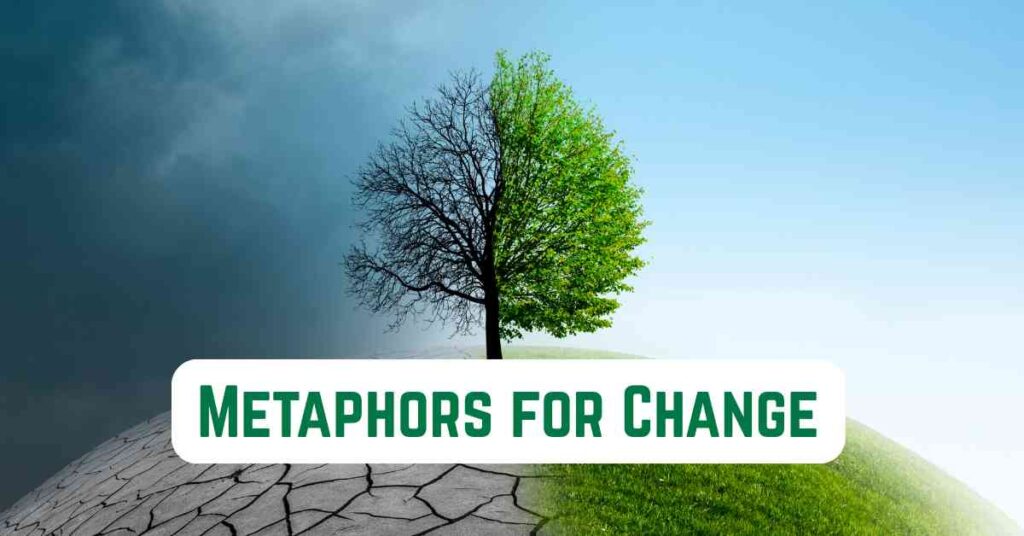

Understanding metaphors for change is crucial for mastering both English grammar and effective communication. Metaphors allow us to express complex ideas in relatable terms, making abstract concepts like change more tangible and understandable. This article is designed for English language learners of all levels, from beginners to advanced speakers, and anyone looking to enhance their understanding of figurative language. By exploring various types of metaphors and their applications, you’ll learn to recognize, interpret, and use them effectively. This comprehensive guide will equip you with the knowledge and skills to navigate the nuances of metaphorical language, enriching your comprehension and expression in English.
Table of Contents
- Definition of Metaphors for Change
- Structural Breakdown
- Types of Metaphors for Change
- Examples of Metaphors for Change
- Usage Rules
- Common Mistakes
- Practice Exercises
- Advanced Topics
- FAQ
- Conclusion
Definition of Metaphors for Change
A metaphor is a figure of speech that directly compares two unrelated things, asserting that one thing is another. It’s not a literal statement but a way to understand one concept in terms of another. Metaphors for change specifically use this comparison to describe the process of transformation, alteration, or evolution. They help us to visualize and comprehend abstract ideas about change by relating them to more concrete or familiar experiences. The function of a metaphor for change is to provide a new perspective, add emotional depth, or simplify complex phenomena. The context in which a metaphor is used greatly influences its interpretation. For example, a metaphor about “climbing a mountain” could refer to overcoming challenges in a career or personal life.
Structural Breakdown
A metaphor consists of two main elements: the tenor and the vehicle. The tenor is the subject being described (in this case, change), and the vehicle is the concept used to describe it. For instance, in the metaphor “Change is a rollercoaster,” “change” is the tenor, and “rollercoaster” is the vehicle. The connection between the tenor and vehicle is based on shared characteristics or associations. In this example, both change and rollercoasters are associated with ups and downs, excitement, and unpredictability. The effectiveness of a metaphor depends on the strength and relevance of this connection. A well-chosen vehicle can illuminate aspects of the tenor that might otherwise be overlooked. The structure also relies on the audience’s understanding of the vehicle. If the audience is unfamiliar with rollercoasters, the metaphor will be less effective. Understanding the structural elements helps in both creating and interpreting metaphors for change.
Types of Metaphors for Change
Metaphors for change can be categorized based on the specific concepts they draw upon. Here are some common types:
Journey Metaphors
Journey metaphors frame change as a process of moving from one point to another. They often involve concepts like roads, paths, destinations, and obstacles. These metaphors emphasize the progression and challenges involved in change.
Growth Metaphors
Growth metaphors use the imagery of plants, seeds, and cultivation to represent change. They highlight the gradual and organic nature of change, emphasizing development and nurturing.
Weather Metaphors
Weather metaphors employ concepts like storms, sunshine, and seasons to depict change. They often convey the unpredictable and sometimes turbulent nature of change, as well as the cyclical patterns of transformation.
Transformation Metaphors
Transformation metaphors focus on the alteration of form or substance. They often involve images of metamorphosis, alchemy, or evolution, emphasizing the radical shifts that can occur during change.
Building Metaphors
Building metaphors use the imagery of construction, architecture, and foundations to represent change. They highlight the deliberate and structural aspects of change, emphasizing planning and stability.
Examples of Metaphors for Change
Here are some examples of metaphors for change, categorized by type:
Journey Metaphors:
The following table shows examples of journey metaphors and their interpretations.
| Metaphor | Interpretation |
|---|---|
| “Change is a long and winding road.” | Change is a process with many twists and turns. |
| “Navigating change is like sailing uncharted waters.” | Change involves uncertainty and requires exploration. |
| “The path to success is paved with change.” | Change is essential for achieving goals. |
| “Change is a bridge to a better future.” | Change connects the present to a more desirable state. |
| “We’re on a journey of transformation.” | We are undergoing a significant change process. |
| “The company is charting a new course.” | The company is changing its direction. |
| “He’s at a crossroads in his career.” | He faces a significant decision about his career path. |
| “This decision is a turning point.” | This decision marks a significant change in direction. |
| “She’s blazing a trail in the industry.” | She’s innovating and leading change in the industry. |
| “The project is moving full steam ahead.” | The project is progressing rapidly and with great energy. |
| “We’re climbing the ladder of success.” | We are advancing through the ranks and achieving goals. |
| “The team is navigating through a difficult period.” | The team is overcoming challenges and adapting to change. |
| “They’re paving the way for future generations.” | They are creating opportunities and setting a new standard. |
| “Change is a marathon, not a sprint.” | Change requires endurance and long-term commitment. |
| “The organization is off course and needs to recalibrate.” | The organization needs to adjust its direction to achieve its goals. |
| “He’s reached a plateau in his career.” | He’s experiencing a period of stagnation and needs to find new challenges. |
| “The company is entering a new chapter.” | The company is beginning a new phase of its development. |
| “We’re embarking on a new adventure.” | We are starting a new and exciting journey. |
| “The project hit a roadblock.” | The project encountered an obstacle that halted progress. |
| “She’s navigating through the complexities of the new system.” | She’s learning and adapting to the intricacies of the new system. |
Growth Metaphors:
The following table shows examples of growth metaphors and their interpretations
| Metaphor | Interpretation |
|---|---|
| “Change is a seed that needs nurturing.” | Change requires care and attention to flourish. |
| “Growth comes from embracing change.” | Change fosters personal and professional development. |
| “The company is blossoming with new ideas.” | The company is thriving and generating innovative concepts. |
| “Change is like pruning a tree to encourage new growth.” | Change involves removing old or unnecessary elements to promote development. |
| “The team is cultivating a culture of innovation.” | The team is fostering an environment that encourages new ideas and creativity. |
| “The project is bearing fruit after years of hard work.” | The project is yielding positive results after a long period of effort. |
| “The idea is still in its infancy.” | The idea is in its early stages of development. |
| “The business is sprouting new branches.” | The business is expanding into new areas. |
| “He’s a late bloomer in the industry.” | He achieved success later in his career than others. |
| “The organization is reaping the rewards of its investments.” | The organization is benefiting from its past efforts. |
| “She’s sowing the seeds of change.” | She’s initiating actions that will lead to future transformations. |
| “The company is weeding out inefficiencies.” | The company is eliminating wasteful practices to improve performance. |
| “The project is germinating slowly but surely.” | The project is developing gradually and steadily. |
| “The team is nurturing new talent.” | The team is supporting and developing the skills of its new members. |
| “The initiative is taking root in the community.” | The initiative is becoming established and accepted in the community. |
| “The company is harvesting its resources.” | The company is utilizing its assets to generate value. |
| “The idea is still budding.” | The idea is in the early stages of development and showing potential. |
| “The plan is flourishing under the new management.” | The plan is thriving and succeeding with the support of the new management. |
| “The project is a fertile ground for innovation.” | The project provides an environment conducive to new ideas and creativity. |
| “The company is cultivating a strong leadership team.” | The company is developing and training its leaders to be effective. |
Weather Metaphors:
The following table shows examples of weather metaphors and their interpretations.
| Metaphor | Interpretation |
|---|---|
| “Change can be a storm that weathers.” | Change can be difficult and challenging, but we can survive it. |
| “After the storm, there’s always sunshine.” | After a period of difficulty, there will be positive outcomes. |
| “The company is weathering the economic downturn.” | The company is surviving the challenges of a difficult economic period. |
| “Change is a season that comes and goes.” | Change is a cyclical process with different phases. |
| “The new policy is creating a ripple effect.” | The new policy is causing a series of consequences. |
| “The industry is experiencing a sea change.” | The industry is undergoing a significant transformation. |
| “The project is facing a headwind.” | The project is encountering opposition or obstacles. |
| “The company is riding the wave of innovation.” | The company is taking advantage of new trends and technologies. |
| “The market is stormy and unpredictable.” | The market is volatile and difficult to navigate. |
| “The team is in the eye of the storm.” | The team is at the center of a chaotic situation but remains calm. |
| “The organization is experiencing a climate of change.” | The organization is undergoing a period of significant transformation. |
| “The project is shrouded in a fog of uncertainty.” | The project is unclear and difficult to understand. |
| “The company is navigating through a turbulent period.” | The company is managing a difficult and unstable time. |
| “The new regulations are creating a chill in the industry.” | The new regulations are causing a negative impact on the industry. |
| “The market is heating up with competition.” | The market is becoming more competitive and intense. |
| “The company is experiencing a drought of innovation.” | The company is lacking new ideas and creativity. |
| “The project is facing a deluge of challenges.” | The project is encountering a large number of obstacles. |
| “The team is basking in the sunshine of success.” | The team is enjoying the positive results of its efforts. |
| “The organization is sowing the seeds of a brighter future.” | The organization is taking actions that will lead to positive outcomes. |
| “The new policy is creating a tidal wave of change.” | The new policy is causing a significant and sweeping transformation. |
Transformation Metaphors:
The following table shows examples of transformation metaphors and their interpretations.
| Metaphor | Interpretation |
|---|---|
| “Change is the butterfly emerging from the cocoon.” | Change is a beautiful and complete transformation. |
| “The company is undergoing a metamorphosis.” | The company is experiencing a significant transformation. |
| “Change is like turning lead into gold.” | Change is taking something ordinary and making it extraordinary. |
| “The team is forging a new identity.” | The team is creating a new image and culture for itself. |
| “The organization is reinventing itself.” | The organization is transforming its identity and operations. |
| “She’s shedding her old skin.” | She’s leaving behind her old habits and behaviors. |
| “The company is melting away its bureaucratic layers.” | The company is simplifying its processes and reducing red tape. |
| “The project is crystallizing into a clear vision.” | The project is becoming more focused and well-defined. |
| “The team is molding itself into a high-performing unit.” | The team is developing the skills and characteristics needed to excel. |
| “The organization is distilling its core values.” | The organization is identifying and emphasizing its most important principles. |
| “The company is refining its strategy.” | The company is improving and perfecting its approach. |
| “The project is undergoing a radical overhaul.” | The project is experiencing a significant and comprehensive transformation. |
| “The team is evolving its processes.” | The team is developing and improving its methods over time. |
| “The organization is transmuting its culture.” | The organization is transforming its values and behaviors. |
| “The company is reshaping its business model.” | The company is changing the way it operates and generates revenue. |
| “The project is transforming from a concept to a reality.” | The project is evolving from an idea into a tangible outcome. |
| “The team is metamorphosing into a more agile unit.” | The team is transforming into a more flexible and responsive group. |
| “The organization is shedding its old ways.” | The organization is abandoning its outdated practices. |
| “The company is reinventing its brand.” | The company is creating a new image and identity for its brand. |
| “The project is distilling the essence of innovation.” | The project is capturing the most important elements of creativity and new ideas. |
Building Metaphors:
The following table shows examples of building metaphors and their interpretations.
| Metaphor | Interpretation |
|---|---|
| “Change is building a new foundation.” | Change is creating a strong base for future success. |
| “The company is constructing a new vision.” | The company is creating a clear and compelling plan for the future. |
| “Change is like renovating a house.” | Change involves updating and improving existing structures. |
| “The team is laying the groundwork for future success.” | The team is establishing the necessary conditions for future achievements. |
| “The organization is erecting a new structure.” | The organization is creating a new framework or system. |
| “The project is architecting a new solution.” | The project is designing and creating a new solution to a problem. |
| “The company is reinforcing its market position.” | The company is strengthening its competitive advantage. |
| “The team is constructing a robust plan.” | The team is creating a strong and resilient plan. |
| “The organization is building bridges with its stakeholders.” | The organization is establishing strong relationships with its key partners. |
| “The company is erecting a new headquarters.” | The company is building a new physical location for its operations. |
| “The project is laying the cornerstone of innovation.” | The project is establishing the foundation for future creativity. |
| “The team is constructing a solid reputation.” | The team is building a strong and positive image. |
| “The organization is building a culture of trust.” | The organization is creating an environment where people feel safe and respected. |
| “The company is reinforcing its commitment to sustainability.” | The company is strengthening its efforts to protect the environment. |
| “The project is architecting a seamless user experience.” | The project is designing a smooth and intuitive experience for users. |
| “The team is constructing a collaborative environment.” | The team is creating a space where people can work together effectively. |
| “The organization is building a strong foundation for growth.” | The organization is establishing the necessary conditions for future expansion. |
| “The company is reinforcing its leadership in the market.” | The company is strengthening its position as a leading player in the industry. |
| “The project is laying the bricks of success.” | The project is establishing the building blocks for future achievements. |
| “The team is constructing a resilient supply chain.” | The team is building a robust and reliable supply network. |
Usage Rules
When using metaphors for change, consider the following rules:
- Relevance: Ensure the vehicle is relevant to the tenor. The shared characteristics should be clear and meaningful.
- Clarity: The metaphor should enhance understanding, not obscure it. Avoid overly complex or obscure vehicles.
- Audience: Consider your audience’s background and understanding. Choose vehicles that are familiar and relatable.
- Consistency: Avoid mixing metaphors within the same context. This can create confusion and weaken the impact.
- Originality: Strive for originality to make your metaphors more engaging and memorable. Avoid clichés.
Common Mistakes
Here are some common mistakes to avoid when using metaphors for change:
| Incorrect | Correct | Explanation |
|---|---|---|
| “Change is a rollercoaster that is also a smooth sea.” | “Change is a rollercoaster.” or “Change is like navigating a smooth sea.” | Mixing metaphors creates confusion. |
| “The change was as fast as a snail.” | “The change was as slow as a snail.” | The vehicle should align with the intended meaning. |
| “Change is like a quantum entanglement of synergistic paradigms.” | “Change is like untangling a complex knot.” | The vehicle should be understandable to the audience. |
| “We must weather the sunshine to find change.” | “We must weather the storm to find change.” | The vehicle should logically connect to the tenor. |
| “The company is building a forest of innovation.” | “The company is building a foundation for innovation.” | The metaphor should be logically consistent. |
Practice Exercises
Exercise 1: Identify the Metaphor
Identify the metaphor in each sentence and explain its meaning.
| Question | Answer |
|---|---|
| 1. “Change is the engine of progress.” | The metaphor is “Change is the engine of progress.” It means change drives advancement and development. |
| 2. “The new policy is a breath of fresh air.” | The metaphor is “The new policy is a breath of fresh air.” It means the new policy is a welcome and revitalizing change. |
| 3. “The company is navigating a sea of uncertainty.” | The metaphor is “The company is navigating a sea of uncertainty.” It means the company is facing unpredictable and challenging circumstances. |
| 4. “The project is a seed that needs to be nurtured.” | The metaphor is “The project is a seed that needs to be nurtured.” It means the project requires care and attention to grow and succeed. |
| 5. “Change is a bridge to a better future.” | The metaphor is “Change is a bridge to a better future.” It means change connects the present to a more desirable state. |
| 6. “The market is a jungle.” | The metaphor is “The market is a jungle.” It means the market is competitive and dangerous. |
| 7. “His words were a knife to my heart.” | The metaphor is “His words were a knife to my heart.” It means his words caused deep emotional pain. |
| 8. “Time is a thief.” | The metaphor is “Time is a thief.” It means time passes quickly and steals our opportunities. |
| 9. “Life is a journey.” | The metaphor is “Life is a journey.” It means life is a process of moving from one point to another. |
| 10. “The mind is a garden.” | The metaphor is “The mind is a garden.” It means the mind needs to be cultivated and cared for. |
Exercise 2: Complete the Metaphor
Complete the following sentences with an appropriate metaphor for change.
| Question | Answer |
|---|---|
| 1. “Embracing change is like __________.” | “Embracing change is like opening a new door.” |
| 2. “The company’s transformation was __________.” | “The company’s transformation was a phoenix rising from the ashes.” |
| 3. “Navigating this change is __________.” | “Navigating this change is like sailing through a storm.” |
| 4. “This new strategy is __________.” | “This new strategy is the cornerstone of our future success.” |
| 5. “The project’s progress is __________.” | “The project’s progress is a slow but steady climb up a mountain.” |
| 6. “Her determination is __________.” | “Her determination is an unyielding oak in the face of adversity.” |
| 7. “Their teamwork is __________.” | “Their teamwork is the glue that holds the project together.” |
| 8. “The market’s volatility is __________.” | “The market’s volatility is a raging river.” |
| 9. “Innovation is __________.” | “Innovation is the lifeblood of our company.” |
| 10. “Leadership is __________.” | “Leadership is the compass guiding us through uncharted waters.” |
Exercise 3: Create Your Own Metaphor
Create your own metaphor for each of the following change scenarios:
| Scenario | Example Metaphor |
|---|---|
| 1. A company adopting a new technology. | “Adopting new technology is like planting a tree; it requires care and patience to see it grow and bear fruit.” |
| 2. A person changing careers. | “Changing careers is like setting sail on a new voyage; it’s exciting but requires preparation and courage.” |
| 3. A team reorganizing its structure. | “Reorganizing the team is like renovating a house; it requires careful planning and may be disruptive, but the result is a more functional space.” |
| 4. A community undergoing gentrification. | “Gentrification is like a river changing its course; it brings new life but can also erode the old.” |
| 5. A student adapting to a new school. | “Adapting to a new school is like learning a new language; it takes time, effort, and a willingness to make mistakes.” |
| 6. A company shifting its focus to sustainability. | “Shifting to sustainability is like building a house with green materials; it requires a different approach but creates a more enduring structure.” |
| 7. An artist experimenting with a new medium. | “Experimenting with a new medium is like exploring a new world; it’s uncertain but full of potential discoveries.” |
| 8. A city recovering from a natural disaster. | “Recovering from a natural disaster is like piecing together a shattered vase; it takes time and care to restore its beauty and function.” |
| 9. A country transitioning to a new political system. | “Transitioning to a new political system is like navigating a ship through a storm; it requires strong leadership and constant adjustments.” |
| 10. A person overcoming a personal challenge. | “Overcoming a personal challenge is like climbing a mountain; it’s difficult but the view from the top is worth the effort.” |
Advanced Topics
For advanced learners, consider exploring the following:
- Extended Metaphors: These are metaphors that are sustained over several lines or paragraphs, creating a more complex and nuanced comparison.
- Mixed Metaphors: While generally avoided, skilled writers can sometimes use mixed metaphors deliberately for humorous or satirical effect.
- Dead Metaphors: These are metaphors that have become so common that they are no longer recognized as figurative language (e.g., “the leg of a table”).
- The role of metaphors in shaping thought and perception: Explore how metaphors can influence our understanding of the world and our attitudes towards change.
FAQ
Q1: What is the difference between a metaphor and a simile?
A metaphor directly equates two things (e.g., “Change is a storm”), while a simile uses “like” or “as” to make a comparison (e.g., “Change is like a storm”). Similes are generally considered less forceful than metaphors.
Q2: How can I improve my ability to create effective metaphors?
Read widely, pay attention to the metaphors used by others, and practice creating your own. Think about the qualities of the subject you want to describe and brainstorm related concepts.
Q3: Are metaphors only used in literature?
No, metaphors are used in all forms of communication, including everyday conversation, business presentations, and scientific writing. They are a fundamental tool for understanding and expressing complex ideas.
Q4: Can a metaphor be too complex?
Yes, if the vehicle is too obscure or unfamiliar to the audience, the metaphor will fail to communicate effectively. Choose vehicles that are relatable and easy to understand.
Q5: What is a dead metaphor?
A dead metaphor is a figure of speech that once was considered a metaphor but has become so common that it is no longer recognised as one. An example of this is “the leg of a table”.
Q6: How do cultural differences affect the interpretation of metaphors?
Metaphors are often rooted in cultural experiences and values. A metaphor that is meaningful in one culture may be confusing or offensive in another. Be mindful of cultural differences when using metaphors in cross-cultural communication.
Q7: Can metaphors be used in persuasive writing?
Yes, metaphors can be very effective in persuasive writing. They can help to make abstract arguments more concrete and emotionally resonant.
Q8: How can I avoid clichés when using metaphors?
Strive for originality by exploring less common comparisons and focusing on specific details. Think about the unique qualities of the subject you want to describe and brainstorm creative ways to express them.
Conclusion
Metaphors for change are powerful tools for understanding and communicating complex ideas. By mastering the art of metaphorical language, you can enhance your comprehension, express yourself more vividly, and connect with your audience on a deeper level. Remember to choose relevant, clear, and original vehicles, and be mindful of your audience’s background and understanding. With practice and attention to detail, you can unlock the full potential of metaphors and become a more effective communicator. Continue to explore the nuances of figurative language and embrace the transformative power of metaphors in your own writing and speaking.