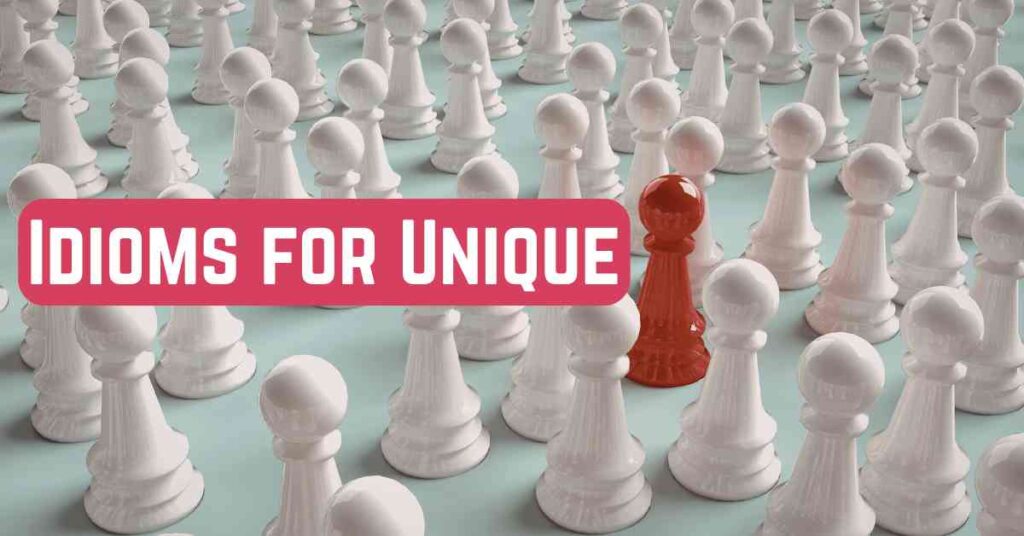

English is rich with idioms that add color and nuance to our language. When describing something or someone as “unique,” we often rely on standard adjectives. However, using idioms can elevate your language, making it more vivid and engaging. This article explores a variety of idioms that effectively convey the concept of uniqueness, helping you to express yourself with greater flair and precision. Whether you’re an ESL learner or a native speaker looking to enrich your vocabulary, understanding and using these idioms will significantly enhance your communication skills.
Table of Contents
- Introduction
- Definition of Uniqueness and Idioms
- Structural Breakdown of Idioms
- Types of Idioms for Uniqueness
- Examples of Idioms for Uniqueness
- Usage Rules for Idioms
- Common Mistakes When Using Idioms
- Practice Exercises
- Advanced Topics: Nuances and Context
- Frequently Asked Questions
- Conclusion
Introduction
The concept of “unique” is fundamental in communication, allowing us to distinguish individuals, objects, or ideas from the rest. While adjectives like ‘distinctive,’ ‘singular,’ and ‘uncommon’ serve this purpose, idioms provide a more colorful and often more impactful way to express uniqueness. Mastering these idioms not only enhances your vocabulary but also allows you to appreciate the cultural nuances embedded within the English language. This article will guide you through a comprehensive exploration of idioms for ‘unique,’ equipping you with the knowledge and practice to use them effectively.
Definition of Uniqueness and Idioms
Uniqueness refers to the state of being the only one of its kind; unlike anything else. It signifies something that is unparalleled, distinct, and without equal. In essence, it emphasizes individuality and originality.
An idiom is a phrase or expression whose meaning cannot be understood from the literal meanings of its individual words. Instead, it conveys a figurative or symbolic meaning that is culturally specific. Idioms add depth and color to language, allowing speakers to convey complex ideas in a concise and memorable way. They are a vital part of everyday language but require understanding of their intended meaning and appropriate context.
Structural Breakdown of Idioms
Idioms, unlike regular phrases, cannot be interpreted literally. Their structure often involves a combination of words that, when put together, create a meaning different from their individual definitions. Understanding the structural elements can help in recognizing and remembering idioms.
Many idioms follow common grammatical structures such as:
- Verb + Preposition: (e.g., stand out which means to be noticeable)
- Noun + Verb: (e.g., one of a kind which means unique)
- Adjective + Noun: (e.g., rare bird which means an unusual person)
- Complete Sentences: (e.g., cut from a different cloth which means having different qualities)
The key is that the overall meaning is not directly derived from the individual words but is instead a culturally understood expression. Learning to recognize these patterns can aid in comprehension and usage.
Types of Idioms for Uniqueness
Idioms that describe uniqueness can be categorized based on how they convey their meaning. Here are some common types:
Idioms with Literal Components
These idioms use words that have a direct connection to the idea of being unique, although the phrase as a whole has a figurative meaning. The literal components contribute to understanding the overall uniqueness being described.
Figurative Idioms
Figurative idioms use metaphors, similes, or other figures of speech to convey the idea of uniqueness. The connection to the concept is not direct but relies on an implied comparison or symbolic representation.
Comparative Idioms
These idioms highlight uniqueness by comparing something to something else, emphasizing the differences and highlighting the rare or unparalleled nature of the subject. These often use similes or metaphors to draw attention to the distinctive qualities.
Examples of Idioms for Uniqueness
The following tables provide a variety of idioms that describe uniqueness, categorized for clarity. Each idiom is presented with its meaning and example sentences to illustrate its proper usage.
Table 1: Common Idioms for Uniqueness
This table lists common idioms used to describe uniqueness, along with their meanings and example sentences to illustrate proper usage.
| Idiom | Meaning | Example Sentence |
|---|---|---|
| One of a kind | Unique; unlike anyone or anything else. | Her artistic style is truly one of a kind; I’ve never seen anything like it. |
| A rare bird | An unusual or exceptional person. | In the corporate world, a CEO who genuinely cares about their employees is a rare bird. |
| Cut from a different cloth | Having different qualities or characteristics than others. | He’s cut from a different cloth than most politicians; he’s honest and straightforward. |
| Stands out from the crowd | To be noticeably different or better than others. | Her innovative ideas always make her stand out from the crowd during brainstorming sessions. |
| In a league of one’s own | So superior or unique as to be in a separate category. | As a musician, she’s in a league of her own; nobody can match her talent. |
| A breed apart | Different from the rest; exceptional. | Philanthropists who dedicate their lives to helping others are a breed apart. |
| Like no other | Unique; unparalleled. | The feeling of holding your newborn child is like no other. |
| Marched to the beat of their own drum | To behave independently and unconventionally. | She’s always marched to the beat of her own drum, which is why she’s so successful. |
| A law unto themselves | Independent and disregarding rules or conventions. | Eccentric millionaires are often a law unto themselves, doing whatever they please. |
| Off the beaten path | Unconventional, away from the ordinary. | They chose to live off the beaten path, far from the city’s hustle and bustle. |
| Diamonds are forever | Something that is unique and will last forever | Their love is like diamonds are forever, it is a love that is so unique and special |
| Different strokes for different folks | People have different preferences and tastes. | I like to go to the beach, and you like to go to the mountains, different strokes for different folks. |
| One in a million | Extremely rare, special, or exceptional. | She’s one in a million; I’m so lucky to have her as a friend. |
| A class act | Someone who is elegant, dignified, and outstanding in their field. | The way she handled the crisis was a class act; she remained calm and professional. |
| Nonpareil | Having no match or equal; unequaled. | Her skill as a surgeon is nonpareil; she’s the best in the country. |
| Incomparable | Beyond comparison; matchless. | His talent as a painter is incomparable; his works are breathtaking. |
| Peerless | Without equal; unmatched. | Her dedication to her work is peerless; she always goes above and beyond. |
| Second to none | The best; unsurpassed. | Their customer service is second to none; they always take care of their clients. |
| Uncommon | Not often found, seen, or experienced. | Her leadership style is uncommon in the industry; she’s very collaborative. |
| Singular | Unique; extraordinary; remarkable. | The artist’s singular vision has made him famous worldwide. |
| Unexampled | Without precedent; unparalleled. | The company’s success this year is unexampled in its history. |
| Atypical | Not representative of a type, group, or class. | His behavior was atypical for someone in his position; he was very humble. |
| Original | Not derivative or imitative; new and inventive. | Her original approach to problem-solving impressed everyone on the team. |
| Unconventional | Not based on or conforming to what is generally done or believed. | His unconventional methods often lead to innovative solutions. |
| Eccentric | Unconventional and slightly strange. | Her eccentric fashion sense always makes her stand out. |
| Idiosyncratic | Peculiar or individual. | His idiosyncratic writing style is what makes his books so unique. |
| Out of the ordinary | Unusual; remarkable. | The concert was out of the ordinary; the band played exceptionally well. |
| Extraordinary | Very unusual or remarkable. | Her extraordinary talent for music was evident from a young age. |
| Remarkable | Worthy of attention; striking. | His remarkable achievements earned him a promotion. |
Table 2: Figurative Idioms for Uniqueness
This table showcases figurative idioms that use metaphors and similes to describe uniqueness, providing deeper insight into their connotative meanings.
| Idiom | Meaning | Example Sentence |
|---|---|---|
| A needle in a haystack | Something very difficult or impossible to find because it is hidden among many other things. | Finding a trustworthy mechanic in this town is like searching for a needle in a haystack. |
| One in a blue moon | Something that happens very rarely. | He only visits his family once in a blue moon, so everyone gets excited when he does. |
| A diamond in the rough | Someone or something with exceptional qualities but lacking refinement. | The young singer is a diamond in the rough; with some training, she could become a star. |
| A breath of fresh air | Someone or something that is new, different, and refreshing. | Her positive attitude was a breath of fresh air in the office. |
| A different kettle of fish | Something completely different from what was previously discussed. | Managing a small business is a different kettle of fish than managing a large corporation. |
| A rare find | Something valuable or exceptional that is difficult to come across. | An honest politician is a rare find these days. |
| The exception to the rule | Someone or something that does not conform to the general rule or pattern. | He’s the exception to the rule; most students struggle with math, but he excels. |
| A standout | Someone or something that is particularly noticeable or impressive. | Her performance in the play was a standout; she received rave reviews. |
| A maverick | An independent-minded person who does not conform to accepted norms. | He’s a maverick in the business world, always challenging conventional wisdom. |
| A trendsetter | Someone who starts new trends or styles. | She’s a trendsetter in the fashion industry, always ahead of the curve. |
| A pacesetter | Someone who sets the standard for others to follow. | The company is a pacesetter in the technology industry, constantly innovating. |
| A game changer | Something that significantly alters the current situation or way of doing things. | The new technology is a game changer for the healthcare industry. |
| A unicorn | A startup company valued at over $1 billion, typically in the technology sector. | The tech company quickly became a unicorn, attracting investors from around the world. |
| Like finding gold | Finding something very valuable or beneficial. | Finding a reliable babysitter is like finding gold. |
| A hidden gem | Something valuable or of high quality that is not widely known. | This small restaurant is a hidden gem; the food is amazing. |
| One in a zillion | Extremely rare and unlikely to occur. | Winning the lottery is one in a zillion. |
| A true original | Someone or something that is genuinely unique and authentic. | The artist is a true original; his work is unlike anything else. |
| A shining example | Someone or something that serves as an excellent model or example. | Her dedication to her community is a shining example for others to follow. |
| A rare gem | Someone or something that is exceptionally valuable and precious. | He’s a rare gem of a person; always kind and supportive. |
| A cut above the rest | Superior to others; outstanding. | Their customer service is a cut above the rest. |
| A star in the sky | Someone who is brilliant and stands out from others. | She is a star in the sky, she will go far in life. |
| A breath of life | Something that brings energy and vitality to a situation. | His leadership was a breath of life to the struggling company. |
| As unique as a snowflake | Each individual is unique and has their own characteristics | Every person is as unique as a snowflake, since no two are the same. |
| From another world | So exceptional or unusual as to seem otherworldly. | Her talent for singing is from another world. |
| A gift from the gods | An exceptional talent or blessing. | His artistic ability is a gift from the gods. |
| Carved in stone | Something that is permanent and unchangeable. | Their friendship is carved in stone; it will last forever. |
| A golden ticket | An opportunity that leads to great success or happiness. | Getting accepted into that university was her golden ticket. |
| A once-in-a-lifetime opportunity | An opportunity that is unlikely to occur again. | This trip to Europe is a once-in-a-lifetime opportunity. |
Table 3: Comparative Idioms for Uniqueness
This table focuses on idioms that use comparisons to highlight uniqueness, emphasizing the differences and unparalleled nature of the subject.
| Idiom | Meaning | Example Sentence |
|---|---|---|
| Like comparing apples and oranges | Comparing two things that are fundamentally different and cannot be compared. | Trying to compare their achievements is like comparing apples and oranges; they work in different fields. |
| Head and shoulders above the rest | Significantly better than others. | In terms of skill, she’s head and shoulders above the rest of the team. |
| A league above | In a significantly superior category. | Their customer service is a league above their competitors. |
| Not cut from the same mold | Different in character or qualities. | He’s not cut from the same mold as his predecessors; he’s much more innovative. |
| Doesn’t fit the mold | Does not conform to the expected pattern or stereotype. | She doesn’t fit the mold of a typical CEO; she’s very approachable and down-to-earth. |
| A world apart | Completely different or separate. | Their lifestyles are a world apart; she lives in the city, and he lives in the country. |
| As different as night and day | Completely different. | Their personalities are as different as night and day; she’s outgoing, and he’s reserved. |
| Like chalk and cheese | Completely different; incompatible. | They’re like chalk and cheese; I don’t know how they’re friends. |
| A whole new ballgame | A completely different situation or set of circumstances. | Starting a new business is a whole new ballgame compared to working for someone else. |
| In a class by itself | Unique and superior in quality. | The hotel is in a class by itself; the service is impeccable. |
| A different animal | Something completely different. | Running a marathon is a different animal than running a 5K. |
| Like two peas in a pod | Very similar, especially in appearance or personality. (Opposite of unique, but included for contrast) | They are like two peas in a pod, they do everything together. |
| As alike as two drops of water | Extremely similar. (Opposite of unique, but included for contrast) | The twins are as alike as two drops of water. |
| One of a kind | Unique and unparalleled (as previously mentioned, but fits here for comparison). | Her voice is one of a kind, nobody can compare. |
| A cut above | Superior to others. | The quality of their products is a cut above the other brands. |
| Stands alone | Unique and without equal. | His accomplishments stand alone, no one can compare. |
| Marches to a different tune | Behaves or thinks differently from others. | He marches to a different tune, he doesn’t care what others think. |
| Not the same as | Different or distinct from something else. | This car is not the same as the other one, it has better features. |
| Like no other | Unique and unparalleled. | The experience was like no other, I will never forget it. |
| An original creation | An original and unique piece of art. | The artist had an original creation, it was so unique. |
| A world of difference | A significant difference between two things. | There is a world of difference between their skill sets. |
| Like a fish out of water | Feeling uncomfortable or out of place. (Opposite of unique, but included for contrast) | He felt like a fish out of water at the fancy party. |
| A whole different story | A completely different situation or set of circumstances. | That’s a whole different story; not what we are talking about. |
| A step above | Slightly better or more advanced than something else. | This hotel is a step above the rest, it has so many ammenities. |
| Unique in its own right | Distinct and special in its own way. | The town is unique in its own right, it has a charm. |
| A distinct character | A unique and noticeable personality or quality. | The city has a distinct character, it is unlike any other. |
| In its own category | Belonging to a unique and separate group. | She is in her own category, she is the best. |
| A different league | Significantly better or more advanced than others. | The team is in a different league, they are so talented. |
Usage Rules for Idioms
Using idioms correctly requires understanding their specific meanings and contexts. Here are some key rules to follow:
- Context is Key: Ensure the idiom fits the situation you are describing. Using an idiom out of context can lead to confusion or misinterpretation.
- Audience Awareness: Consider your audience. Some idioms are more formal or informal than others. Choose idioms that are appropriate for your audience’s level of English proficiency and cultural background.
- Avoid Overuse: While idioms can add color to your language, using too many can make your speech sound unnatural or forced.
- Understand Variations: Some idioms have slight variations. Be aware of these and use the most common and accepted form.
- Literal vs. Figurative: Always remember that idioms should not be taken literally. Focus on the intended figurative meaning.
Common Mistakes When Using Idioms
Here are some common mistakes to avoid when using idioms:
- Literal Interpretation: Interpreting an idiom literally instead of understanding its figurative meaning.
- Incorrect Word Choice: Using the wrong words within an idiom, altering its meaning or making it nonsensical.
- Overusing Idioms: Cluttering your speech or writing with too many idioms, making it sound unnatural.
- Misunderstanding Context: Using an idiom in an inappropriate context, leading to confusion.
- Ignoring Audience: Using idioms that are too advanced or culturally specific for your audience to understand.
Table 4: Correct vs. Incorrect Usage
This table highlights common mistakes made when using idioms and provides the correct alternatives for clarity.
| Incorrect Usage | Correct Usage | Explanation |
|---|---|---|
| “He is one of a kind of person.” | “He is one of a kind.” | The phrase “one of a kind” doesn’t need “of person” after it; it’s already implied. |
| “She stands out from the people.” | “She stands out from the crowd.” | The correct idiom is “stands out from the crowd,” not “people.” |
| “He is cut from a different material.” | “He is cut from a different cloth.” | The idiom is “cut from a different cloth,” not “material.” |
| “They are like two apples and oranges.” | “They are like comparing apples and oranges.” | The correct idiom is “like comparing apples and oranges,” referring to the act of comparison. |
| “She is head and shoulders above all.” | “She is head and shoulders above the rest.” | The idiom is “head and shoulders above the rest,” not “all.” |
| “He runs to the beat of his own drum.” | “He marches to the beat of his own drum.” | The correct idiom is “marches to the beat of his own drum,” not “runs.” |
| “It happens once in a green moon.” | “It happens once in a blue moon.” | The correct idiom is “once in a blue moon,” not “green moon.” |
| “She is a diamond in the coal.” | “She is a diamond in the rough.” | The correct idiom is “diamond in the rough,” not “coal.” |
| “That’s a different bucket of fish.” | “That’s a different kettle of fish.” | The correct idiom is “kettle of fish,” not “bucket.” |
| “He is a rare finded person.” | “He is a rare find.” | The correct idiom is “rare find,” not “rare finded person.” |
Practice Exercises
Test your understanding of idioms for uniqueness with these exercises. Choose the correct idiom to complete each sentence.
Exercise 1: Fill in the Blanks
Complete each sentence with the correct idiom from the list provided.
Idiom List: one of a kind, stands out from the crowd, a rare bird, cut from a different cloth, in a league of his own
| Question | Answer |
|---|---|
| 1. Her innovative designs always make her __________. | stands out from the crowd |
| 2. He’s __________, always willing to help others without expecting anything in return. | a rare bird |
| 3. His talent as a musician puts him __________. | in a league of his own |
| 4. This handmade jewelry is truly __________. | one of a kind |
| 5. She’s __________ than most politicians; she’s honest and straightforward. | cut from a different cloth |
| 6. The experience was __________; it could not be compared. | one of a kind |
| 7. She __________ at work because she is very talented. | stands out from the crowd |
| 8. He is __________ he is always willing to help others. | a rare bird |
| 9. The CEO is __________ because he is well known. | in a league of his own |
| 10. The painting I did is __________; it cannot be recreated. | cut from a different cloth |
Exercise 2: Multiple Choice
Choose the idiom that best fits the meaning of the sentence.
| Question | Options | Answer |
|---|---|---|
| 1. Finding a reliable mechanic in this town is like… | a) finding gold b) a needle in a haystack c) a walk in the park | b) a needle in a haystack |
| 2. He only visits his family __________, so everyone gets excited when he does. | a) every day b) once in a blue moon c) frequently | b) once in a blue moon |
| 3. The young singer is __________, with some training, she could become a star. | a) a diamond in the rough b) a fish out of water c) a couch potato | a) a diamond in the rough |
| 4. Her positive attitude was __________ in the office. | a) a ray of sunshine b) a breath of fresh air c) a dark cloud | b) a breath of fresh air |
| 5. Managing a small business is __________ than managing a large corporation. | a) the same thing b) a different kettle of fish c) a piece of cake | b) a different kettle of fish |
| 6. It is like looking for __________ to find a trustworthy person there. | a) a needle in a haystack b) gold c) a penny | a) a needle in a haystack |
| 7. She goes to the beach __________ because she is busy. | a) once in a blue moon b) everyday c) weekly | a) once in a blue moon |
| 8. He is __________; he is not perfect but with some training, he will be. | a) a couch potato b) a diamond in the rough c) a fish out of water | b) a diamond in the rough |
| 9. She is __________; she is very positive at work. | a) a dark cloud b) a breath of fresh air c) a walk in the park | b) a breath of fresh air |
| 10. Running a business versus working for someone else is __________. | a) the same thing b) a different kettle of fish c) a piece of cake | b) a different kettle of fish |
Advanced Topics: Nuances and Context
For advanced learners, understanding the subtle nuances and contextual appropriateness of idioms is crucial. Consider these points:
- Cultural Sensitivity: Some idioms may have different connotations or be offensive in certain cultures. Be mindful of your audience and the potential for misinterpretation.
- Historical Context: Many idioms have historical roots. Understanding their origins can provide deeper insight into their meanings and usage.
- Formal vs. Informal: Some idioms are more appropriate for formal settings, while others are better suited for informal conversations. Choose idioms that match the tone of the situation.
- Regional Variations: English idioms can vary by region (e.g., British English vs. American English). Be aware of these differences and use idioms that are commonly understood in your target region.
Frequently Asked Questions
Here are some frequently asked questions about using idioms for uniqueness:
- What is the difference between an idiom and a regular phrase?
An idiom is a phrase whose meaning cannot be understood from the literal meanings of its individual words. A regular phrase means exactly what the words suggest when taken individually. - How can I learn more idioms?
Read widely, listen to native speakers, and use idiom dictionaries or online resources. Pay attention to how idioms are used in context. - Is it okay to use idioms in formal writing?
It depends on the specific idiom and the tone of your writing. Some idioms are too informal for formal contexts. Choose idioms that are appropriate for your audience and purpose. - What should I do if I don’t understand an idiom?
Look it up in an idiom dictionary or ask a native speaker for clarification. Understanding the context in which the idiom is used can also help. - Why is it important to learn idioms?
Idioms add color and nuance to your language, making it more engaging and expressive. They also help you understand native speakers and cultural references. - Are there any idioms that should be avoided?
Yes, some idioms are outdated, offensive, or culturally insensitive. Be mindful of your audience and the potential for misinterpretation. - How can I practice using idioms?
Use idioms in your everyday conversations and writing. Try to incorporate a few new idioms each week. Get feedback from native speakers. - Is it better to use simple language instead of idioms to avoid mistakes?
While simplicity can be effective, learning idioms enriches your understanding and expressive capabilities. Start with common idioms and gradually expand your vocabulary. - How to know if I am using an idiom correctly?
Read the sentence out loud and think about the context. Does it sound natural? If possible, ask a native speaker if you are unsure. - What are some resources to learn more about idioms?
Many online dictionaries and language learning websites provide explanations and examples of idioms. Consider using resources like the Oxford Idioms Dictionary or Merriam-Webster’s online dictionary.
Conclusion
Mastering idioms for uniqueness can significantly enhance your ability to express yourself effectively and engagingly in English. By understanding the definition, structural elements, and usage rules of these idioms, you can add depth and color to your language. Remember to consider the context, audience, and potential for misinterpretation when using idioms. With practice and awareness, you can confidently incorporate these expressions into your communication, making it more vivid and nuanced.