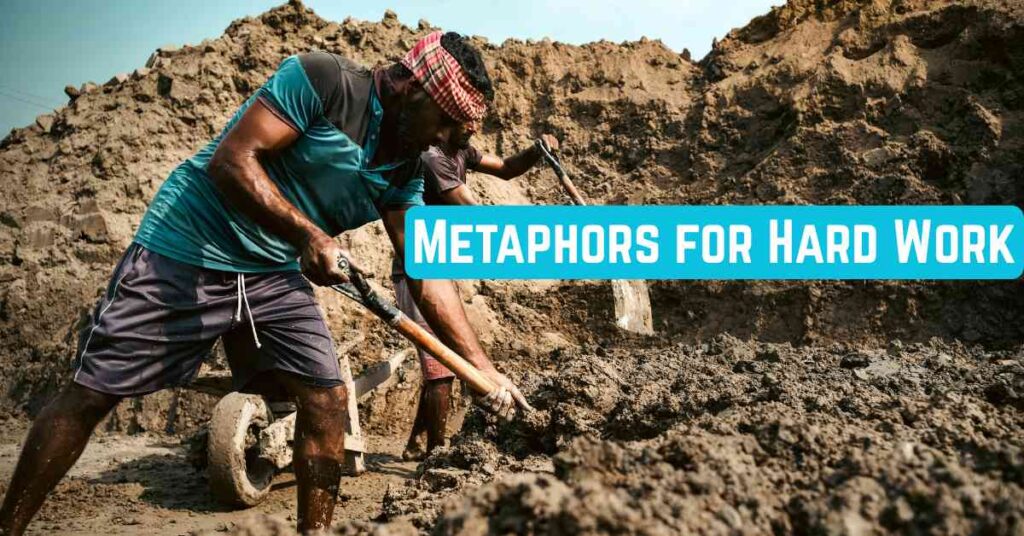

Understanding metaphors is crucial for mastering English, as they add depth and color to the language. This article focuses on metaphors used to describe hard work, exploring their grammatical structures, meanings, and proper usage. Learning these metaphors will enhance your comprehension and ability to express yourself vividly. This guide is suitable for English language learners of all levels, from beginners to advanced speakers, and anyone looking to improve their understanding of figurative language.
Table of Contents
- Introduction
- Definition of Metaphor
- Structural Breakdown
- Types of Metaphors for Hard Work
- Examples of Metaphors for Hard Work
- Usage Rules
- Common Mistakes
- Practice Exercises
- Advanced Topics
- FAQ
- Conclusion
Definition of Metaphor
A metaphor is a figure of speech that directly compares two unrelated things, asserting that one thing is another. It does so for rhetorical effect, without using “like” or “as” (which would make it a simile). Metaphors enhance understanding and create vivid imagery. They are essential for conveying complex ideas in a relatable way.
In the context of hard work, metaphors help us understand the intensity, challenges, and rewards associated with dedicated effort. They transform abstract concepts into tangible images, making them more accessible and memorable.
Classification of Metaphors
Metaphors can be broadly classified into:
- Standard Metaphors: Common and easily understood (e.g., “time is money”).
- Novel Metaphors: Original and striking, creating a fresh perspective (e.g., “his mind was a beehive of ideas”).
- Dead Metaphors: Overused to the point of losing their figurative sense (e.g., “the heart of the matter”).
- Mixed Metaphors: Combining two or more inconsistent metaphors (often unintentionally humorous and should be avoided).
Function of Metaphors
Metaphors serve several crucial functions:
- Clarification: Simplifying complex ideas by relating them to something familiar.
- Emphasis: Highlighting certain qualities or aspects.
- Emotional Impact: Evoking feelings and creating a stronger connection with the audience.
- Engagement: Making language more interesting and memorable.
Contexts of Metaphor Use
Metaphors are used in various contexts:
- Literature: Enhancing imagery and thematic depth in novels, poems, and plays.
- Speech: Making everyday conversations more engaging.
- Business: Communicating complex strategies and inspiring teams.
- Journalism: Capturing attention and conveying information effectively.
Structural Breakdown
A metaphor typically consists of two main elements:
- Tenor (Topic): The subject being described (e.g., hard work).
- Vehicle: The thing used to describe the subject (e.g., a marathon).
The relationship between the tenor and vehicle creates the metaphorical meaning. Understanding this relationship is key to interpreting and using metaphors effectively.
For example, in the metaphor “Hard work is a marathon,” “hard work” is the tenor, and “marathon” is the vehicle. The metaphor suggests that hard work, like a marathon, requires endurance, perseverance, and a long-term commitment.
Types of Metaphors for Hard Work
Metaphors for hard work can be categorized based on the aspects of hard work they emphasize.
Effort-Based Metaphors
These metaphors focus on the sheer exertion and energy expended in hard work.
Persistence-Based Metaphors
These emphasize the continuous and unwavering dedication required for hard work.
Challenge-Based Metaphors
These highlight the obstacles and difficulties that hard work entails.
Reward-Based Metaphors
These focus on the positive outcomes and achievements resulting from hard work.
Examples of Metaphors for Hard Work
The following tables provide examples of metaphors for hard work, categorized by the aspect they emphasize. Each example is accompanied by an explanation of its meaning.
Effort-Based Metaphors Examples
This table illustrates metaphors that emphasize the intense effort and energy involved in hard work. Each example conveys the idea of significant exertion.
| Metaphor | Explanation |
|---|---|
| “He poured his heart and soul into the project.” | Implies that he invested all his emotional and physical energy. |
| “She burned the midnight oil to finish the report.” | Suggests working late into the night, expending significant effort. |
| “They sweated blood to meet the deadline.” | Indicates extreme effort and sacrifice to achieve a goal. |
| “He moved mountains to get the deal done.” | Describes overcoming seemingly insurmountable obstacles. |
| “She left no stone unturned in her research.” | Implies thorough and exhaustive effort. |
| “He climbed the ladder of success.” | Suggests a gradual but strenuous ascent to achievement. |
| “She carried the weight of the world on her shoulders.” | Indicates a heavy burden of responsibility and effort. |
| “He wrestled with the problem until he found a solution.” | Implies a difficult and intense struggle. |
| “She dug deep to find the strength to continue.” | Suggests tapping into hidden reserves of energy and determination. |
| “He went the extra mile to ensure success.” | Indicates exceeding expectations and putting in additional effort. |
| “She rolled up her sleeves and got to work.” | Implies a readiness to engage in physical or mental labor. |
| “He put his nose to the grindstone.” | Suggests diligent and continuous effort. |
| “She hammered away at the problem.” | Indicates persistent and forceful effort. |
| “He toiled day and night.” | Describes relentless and continuous work. |
| “She pushed herself to the limit.” | Implies exerting maximum effort. |
| “He gave it his all.” | Suggests complete and total effort. |
| “She strained every nerve to succeed.” | Indicates intense mental and physical exertion. |
| “He poured his energy into the task.” | Implies a significant investment of effort. |
| “She invested heavily in the project.” | Suggests a large commitment of time and effort. |
| “He exerted himself fully.” | Indicates complete and total exertion. |
| “She strained her back lifting the heavy boxes” | Implies heavy physical labor and strain. |
| “He was working like a dog” | Implies relentless and exhausting work. |
| “She worked until she dropped” | Suggests working to the point of exhaustion. |
| “He gave 110 percent to the effort” | Indicates exceeding normal expectations of effort. |
| “She gave every ounce of her being” | Implies total commitment and effort. |
Persistence-Based Metaphors Examples
This table highlights metaphors that emphasize the continuous and unwavering dedication required for hard work. These examples stress the importance of perseverance.
| Metaphor | Explanation |
|---|---|
| “He kept his eye on the ball.” | Suggests maintaining focus and dedication. |
| “She stayed the course despite the challenges.” | Indicates unwavering commitment to a goal. |
| “He never gave up, even when things got tough.” | Emphasizes resilience and perseverance. |
| “She pressed on, undeterred by setbacks.” | Implies continued effort despite obstacles. |
| “He remained steadfast in his commitment.” | Suggests unwavering dedication. |
| “She weathered the storm and emerged stronger.” | Indicates overcoming challenges through perseverance. |
| “He hung in there until the very end.” | Emphasizes persistence in the face of adversity. |
| “She stood her ground despite the opposition.” | Suggests unwavering determination. |
| “He persevered through thick and thin.” | Indicates continued effort regardless of circumstances. |
| “She remained committed to her vision.” | Emphasizes unwavering dedication to a goal. |
| “He slogged through the difficult parts of the project.” | Suggests persevering despite the difficulty of the work. |
| “She chipped away at the problem until it was solved.” | Implies slow but steady progress. |
| “He was in it for the long haul.” | Suggests a sustained commitment. |
| “She wasn’t one to back down from a challenge.” | Implies a determination to persevere. |
| “He dug in his heels and refused to quit.” | Suggests a stubborn determination to continue. |
| “She kept plugging away until she succeeded.” | Implies persistent and consistent effort. |
| “He stuck to his guns despite the criticism.” | Suggests unwavering commitment to a belief or plan. |
| “She kept her nose to the grindstone.” | Implies diligent and continuous effort. |
| “He didn’t let anything stand in his way.” | Suggests a strong determination to overcome obstacles. |
| “She kept her eye on the prize.” | Implies maintaining focus on the goal. |
| “He plodded along until the job was done.” | Suggests slow, persistent effort. |
| “She refused to throw in the towel.” | Implies a determination not to give up. |
| “He stuck with it through thick and thin.” | Suggests loyalty and persistence in all circumstances. |
| “She stayed the course, no matter what.” | Implies unwavering commitment. |
| “He was determined to see it through.” | Suggests a strong resolve to complete a task. |
Challenge-Based Metaphors Examples
This table includes metaphors that highlight the obstacles and difficulties inherent in hard work. These examples emphasize the demanding nature of the task.
| Metaphor | Explanation |
|---|---|
| “It was an uphill battle from the start.” | Suggests a constant struggle against adversity. |
| “She faced a mountain of challenges.” | Indicates numerous and significant obstacles. |
| “He navigated a minefield of potential problems.” | Implies dealing with numerous hidden dangers. |
| “She swam against the tide to achieve her goals.” | Suggests overcoming strong opposition. |
| “He walked through fire to get the job done.” | Indicates enduring extreme hardship. |
| “She climbed the walls with frustration.” | Implies feeling trapped and overwhelmed. |
| “He wrestled with his conscience over the decision.” | Suggests a difficult internal struggle. |
| “She fought tooth and nail for her beliefs.” | Indicates a fierce and determined struggle. |
| “He battled his demons to overcome his addiction.” | Suggests a personal and intense struggle. |
| “She weathered the storm of criticism.” | Implies enduring harsh and negative feedback. |
| “He was caught between a rock and a hard place.” | Suggests being in a difficult situation with no easy solution. |
| “She was up against a brick wall.” | Implies facing an insurmountable obstacle. |
| “He was in the trenches.” | Suggests being in the midst of a difficult and demanding situation. |
| “She was walking a tightrope.” | Implies being in a precarious situation where any mistake could be disastrous. |
| “He was skating on thin ice.” | Suggests being in a risky situation where any misstep could lead to trouble. |
| “She was navigating a maze of bureaucracy.” | Implies dealing with a complex and confusing system. |
| “He was facing an uphill climb.” | Suggests a difficult and challenging task. |
| “She was in the hot seat.” | Implies being under pressure and scrutiny. |
| “He was in the eye of the storm.” | Suggests being at the center of a chaotic and challenging situation. |
| “She was walking on eggshells.” | Implies being in a delicate situation where one must be very careful. |
| “He was swimming upstream.” | Suggests facing opposition and difficulty. |
| “She was fighting a losing battle.” | Implies a struggle that is likely to end in defeat. |
| “He was pushing a boulder up a hill.” | Suggests a difficult and seemingly endless task. |
| “She was treading water.” | Implies struggling to stay afloat in a difficult situation. |
| “He was dancing with the devil.” | Suggests taking a dangerous risk. |
Reward-Based Metaphors Examples
This table presents metaphors that focus on the positive outcomes and achievements resulting from hard work. These examples highlight the benefits of dedication.
| Metaphor | Explanation |
|---|---|
| “He reaped the rewards of his hard work.” | Suggests receiving benefits as a result of effort. |
| “She tasted the sweet success of her efforts.” | Indicates experiencing the satisfaction of achievement. |
| “He struck gold with his innovative idea.” | Implies achieving a valuable and profitable outcome. |
| “She climbed to the top of the mountain.” | Suggests reaching the pinnacle of success. |
| “He reached the light at the end of the tunnel.” | Indicates overcoming difficulties and achieving a positive outcome. |
| “She basked in the glow of her accomplishments.” | Implies enjoying the recognition and satisfaction of success. |
| “He savored the fruits of his labor.” | Suggests enjoying the benefits of hard work. |
| “She found her pot of gold at the end of the rainbow.” | Implies achieving a long-sought-after goal. |
| “He harvested a bumper crop of achievements.” | Indicates a large and successful outcome. |
| “She turned her dreams into reality.” | Suggests achieving ambitious goals through hard work. |
| “He cashed in on his efforts” | Suggests receiving financial benefit from his hard work. |
| “She had a field day with the results” | Implies enjoying great success. |
| “He made a killing in the market” | Suggests making a large sum of money through investments. |
| “She hit the jackpot” | Implies achieving a sudden and unexpected success. |
| “He struck it rich” | Suggests becoming wealthy through hard work or good fortune. |
| “She came up smelling like roses” | Implies emerging from a difficult situation with a good reputation. |
| “He landed on his feet” | Suggests recovering from a setback and achieving success. |
| “She turned the corner” | Implies overcoming a difficult situation and moving towards success. |
| “He won the grand prize” | Suggests achieving the ultimate reward. |
| “She reached the promised land” | Implies achieving a long-awaited goal. |
| “He hit paydirt” | Suggests discovering something valuable. |
| “She reached the summit” | Implies reaching the highest point of achievement. |
| “He finally arrived” | Suggests achieving a long-term goal after much effort. |
| “She made her mark” | Implies achieving recognition and leaving a lasting impact. |
| “He left his footprint on the world” | Suggests making a significant and lasting contribution. |
Usage Rules
Using metaphors effectively requires understanding their nuances and adhering to certain guidelines.
- Clarity: Ensure the metaphor is easily understood by the audience. Avoid obscure or overly complex comparisons.
- Appropriateness: Choose metaphors that are relevant to the context and audience.
- Consistency: Avoid mixing metaphors that create conflicting images.
- Originality: Strive for fresh and creative metaphors that add impact.
- Moderation: Use metaphors sparingly to avoid overwhelming the audience.
Example of Correct Usage: “Her dedication was a lighthouse, guiding the team through the storm.” (Clear, appropriate, and consistent)
Example of Incorrect Usage: “He was a fish out of water, but he also had his ducks in a row.” (Mixed metaphor, inconsistent images)
Common Mistakes
Learners often make mistakes when using metaphors. Recognizing and avoiding these errors is crucial for effective communication.
| Mistake | Incorrect Example | Correct Example |
|---|---|---|
| Mixed Metaphor | “Let’s nip it in the bud before it snowballs.” | “Let’s nip it in the bud before it becomes a problem.” |
| Cliché | “He worked like a dog.” | “He worked tirelessly to meet the deadline.” |
| Inappropriate Metaphor | “The company’s profits were a volcano.” (When profits were slightly up) | “The company’s profits saw a significant increase.” |
| Overuse of Metaphors | “The project was a rollercoaster, a whirlwind of activity, a symphony of chaos.” | “The project was intense and demanding.” |
Practice Exercises
Test your understanding of metaphors for hard work with these exercises.
Exercise 1: Identify the Metaphor
Identify the metaphor in each sentence and explain its meaning.
| Question | Answer |
|---|---|
| 1. She is a workhorse in the office. | Metaphor: Workhorse. Meaning: She is a tireless and productive worker. |
| 2. He burned bridges to get ahead. | Metaphor: Burned bridges. Meaning: He damaged relationships to advance. |
| 3. The project was a marathon, not a sprint. | Metaphor: Marathon. Meaning: The project required endurance and long-term effort. |
| 4. She climbed the corporate ladder with determination. | Metaphor: Corporate ladder. Meaning: She advanced in her career through hard work. |
| 5. He was drowning in paperwork. | Metaphor: Drowning. Meaning: He was overwhelmed with tasks. |
| 6. She hit a wall during the project. | Metaphor: Hit a wall. Meaning: She encountered a significant obstacle. |
| 7. He was a machine when it came to productivity. | Metaphor: Machine. Meaning: He was extremely efficient and productive. |
| 8. She was a dynamo of energy. | Metaphor: Dynamo. Meaning: She was full of energy and enthusiasm. |
| 9. He moved heaven and earth to get the deal done. | Metaphor: Moved heaven and earth. Meaning: He made extraordinary efforts. |
| 10. She sailed through the project with ease. | Metaphor: Sailed through. Meaning: She completed the project effortlessly. |
Exercise 2: Complete the Metaphor
Complete the following sentences with an appropriate metaphor for hard work.
| Question | Answer |
|---|---|
| 1. He ________ to finish the project on time. | Answer: He burned the midnight oil to finish the project on time. |
| 2. She ________ to overcome the challenges. | Answer: She moved mountains to overcome the challenges. |
| 3. The task was ________, requiring immense effort. | Answer: The task was an uphill battle, requiring immense effort. |
| 4. He ________ to achieve his goals. | Answer: He poured his heart and soul to achieve his goals. |
| 5. She ________ to reach the top. | Answer: She climbed the ladder of success to reach the top. |
| 6. He ________ until he found a solution. | Answer: He wrestled with the problem until he found a solution. |
| 7. She ________ to find the strength to continue. | Answer: She dug deep to find the strength to continue. |
| 8. He ________ to ensure success. | Answer: He went the extra mile to ensure success. |
| 9. She ________ and got to work. | Answer: She rolled up her sleeves and got to work. |
| 10. He ________ to meet the deadline. | Answer: He sweated blood to meet the deadline. |
Exercise 3: Correct the Mixed Metaphor
Rewrite the following sentences to correct the mixed metaphors.
| Question | Answer |
|---|---|
| 1. He was skating on thin ice, but he also had all his ducks in a row. | Answer: He was skating on thin ice, and needed to be careful. |
| 2. She was a shining star, but she also hit a brick wall. | Answer: She was a shining star until she hit a significant obstacle. |
| 3. He was burning the candle at both ends, but he also kept his eye on the ball. | Answer: He was working excessively hard to stay focused. |
| 4. She was juggling many balls while also climbing the corporate ladder. | Answer: She was managing many responsibilities while advancing her career. |
| 5. He had to weather the storm while also keeping his head above water. | Answer: He had to weather the storm to survive the crisis. |
| 6. She was swimming against the tide while also keeping her eye on the prize. | Answer: She was swimming against the tide, determined to reach her goal. |
| 7. He was in the trenches, but he also wanted to nip it in the bud. | Answer: He was in the trenches, dealing with difficult challenges. |
| 8. She was walking a tightrope while also having all the answers. | Answer: She was walking a tightrope, needing to be careful despite her knowledge. |
| 9. He poured his heart and soul into the project, but he was also skating on thin ice. | Answer: He poured his heart and soul into the project, despite the risks involved. |
| 10. She was a workhorse, but she also wanted to think outside the box. | Answer: She was a workhorse, but she also wanted to be innovative. |
Advanced Topics
For advanced learners, exploring the nuances of metaphor usage can further enhance their understanding and skills.
- Extended Metaphors: Developing a single metaphor throughout a piece of writing.
- Submerged Metaphors: Subtle metaphors that are not explicitly stated.
- Cognitive Metaphors: Metaphors that reflect fundamental ways of thinking.
- Cultural Metaphors: Metaphors that are specific to certain cultures.
Understanding these advanced topics allows for more sophisticated and nuanced use of metaphors in both writing and speech.
FAQ
Here are some frequently asked questions about metaphors for hard work.
- What is the difference between a metaphor and a simile?
A metaphor directly equates two things (e.g., “Hard work is a marathon”), while a simile uses “like” or “as” to make a comparison (e.g., “Hard work is like a marathon”).
- Why are metaphors important in language?
Metaphors enhance understanding, add emotional impact, and make language more engaging and memorable. They allow for creative and vivid expression.
- How can I avoid using mixed metaphors?
Pay attention to the images you are creating and ensure they are consistent. Avoid combining metaphors that create conflicting or nonsensical pictures.
- What are some common metaphors for success?
Common metaphors for success include “climbing the ladder,” “reaching the top,” and “reaping the rewards.”
- How can I improve my use of metaphors?
Read widely, pay attention to how metaphors are used in different contexts, and practice using them in your own writing and speech. Also, seek feedback on your usage.
- Are metaphors culturally specific?
Yes, some metaphors are specific to certain cultures and may not be understood universally. Be mindful of your audience when using metaphors.
- What is a dead metaphor?
A dead metaphor is a metaphor that has been overused to the point of losing its figurative meaning. It is often used unconsciously and no longer evokes a vivid image (e.g., “the heart of the matter”).
- How do metaphors enhance communication in a business setting?
Metaphors can simplify complex strategies, inspire teams, and create a shared understanding of goals. They can also make presentations and reports more engaging.
Conclusion
Metaphors for hard work are powerful tools for expressing the intensity, challenges, and rewards associated with dedicated effort. By understanding their structure, types, and usage rules, you can effectively incorporate them into your communication. Avoiding common mistakes and practicing regularly will further enhance your ability to use metaphors creatively and precisely. Master these metaphors, and you’ll find your English both more expressive and more impactful.