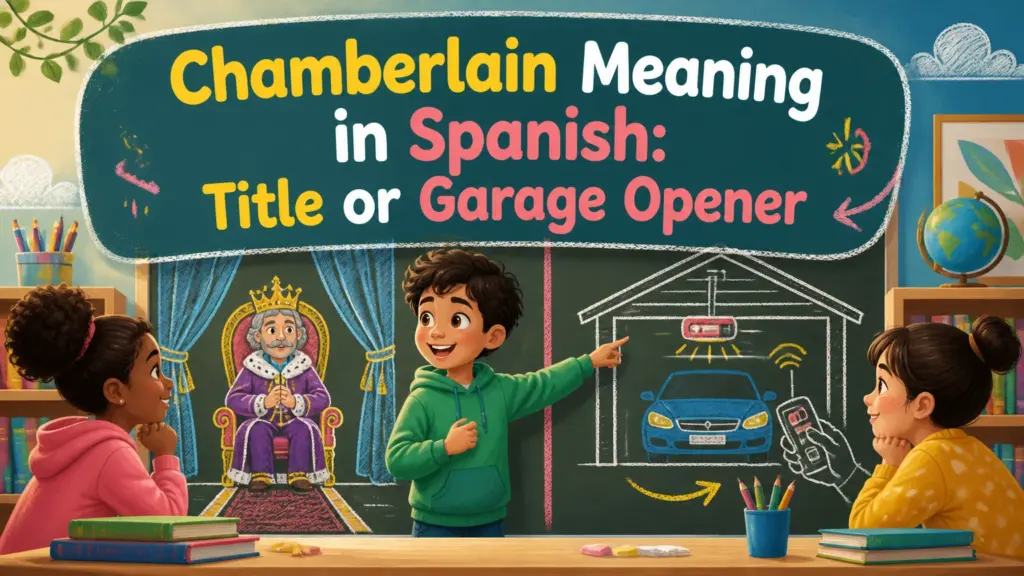

“Chamberlain” in Spanish usually remains Chamberlain when it names the garage-door brand, while the historical title translates as chambelán. In older royal or aristocratic contexts, camarero mayor may be more precise. The correct meaning therefore depends on whether the word appears in a biography, palace history, product label, or garage-door discussion.
Key Facts at a Glance
- Chambelán is the standard Spanish translation for the historical English title “chamberlain.”
- Camarero mayor is a court-historical equivalent, not a universal synonym in modern Spanish.
- Chamberlain is normally unchanged when it is a brand name, surname, or place name.
- Spanish-speaking technicians may call a Chamberlain unit an abridor de puerta de garaje, motor para puerta de garaje, or automatizador.
- Typical US retail prices range from approximately $150-$550, before installation and regional taxes.
- Safety sensors sit near the floor and should reverse or prevent closure when their invisible beam is interrupted.
What Does Chamberlain Mean in Spanish?
The Spanish meaning of Chamberlain has two main branches: chambelán, the historical office, and Chamberlain, the unchanged proper name used for a company, surname, or product brand. Context determines the translation, so a dictionary-only answer can mislead someone researching either court history or garage equipment.
The English title came from the idea of a person responsible for a ruler’s private chamber or household administration. In Spanish historical writing, chambelán is the closest direct equivalent. Court terminology can differ by country and century, however, and camarero mayor may describe a comparable senior household official.
The garage-door company is different. A product label such as “Chamberlain belt-drive opener” should not become chambelán de correa. Spanish copy normally preserves Chamberlain and translates the product category around it, producing phrases such as abridor de puerta de garaje Chamberlain.
Is Chamberlain a Spanish Word?
Chamberlain is not ordinarily a Spanish common noun. Spanish uses chambelán for the historical title, while Chamberlain remains unchanged as a commercial name or surname. The pronunciation also tends to follow the English name when referring to the company.
Examples make the distinction clear:
- El chambelán recibió a los embajadores.
“The chamberlain received the ambassadors.” - Compré un abridor Chamberlain para la puerta del garaje.
“I bought a Chamberlain opener for the garage door.” - William Chamberlain escribió el informe.
Here, Chamberlain is a surname and is not translated.
What Did a Chamberlain Do?
A historical chamberlain managed access to a ruler’s private household and often supervised servants, ceremonial arrangements, finances, or official audiences. The exact authority varied substantially between the English monarchy, European courts, and later institutional uses.
In Spanish, chambelán generally describes a high-ranking court official associated with a monarch or noble household. Some translations use camarero mayor when the source refers specifically to the senior officer responsible for the royal chambers.
The terms are related but not interchangeable in every sentence. Chambelán preserves the title’s direct historical meaning; camarero mayor emphasizes the office’s household function. A translator should inspect the surrounding institution, date, and rank before choosing between them.
What Does Chamberlain Mean in Garage-Door Spanish?
In garage-door Spanish, Chamberlain identifies the manufacturer or brand, not a translated mechanical component. The most useful category terms are abridor de puerta de garaje, motor para puerta de garaje, automatizador de garaje, and, in parts of Latin America, motor para portón residencial.
Regional vocabulary affects search results and technician communication. Spain commonly uses puerta de garaje and automatismo; Mexico frequently uses abridor de cochera or motor para puerta de garaje; Argentina may use portón automático; Colombia and other Latin American markets often use motor para portón.
| English term | Spanish term | Typical regional use | Meaning |
|---|---|---|---|
| Garage door opener | Abridor de puerta de garaje | General, Mexico, US Spanish | Complete automatic opening system |
| Garage door motor | Motor para puerta de garaje | Mexico and Latin America | Motor unit, sometimes the complete opener |
| Garage automation | Automatizador de garaje | Spain and technical writing | Automatic control system |
| Automatic gate motor | Motor para portón automático | Latin America | Usually a gate operator, not an overhead garage opener |
| Wall control | Pulsador de pared | General technical Spanish | Fixed interior control |
| Safety sensor | Fotocelda, sensor de seguridad | Latin America and Spain | Beam-based obstruction sensor |
Using the wrong category can produce the wrong equipment. A motor para portón corredizo is designed for a sliding gate, while a Chamberlain overhead opener normally operates a sectional or one-piece garage door.
How Does a Chamberlain Opener Work?
A Chamberlain residential opener uses an electric motor to move a trolley along a rail or rotate a drive mechanism connected to the door. A remote control, wall console, wireless keypad, or compatible MyQ control initiates movement, while photoelectric safety sensors monitor the opening near floor level.
The main assembly includes a motor head, rail, trolley, door arm, header bracket, and drive system. Chain-drive models pull the trolley with a metal chain; belt-drive models use a reinforced belt; wall-mount or jackshaft models rotate the torsion shaft beside the door and avoid a conventional ceiling rail.
The opener is not supposed to compensate for a failed spring. Garage-door springs counterbalance most of the door’s weight, allowing the motor to control movement rather than lift the full mass directly. A properly balanced door should remain near mid-height when manually released, although spring adjustment belongs to a trained technician because a wound torsion spring stores significant energy.
What Do the Safety Sensors Do?
Chamberlain safety sensors project an invisible beam across the door opening, normally about 10-15 cm, or 4-6 inches, above the floor. If the beam is blocked or the sensors lose alignment, the opener should prevent closure or reverse the door.
Sensor behavior is a safety function, not a nuisance setting. Do not bypass the sensors, mount them higher, or tape them out of alignment. Clean both lenses, verify that the brackets are stable, and check that the indicator lights show the alignment condition specified by the model manual.
Which Chamberlain Opener Type Fits the Garage?
Belt drive is usually the best choice for an attached garage below a bedroom, chain drive suits budget-conscious or heavier-door applications, and wall-mount drive is valuable when ceiling space is limited. Compatibility depends on door weight, balance, drum and spring arrangement, ceiling geometry, and model requirements.
| Drive type | Typical sound level | Typical price | Best application |
|---|---|---|---|
| Chain drive | 65-75 dB near motor | $150-$230 | Detached garage or rental property |
| Belt drive | 50-60 dB near motor | $200-$350 | Attached garage or room above garage |
| Wall mount, jackshaft | 45-55 dB near motor | $400-$550 | High, vaulted, or obstructed ceiling |
| Screw drive | 60-70 dB near motor | $180-$300 | Compatible doors needing simple travel system |
The price ranges are typical US retail estimates, not guaranteed current prices. Installation, rails, brackets, taxes, battery backup, cameras, and unusual structural work can change the final total.
Belt Drive Versus Chain Drive
A reinforced belt normally produces less vibration and noise than a steel chain, but the quieter system costs more initially. Chain drive remains practical where the motor is separated from living areas or where a heavier door and lower purchase price matter more than acoustic comfort.
Belt tension should follow the manufacturer’s specification. Overtightening creates unnecessary load on the sprocket, bearings, and internal gearing. Chain lubrication requirements also vary by design, so the owner’s manual should override generic garage-maintenance advice.
What Is a Wall-Mount Opener?
A wall-mount, or jackshaft, opener mounts beside the garage door and drives the torsion shaft instead of hanging from the ceiling. The layout frees overhead storage space and can include an automatic locking feature, but it requires a compatible torsion-spring arrangement and correct shaft geometry.
Wall-mount systems are not a universal replacement for ceiling-mounted openers. They may be unsuitable for doors with incompatible drums, insufficient side clearance, extension springs, or unusual lifting hardware. A site measurement should precede purchase.
What Specifications Matter Most?
Door balance, actual door weight, travel height, cycle frequency, power source, and accessory compatibility matter more than horsepower alone. Chamberlain residential products may be marketed with ratings such as 1/2 horsepower or 3/4 horsepower, but the rating system is not a reliable cross-brand performance ranking.
Typical residential opener specifications include AC or DC motors, battery-backup options, rolling-code remotes, LED lighting, electronic travel limits, and wireless connectivity. Modern units often use 2.4 GHz Wi-Fi, although setup requirements differ by model and router.
| Specification | Typical value | Why it matters |
|---|---|---|
| Residential motor rating | 1/2-1-1/4 HP equivalent | Relates to intended door load and design |
| Wi-Fi band | 2.4 GHz on many models | Affects router compatibility and range |
| Door travel speed | About 17-23 cm/second | Determines opening and closing duration |
| Sensor mounting height | 10-15 cm | Required for obstruction detection |
| Expected service life | About 10-15 years | Depends on cycles, environment, and maintenance |
| Typical installation time | 2-4 hours DIY, 1-2 hours professional | Varies with wiring and ceiling structure |
A heavier motor does not repair a poorly balanced door. The most useful pre-purchase measurement is the door’s condition and balance, followed by its height, width, lift type, and spring configuration.
Does Chamberlain Work With MyQ and Wi-Fi?
Many newer Chamberlain openers support MyQ, the manufacturer’s connected garage platform, but compatibility depends on the exact model, region, firmware, router, and accessory. A Chamberlain name alone does not guarantee Wi-Fi control.
Before buying, check the model number against Chamberlain’s current compatibility documentation. Confirm whether the unit has integrated Wi-Fi or requires a separate hub, whether the app supports the intended account region, and whether camera recording or third-party integrations involve separate terms or fees.
Wi-Fi control also depends on the home network. A strong signal at the opener, a supported 2.4 GHz configuration, current app software, and correct date and time settings can affect setup. A wireless keypad or standard remote remains useful when internet service is unavailable.
How Much Does a Chamberlain Opener Cost?
A typical Chamberlain opener costs $150-$550 before installation, with chain-drive units at the low end, belt-drive units in the middle, and wall-mount systems at the high end. Professional installation commonly adds approximately $150-$500, depending on local labor and whether old equipment must be removed.
| Cost item | Typical US range | Common cause of variation |
|---|---|---|
| Chain-drive opener | $150-$230 | Basic motor and rail package |
| Belt-drive opener | $200-$350 | Quiet drive, lighting, Wi-Fi features |
| Wall-mount opener | $400-$550 | Jackshaft hardware and locking features |
| Professional installation | $150-$500 | Door size, wiring, removal, ceiling access |
| Replacement safety sensors | $25-$75 | Model-specific parts and brackets |
| Internal gear kit | $25-$90 | Gear, sprocket, or wear-part replacement |
Mexican-peso conversions and Latin American prices change with exchange rates, import costs, taxes, warranty terms, and local distribution. A US estimate should not be copied directly into a Mexican, Chilean, or Argentine purchasing decision.
Can You Install a Chamberlain Opener Yourself?
A capable DIYer can install a compatible Chamberlain unit in roughly 2-4 hours, but the decisive prerequisite is a correctly balanced door and sound mounting structure. Spring repairs, structural reinforcement, electrical changes, and unfamiliar torsion hardware warrant professional service.
A standard installation overview includes these actions:
- Inventory the kit. Confirm the motor head, rail sections, trolley, brackets, door arm, sensors, fasteners, remote, and manual.
- Inspect the door. Disconnect the existing opener and test manual movement. Stop if the door binds, drops, or will not remain near mid-height.
- Install the header bracket. Fasten it to structural framing above the door, not merely to drywall or thin trim.
- Assemble and support the rail. Keep the rail aligned with the door’s centerline and suspend the motor from structural ceiling members.
- Connect the door arm. Use the straight and curved sections specified for the door bracket and trolley.
- Mount the sensors. Place both photoelectric sensors at the manufacturer’s specified low height, facing each other.
- Set travel and force limits. Program the open and close positions according to the model manual, then test reversal.
- Test every control. Check the wall console, remote, keypad, manual release, lighting, battery backup, and sensor response.
A successful installation closes smoothly, reverses when a test object interrupts the beam, and does not strain, scrape, or drift during manual operation. Never test reversal with a person, pet, or valuable object beneath the door.
Why Does the Door Reverse or Refuse to Close?
A Chamberlain door that reverses commonly has blocked or misaligned photoelectric sensors, excessive closing force, incorrect travel limits, binding door hardware, or a door that is out of balance. Sensor lights, flashes, and beeps vary by model, so the exact diagnostic code must be matched to the manual.
| Symptom | Likely cause | Safe first action |
|---|---|---|
| Door reverses immediately | Sensor beam blocked or misaligned | Clean lenses and align brackets |
| Motor light flashes repeatedly | Model-specific sensor or diagnostic fault | Count flashes and consult the manual |
| Remote works only nearby | Weak battery or radio interference | Replace battery and test another location |
| Motor hums without movement | Disengaged trolley or damaged gear | Check manual release, then disconnect power |
| Door closes unevenly | Track, roller, spring, or balance problem | Stop operation and inspect door hardware |
| Opener runs but door stays still | Trolley disconnected or drive failure | Reconnect trolley only if hardware is sound |
A common practitioner mistake is replacing the motor when the door itself is the problem. Another is applying heavy grease to tracks, which attracts grit; use the lubricant specified for hinges, rollers, bearings, and drive components rather than treating the track as a grease channel.
When Should You Stop Troubleshooting?
Stop and call a qualified garage-door technician when a spring is broken, a cable is loose, the door falls, the tracks are bent, the shaft is damaged, or the opener repeatedly strains. Torsion springs and lifting cables can cause severe injury if adjusted without appropriate training and tools.
How Does Chamberlain Compare With Alternatives?
Chamberlain generally targets residential consumers, while LiftMaster emphasizes professional-channel products and Genie offers another major residential alternative. The practical winner depends on local parts access, installer familiarity, warranty terms, door compatibility, and smart-control requirements rather than brand recognition alone.
| Brand or approach | Typical buyer | Drive options | Main consideration |
|---|---|---|---|
| Chamberlain | Homeowner or DIY buyer | Chain, belt, wall mount | Broad residential availability |
| LiftMaster | Professional-install customer | Chain, belt, jackshaft | Installer support and commercial-adjacent models |
| Genie | Homeowner seeking alternative | Chain, belt, screw | Model-specific accessories and compatibility |
| Local automation brand | Regional gate or door owner | Varies by market | Service network and parts availability |
LiftMaster and Chamberlain products may share corporate relationships or technologies in some markets, but model compatibility, accessories, and warranties should be verified by exact part number. A technician who stocks one ecosystem can often support it faster than a theoretically similar alternative.
Which Spanish Term Should You Use?
Use chambelán for the historical royal title, abridor de puerta de garaje Chamberlain for a general product description, and motor para portón Chamberlain when local usage calls the door a portón. Use automatizador in technical or Spain-oriented writing when the emphasis is on the complete automation system.
| Situation | Recommended Spanish wording | Avoid |
|---|---|---|
| Historical court official | Chambelán | Motor Chamberlain |
| Senior royal household office | Camarero mayor | Treating it as a modern job title |
| US-style overhead garage door | Abridor de puerta de garaje Chamberlain | Chambelán de garaje |
| Mexican garage product search | Abridor de cochera Chamberlain | Portón corredizo if the door is overhead |
| Latin American automatic door | Motor para portón Chamberlain | Assuming every portón is a garage door |
| Technical Spain-oriented copy | Automatizador de garaje Chamberlain | Literal translation of the brand |
The phrase Chamberlain meaning in Spanish therefore has no single answer outside context. Translation changes the title, but branding normally stays intact.
Frequently Asked Questions
Is Chamberlain a person’s name?
Yes. Chamberlain is an English surname and may also appear in historical names, institutional names, or place names. Surnames are generally preserved in Spanish, although a historical title attached to the person may be translated as chambelán.
What is the plural of chambelán?
The standard plural is chambelanes. Spanish accent placement changes because the plural ending alters the stress pattern: chambelán becomes chambelanes, not chambeláns.
Does chambelán mean butler?
Not exactly. A chambelán was a high-ranking court official, while mayordomo or butler usually refers to household service management. Some fictional translations blur the distinction, but historical rank and duties should determine the word.
Is Chamberlain the same as LiftMaster?
Chamberlain and LiftMaster are related brands within the same corporate family in many markets, but they are not automatically identical products. Remote controls, rails, logic boards, accessories, warranties, and service channels depend on the specific model number.
How often should a garage-door opener be maintained?
Inspect the door, rollers, hinges, cables, sensors, and opener operation at least twice yearly in a typical home. High-cycle doors, coastal environments, dusty workshops, and rental properties may need more frequent inspection, while spring adjustment should be left to a trained technician.
Can a Chamberlain opener lift any garage door?
No. A Chamberlain opener must match the door’s size, weight, lift type, travel, balance, spring system, and structural mounting conditions. An opener with a higher stated horsepower rating is not a safe substitute for repairing a damaged or unbalanced door.
The Bottom Line
Chamberlain meaning in Spanish depends on context: translate the historical office as chambelán, consider camarero mayor for a specific royal-court function, and retain Chamberlain when referring to the brand, surname, or product name. For garage equipment, pair the unchanged brand with a local term such as abridor de puerta de garaje, motor para puerta de garaje, or automatizador.