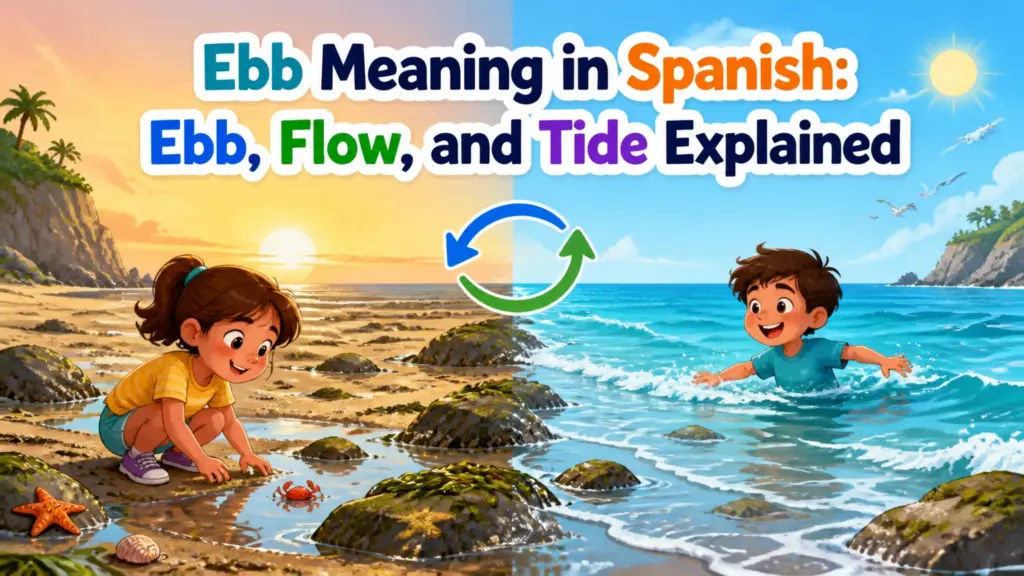

The English word “ebb” usually means reflujo or marea saliente when it describes the sea, and menguar, disminuir, or debilitarse when it describes something becoming weaker. In the idiom “ebb and flow,” Spanish commonly uses “flujo y reflujo” or “altibajos,” depending on whether the meaning is literal or figurative.
Key Facts at a Glance
- Ebb tide means the tide moving away from the shore, best translated as marea saliente, marea vaciante, or reflujo de la marea.
- Low tide means the lowest water level, so marea baja is not always an exact translation of ebb tide.
- The verb to ebb means to gradually decrease in strength, volume, intensity, or importance.
- Ebb and flow literally means flujo y reflujo and figuratively means altibajos, ciclos, or periodos de auge y declive.
- The past tense and past participle of ebb are both ebbed.
- In technical contexts, EBB may mean Ebb and Flow in hydroponics or Electric Blowback in airsoft, rather than the ordinary English word.
What Does “Ebb” Mean in Spanish?
The most accurate Spanish translation of “ebb” depends on the noun or verb surrounding it. As a maritime noun, ebb refers to the seaward movement of a tide; as a verb, to ebb describes a gradual decline; in figurative writing, the word often conveys weakening energy, interest, confidence, or influence.
| English expression | Natural Spanish translation | Meaning |
|---|---|---|
| the ebb | el reflujo | The retreating movement of water |
| ebb tide | marea saliente | Tide moving away from land |
| ebb current | corriente vaciante | Water current moving seaward |
| to ebb | menguar | To become weaker gradually |
| interest ebbed | el interés disminuyó | Interest became less intense |
| ebb and flow | flujo y reflujo | Alternating increase and decrease |
| ebb and flow of life | altibajos de la vida | Figurative cycles and changes |
| ebb away | ir desapareciendo | Gradual loss of force or presence |
The translation “reflujo” works best for water, while “menguar” often works best for abstract subjects such as enthusiasm or political influence. Spanish translators should select the phrase that expresses the relationship between the subject and the decline, rather than replace the English word mechanically.
Is “Ebb” a Noun or a Verb?
“Ebb” functions as both a noun and a verb. The noun usually appears in maritime or literary contexts, while the verb normally describes a gradual reduction in a force, feeling, resource, or condition.
“Ebb” as a noun
As a noun, ebb most commonly refers to the outgoing phase of a tide.
- The ebb began at noon.
El reflujo comenzó al mediodía. - The boats moved with the ebb.
Los barcos avanzaron con la marea vaciante. - At the ebb, the rocks became visible.
Durante la marea descendente, las rocas quedaron visibles.
The noun can also mean a low or declining point in a figurative sense:
- The company was at the ebb of its fortunes.
La empresa atravesaba el punto más bajo de su fortuna.
That figurative noun use is formal and somewhat literary. In ordinary Spanish, declive, decadencia, or punto más bajo will usually sound more natural.
“Ebb” as a verb
The verb to ebb is generally intransitive, meaning it does not require a direct object.
- The tide ebbed.
La marea refluyó. - Her confidence ebbed.
Su confianza disminuyó. - Public support ebbed after the scandal.
El apoyo público disminuyó después del escándalo.
The regular forms are:
| Form | English example | Spanish equivalent |
|---|---|---|
| Base form | tides ebb | las mareas refluyen |
| Third-person singular | interest ebbs | el interés mengua |
| Past tense | energy ebbed | la energía disminuyó |
| Past participle | support has ebbed | el apoyo ha disminuido |
| Present participle | confidence is ebbing | la confianza está disminuyendo |
How Do You Translate “Ebb” by Context?
Translate “ebb” according to what is declining or moving. Water normally calls for reflujo or marea saliente; abstract subjects usually call for disminuir, menguar, debilitarse, or perder fuerza.
| Context | English sentence | Recommended Spanish |
|---|---|---|
| Ocean tide | The tide began to ebb. | La marea comenzó a refluir. |
| Water level | The river ebbed after the storm. | El río descendió después de la tormenta. |
| Energy | His energy ebbed during the race. | Su energía disminuyó durante la carrera. |
| Interest | Public interest ebbed quickly. | El interés público disminuyó rápidamente. |
| Emotion | Her anger ebbed. | Su enojo fue disminuyendo. |
| Political power | The minister’s influence ebbed. | La influencia del ministro se debilitó. |
| Money | Their savings ebbed away. | Sus ahorros fueron disminuyendo. |
| Confidence | Confidence ebbed after the defeat. | La confianza menguó tras la derrota. |
| Conversation | The conversation ebbed. | La conversación perdió fuerza. |
| Violence | The violence ebbed overnight. | La violencia disminuyó durante la noche. |
| Sound | The music ebbed into silence. | La música se desvaneció hasta quedar en silencio. |
| Resources | Water supplies ebbed. | Las reservas de agua disminuyeron. |
A useful rule is to ask whether the sentence describes movement away, a lower level, or loss of intensity. Those three meanings often produce different Spanish translations.
What Does “Ebb Tide” Mean in Spanish?
“Ebb tide” means the period when seawater flows away from the coast toward the open sea. The most precise Spanish options are marea saliente, marea vaciante, marea descendente, and reflujo de la marea; marea baja refers specifically to the lowest tidal level.
Ebb tide versus low tide
The two English expressions are related but not identical.
| English term | Spanish equivalent | Exact reference |
|---|---|---|
| ebb tide | marea saliente | Water moving away from shore |
| falling tide | marea descendente | Water level decreasing |
| low tide | marea baja | Lowest water level in the cycle |
| flood tide | marea entrante | Water moving toward shore |
| high tide | marea alta | Highest water level in the cycle |
| ebb current | corriente vaciante | Seaward tidal current |
The outgoing movement occurs before low tide. Once the water reaches its lowest point, the ebb phase ends and the incoming, or flood, phase begins. For a general audience, marea baja may be acceptable when the sentence concerns exposed beaches or low water, but a marine report should preserve the movement distinction.
Maritime examples
- The fishermen waited for the ebb tide.
Los pescadores esperaron la marea vaciante. - The ship left on the ebb.
El barco partió con la marea saliente. - Strong ebb currents can make navigation dangerous.
Las corrientes vaciantes fuertes pueden dificultar la navegación. - The beach was exposed at low tide.
La playa quedó expuesta durante la marea baja.
What Does “Ebb and Flow” Mean in Spanish?
“Ebb and flow” translates literally as “flujo y reflujo,” but figuratively it usually means “altibajos,” “ciclos,” or “periodos de auge y declive.” The best choice depends on whether the sentence emphasizes alternating movement, changing fortunes, or emotional fluctuation.
| Use | English | Natural Spanish |
|---|---|---|
| Literal sea movement | The ebb and flow of the tide | El flujo y reflujo de la marea |
| Business cycles | The ebb and flow of business | Los ciclos del negocio |
| Life changes | The ebb and flow of life | Los altibajos de la vida |
| Emotions | The ebb and flow of emotion | Las fluctuaciones emocionales |
| Political support | The ebb and flow of public opinion | Los cambios de la opinión pública |
| Literary style | The ebb and flow of time | El flujo y reflujo del tiempo |
“Flujo y reflujo” preserves the image and works well in formal, literary, scientific, or translated prose. “Altibajos” sounds more idiomatic when the subject is personal experience, finance, relationships, or fortune.
- Every relationship has its ebb and flow.
Toda relación tiene sus altibajos. - The novel follows the ebb and flow of history.
La novela sigue el flujo y reflujo de la historia. - Markets move through cycles of ebb and flow.
Los mercados atraviesan ciclos de auge y declive.
A literal translation can sound unnatural if the context is not connected to water. Los altibajos del negocio normally communicates the idea better than el flujo y reflujo del negocio.
How Do You Pronounce “Ebb”?
“Ebb” is pronounced /eb/, like the first syllable of English “ebb and flow.” The vowel is the short e sound found in bed, not the long vowel in be or the Spanish vowel sequence in iba.
| Feature | Description |
|---|---|
| IPA | /eb/ |
| Syllables | One |
| Stress | Entire word receives one syllable of stress |
| Final sound | English /b/, pronounced clearly |
| Approximation | “eb,” with a short English e |
| Related phrase | /ˌeb ən ˈfloʊ/, “ebb and flow” |
Spanish speakers should avoid adding a final vowel, such as “ebi,” because ebb ends with a consonant. The pronunciation differs from ebb only in spelling and sound, not in meaning, when the word appears as a regular English verb or noun.
What Are the Most Common Collocations With “Ebb”?
The most useful collocations are “ebb tide,” “ebb and flow,” “ebb away,” “ebb back,” and “at a low ebb.” Learning these combinations is more reliable than memorizing a single Spanish equivalent because each collocation controls the intended meaning.
Ebb away
“Ebb away” means to disappear or weaken gradually.
- Her pain ebbed away.
El dolor fue desapareciendo poco a poco. - The sound ebbed away in the distance.
El sonido se fue apagando a lo lejos.
Possible translations include desvanecerse, apagarse, disminuir gradualmente, and irse debilitando.
Ebb back
“Ebb back” means to recede and then return toward a lower or previous level.
- The crowd ebbed back from the entrance.
La multitud retrocedió desde la entrada. - His confidence ebbed back after the criticism.
Su confianza volvió a disminuir después de las críticas.
The translation changes according to whether the subject physically retreats or becomes weaker again.
At a low ebb
“At a low ebb” means at a particularly weak, difficult, or unsuccessful point.
- The team was at a low ebb.
El equipo atravesaba un momento muy difícil. - She was at a low ebb after the loss.
Se encontraba en un punto muy bajo después de la pérdida.
The phrase is idiomatic. Translating it as “en una marea baja” is normally incorrect unless the sentence deliberately uses a nautical metaphor.
How Does “Ebb” Differ From “Wane,” “Recede,” and “Decline”?
“Ebb” emphasizes gradual weakening, “wane” emphasizes a loss of intensity or influence, “recede” emphasizes moving backward or away, and “decline” is the broadest and most neutral term. Spanish translations overlap, but the underlying image helps determine the most accurate word.
| English word | Main idea | Common Spanish translation | Typical subject |
|---|---|---|---|
| ebb | Gradual weakening or retreat | menguar, refluir | tide, energy, support |
| wane | Become less powerful or intense | menguar, decaer | moon, influence, enthusiasm |
| recede | Move farther away or decrease | retroceder, retirarse | water, hairline, memory |
| decline | Become lower, weaker, or worse | disminuir, declinar | sales, health, population |
| fade | Lose color, sound, or force | desvanecerse, apagarse | light, sound, memory |
| dwindle | Decrease steadily toward little | mermar, reducirse | supplies, numbers, savings |
Examples clarify the difference:
- The tide ebbed.
The water moved seaward. - Her influence waned.
Her influence became weaker. - The floodwaters receded.
The water moved away or dropped. - Sales declined.
Sales became lower. - The music faded.
The music gradually became less audible.
Ebb is more literary than decline in many abstract contexts. A business report may prefer decline, while a novel may choose ebb to create an image of a force slowly retreating.
Can “Ebb” Mean “Marea Baja”?
“Ebb” can relate to “marea baja,” but “marea baja” is not always its exact translation. Use marea baja for the lowest water level and marea saliente, marea vaciante, or reflujo for the movement of water away from shore.
The distinction matters in navigation, coastal science, fishing, and safety instructions. A warning about strong ebb currents concerns moving water, not merely the time when the water reaches its lowest level.
For casual travel writing, the following translation may be acceptable:
- The tide was ebbing, and the rocks appeared.
La marea estaba bajando y aparecieron las rocas.
For technical writing, use a more precise form:
- The ebb current reached two knots.
La corriente vaciante alcanzó dos nudos.
The Spanish term marea vaciante is especially common in maritime and hydrodynamic contexts, while marea saliente is transparent to general readers. Reflujo is concise but may require context because it also has medical meanings.
What Does EBB Mean in Hydroponics?
In hydroponics, EBB usually abbreviates “ebb and flow,” also called “flood and drain.” A pump temporarily floods a grow tray with nutrient solution, then gravity drains the solution back into a reservoir, exposing the root zone to fresh air between cycles.
This technical meaning is unrelated to the ordinary translation of ebb. A typical system contains a reservoir, submersible pump, timer, flood tray, drain fitting, overflow tube, growing medium, and nutrient solution.
Typical operating cycle
- The pump lifts nutrient solution from the reservoir.
- The tray floods until the overflow fitting sets the maximum level.
- Roots receive water and dissolved nutrients for about 10-15 minutes.
- The timer stops the pump.
- Gravity returns the solution to the reservoir.
- Air enters the medium as the tray drains.
Typical home-built systems cost approximately €50-€100, while prefabricated systems often cost €150-€600, depending on tray size, reservoir volume, fittings, and automation. A common starting schedule is 2-6 flood cycles per day, but clay pebbles, coco coir, plant size, temperature, and humidity change the correct frequency.
| Hydroponic attribute | Typical range or requirement | Practical consequence |
|---|---|---|
| Flood duration | 10-15 minutes | Saturates the root medium |
| Daily frequency | 2-6 cycles | More cycles in hot, dry conditions |
| DIY cost | €50-€100 | Requires pump, tray, timer, and fittings |
| Commercial cost | €150-€600 | Larger systems cost more |
| Reservoir position | Below the tray | Enables gravity drainage |
| Common media | Clay pebbles, coco, perlite | Media controls water retention |
The principal advantage is alternating hydration and aeration. The main risks are pump failure, blocked drains, salt buildup, and excessive flooding. A power outage can dry roots quickly, while overwatering prevents the oxygen exchange that makes the method effective.
What Does EBB Mean in Airsoft?
In airsoft, EBB usually means “Electric Blowback,” an electrically powered mechanism that moves a slide, bolt, or charging handle to simulate recoil. An EBB replica uses battery power and gearbox movement, unlike a GBB replica, which uses expanding gas to cycle the action.
The abbreviation appears in product descriptions, forums, and retailer catalogs. EBB models vary considerably: some move only a lightweight bolt for visual realism, while recoil-focused systems use a heavier moving mass and may include magazine cutoff features.
| Airsoft system | Power source | Blowback mechanism | Typical price |
|---|---|---|---|
| Basic EBB | Battery | Lightweight mechanical bolt | €150-€280 |
| Standard AEG | Battery | No simulated recoil | €100-€250 |
| GBB rifle | Green gas or gas mixture | Gas-powered bolt carrier | €250-€600 |
| Tokyo Marui Recoil Shock | Battery | Dedicated recoil weight | €450-€750 or more |
| KWA ERG | Battery | Recoil gearbox system | €400-€700 |
Electric blowback can increase battery consumption and mechanical stress. A low-voltage battery may cause incomplete cycling, but users should follow the manufacturer’s specifications rather than install an 11.1 V LiPo battery automatically, because an unsupported voltage can damage the motor, wiring, or electronic trigger system.
This technical acronym should not be used to translate an ordinary sentence such as “her enthusiasm ebbed.” In that sentence, ebbed means disminuyó or menguó, not anything related to airsoft.
What Are Common Translation Mistakes?
The most common mistake is translating every occurrence of “ebb” as “marea baja.” That translation ignores the difference between a tide’s direction, a water level, and the figurative weakening of an abstract subject.
Avoid these errors:
- Ebb tide = marea baja in every context
Better: marea vaciante for seaward movement and marea baja for the lowest level. - Ebb and flow = flujo y reflujo in every figurative context
Better: altibajos for personal or financial changes. - To ebb = refluir in every sentence
Better: disminuir, menguar, or debilitarse for confidence, support, or energy. - At a low ebb = en una marea baja
Better: en un punto bajo, en un momento difícil, or en declive. - Ebb as an acronym in normal prose
Better: identify whether the text concerns hydroponics or airsoft before using a technical expansion. - Ignoring register
Menguar and reflujo can sound literary or technical, while bajar and disminuir are more neutral.
A practitioner rule helps: first identify the subject, then identify whether the subject moves, weakens, or reaches a minimum. Only after that should you choose the Spanish verb or noun.
Which Spanish Translation Should You Choose?
Use the following decision sequence when translating “ebb”:
- Is the subject seawater moving away from land?
Choose reflujo, marea vaciante, or marea saliente. - Is the sentence describing the lowest water level?
Choose marea baja. - Is an emotion, force, resource, or influence becoming weaker?
Choose menguar, disminuir, debilitarse, or perder fuerza. - Does the sentence contain “and flow”?
Choose flujo y reflujo literally or altibajos figuratively. - Does the text use capital letters and discuss equipment?
Check whether EBB means Ebb and Flow hydroponics or Electric Blowback airsoft.
The most natural translation is often a phrase rather than a direct dictionary equivalent. For example, “the ebb of enthusiasm” may become la pérdida gradual de entusiasmo, even though menguar is a valid dictionary-level translation.
FAQ About “Ebb” in Spanish
What is the simplest Spanish translation of “ebb”?
The simplest translation is reflujo for the sea and disminuir or menguar for a gradual loss of strength. No single Spanish word covers every use. The surrounding noun determines the best choice: ebb tide concerns tidal movement, while interest ebbed concerns declining interest.
Is “ebb” the opposite of “flow”?
In the literal phrase “ebb and flow,” ebb describes the retreating phase and flow describes the advancing phase. In broader figurative use, ebb suggests decline or weakening, while flow suggests movement, increase, continuity, or development. Spanish commonly expresses the pair as flujo y reflujo.
What does “the tide is ebbing” mean?
“The tide is ebbing” means that seawater is moving away from the shore. Natural Spanish translations include la marea está bajando, la marea está vaciando, and la marea está refluyendo. La marea está bajando is easiest for general readers, while está vaciando is more maritime.
What does “ebb away” mean?
“Ebb away” means to weaken or disappear gradually. Depending on the subject, translate it as irse apagando, desvanecerse, disminuir poco a poco, or perder fuerza. For example, “His fear ebbed away” becomes “Su miedo fue desapareciendo poco a poco.”
Does “ebb” have a negative meaning?
“Ebb” usually implies decline, retreat, or weakening, but it is not inherently negative. A tide naturally ebbs as part of a regular cycle, and a pain or fever that ebbs may indicate improvement. The emotional meaning comes from the subject and context, not from the word alone.
What is the difference between “ebb” and “wane”?
“Ebb” and “wane” both describe gradual weakening, but “ebb” often suggests retreating movement or alternating cycles, while “wane” focuses on reduced strength, brightness, or influence. Translate both as menguar in some contexts, but use refluir for an ebbing tide and decaer for waning popularity.
Conclusion
The meaning of “ebb” in Spanish changes with context: use reflujo, marea vaciante, or marea saliente for an outgoing tide; use menguar, disminuir, or debilitarse for a gradual decline; and use flujo y reflujo or altibajos for “ebb and flow.” Technical capitalized EBB may instead refer to hydroponics or electric airsoft blowback.