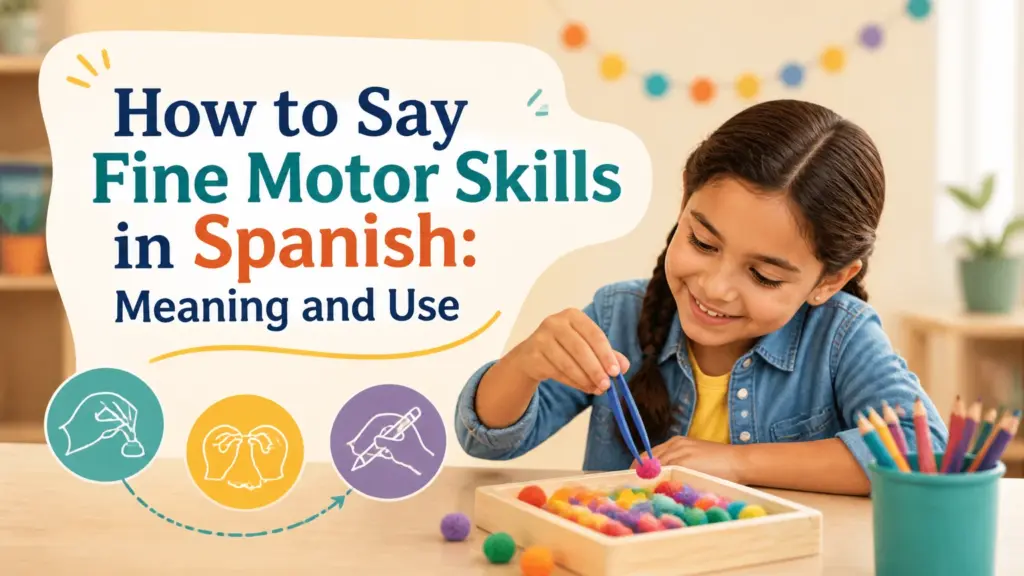

The most common Spanish translation of “fine motor skills” is motricidad fina. Spanish speakers also use habilidades motoras finas, a more literal phrase that is clear in general conversation and educational writing, while motricidad fina is usually the more concise technical term in clinical, developmental, and school contexts.
Key Facts at a Glance
- Motricidad fina is the standard Spanish term for fine motor skills.
- Habilidades motoras finas means “fine motor abilities” and is also correct.
- Fine motor skills involve controlled movements of the fingers, hands, and wrists.
- Motricidad gruesa means gross motor skills, such as running, jumping, and climbing.
- Terapia ocupacional means occupational therapy in Spanish.
- For a professional report, write dificultades en la motricidad fina for “fine motor difficulties.”
What Is the Correct Spanish Translation?
Motricidad fina is the best default translation for “fine motor skills” when the subject is child development, occupational therapy, rehabilitation, education, or developmental assessment. The expression is short, idiomatic, and widely understandable across Spanish-speaking countries.
The phrase is made of two parts. Motricidad refers to the ability to produce and control movement, while fina identifies precise movement involving relatively small muscle groups and carefully controlled actions. The feminine adjective agrees with the feminine noun motricidad.
| English expression | Standard Spanish translation | Typical context |
|---|---|---|
| Fine motor skills | Motricidad fina | Clinical, educational, developmental |
| Fine motor abilities | Habilidades motoras finas | General explanation, school writing |
| Fine motor control | Control de la motricidad fina | Assessment, therapy, rehabilitation |
| Fine motor development | Desarrollo de la motricidad fina | Child development and milestones |
| Fine motor delay | Retraso en la motricidad fina | Pediatric discussion, with professional caution |
| Fine motor difficulty | Dificultad en la motricidad fina | Reports, parent-teacher communication |
A useful translation rule is to choose motricidad fina when the English phrase names a developmental domain. Choose habilidades motoras finas when the sentence emphasizes particular abilities or tasks.
Is “Habilidades Motoras Finas” Also Correct?
Yes. Habilidades motoras finas is grammatically correct and communicates the meaning clearly, but it is more literal and slightly longer than motricidad fina. A teacher might write either phrase, whereas a clinical document often favors motricidad fina because it names the established area of motor development.
The adjective motoras agrees with the feminine plural noun habilidades, and finas agrees with the same noun. Do not write habilidades motor fino or motricidad fino. Those forms break Spanish gender agreement.
How Do You Pronounce “Motricidad Fina”?
Motricidad fina is approximately pronounced moh-tree-see-DAHD FEE-nah. The stress falls on the final syllable of motricidad, while fina is stressed on its first syllable.
A more detailed guide is:
- mo: like “moh”
- tri: like “tree”
- ci: approximately “see” in most Latin American varieties
- dad: “dahd,” with the final d often softened in casual speech
- fi: “fee”
- na: “nah”
In Spain, the c before i may sound like the English “th” in much of the country, producing an approximation closer to moh-tree-thee-DAHD FEE-nah. Latin American Spanish generally uses an “s” sound instead.
Spanish spelling does not require an accent mark in motricidad fina. The word motricidad naturally receives stress on the final syllable because it ends in a consonant other than n or s.
What Does “Motricidad Fina” Include?
Motricidad fina includes precise, coordinated movements of the fingers, hands, and wrists, often guided by vision. Picking up a small bead, fastening a button, using scissors, drawing, typing, and manipulating coins all require some form of fine motor control.
Fine motor performance depends on more than finger strength. It also involves posture, shoulder stability, bilateral coordination, visual-motor integration, sensory feedback, motor planning, and the ability to regulate force.
| Fine motor component | Spanish term | Example task |
|---|---|---|
| Pincer grasp | Agarre de pinza | Picking up a raisin with thumb and index finger |
| Palmar grasp | Agarre palmar | Holding a thick crayon with the whole hand |
| Bilateral coordination | Coordinación bilateral | Holding paper with one hand while cutting |
| Finger isolation | Aislamiento de los dedos | Pressing one piano key or keyboard key |
| In-hand manipulation | Manipulación dentro de la mano | Rotating a pencil without the other hand |
| Visual-motor integration | Integración visomotora | Copying a shape onto paper |
Fine motor skills differ from gross motor skills, translated as motricidad gruesa or habilidades motoras gruesas. Gross motor movement uses larger muscle groups for actions such as walking, balancing, running, and jumping. The distinction is useful, but the two systems interact. A child may struggle with handwriting partly because of weak posture or poor shoulder stability, not only because of finger control.
How Does Fine Motor Coordination Work?
Fine motor coordination combines visual information, motor planning, muscle activation, and sensory feedback. The eyes identify an object or target, the brain plans the action, the nervous system sends commands to the hand, and touch feedback adjusts grip and pressure while the movement occurs.
The process is continuous rather than a simple four-step chain. For example, threading a bead requires the child to locate the hole, orient the bead, stabilize the string, adjust finger force, and correct the movement when the string misses the opening.
The main components are:
- Visual input: The person identifies the object, target, size, position, and orientation.
- Motor planning: The brain selects an action, such as pinching, rotating, pressing, or releasing.
- Postural support: The trunk, shoulder, and elbow provide a stable base for hand movement.
- Motor command: Nerve signals activate the relevant muscles in the arm and hand.
- Sensory feedback: Touch and proprioception help regulate force and finger position.
- Error correction: The nervous system modifies the movement when the object slips or the target shifts.
One practitioner insight matters here: isolated hand exercises cannot compensate for poor seating or unstable posture. A child who writes with feet unsupported and shoulders elevated may appear to have weak fine motor skills when the immediate problem is whole-body positioning.
What Are Typical Fine Motor Milestones?
Fine motor milestones describe common developmental patterns, not rigid deadlines. Children develop at different rates, and a single missed task does not establish a disorder; loss of a previously acquired skill, persistent functional difficulty, or broad developmental concern deserves professional assessment.
| Approximate age | Common fine motor skill | Spanish description |
|---|---|---|
| 0-3 months | Reflexive grasp; hands often closed | Agarre reflejo; manos frecuentemente cerradas |
| 4-6 months | Reaches and grasps with the whole hand | Alcanza y agarra con toda la mano |
| 7-9 months | Transfers objects between hands | Pasa objetos de una mano a otra |
| 10-12 months | Uses a more refined pincer grasp | Usa un agarre de pinza más preciso |
| 1-2 years | Scribbles, stacks blocks, turns pages | Hace garabatos, apila bloques y pasa páginas |
| 2-3 years | Copies lines, snips paper, manages large buttons | Copia líneas, corta papel y abrocha botones grandes |
| 3-4 years | Copies a circle and uses scissors with more control | Copia un círculo y usa tijeras con mayor control |
| 4-5 years | Draws recognizable forms and manages clothing fasteners | Dibuja formas reconocibles y maneja cierres |
| 5 years and older | Develops more efficient handwriting and complex cutting | Mejora la escritura y recorta formas complejas |
Age ranges should not be used to compare children mechanically. Premature birth, visual impairment, neuromotor conditions, developmental differences, hand dominance, and opportunities for practice can all influence performance.
Which Fine Motor Activities Help Children?
Fine motor activities should match the child’s ability and should have a meaningful purpose. Play-Doh, sticker peeling, large beads, clothespins, puzzles, kitchen tongs, building blocks, finger painting, and supervised scissor work can develop hand control without turning every activity into handwriting practice.
A useful progression moves from larger, easier objects to smaller, more precise ones:
- Squeeze sponges or therapy putty.
- Pick up large pom-poms with kitchen tongs.
- Thread large beads onto a stiff lace.
- Peel and place stickers.
- Tear paper, then cut thick paper with child-safe scissors.
- Copy vertical and horizontal lines before letters.
- Practice buttons, zippers, utensils, and shoelaces in daily routines.
For preschool children, vertical drawing surfaces such as easels can encourage wrist extension and shoulder stability. The activity is not automatically better than table work, but the altered position can provide useful postural practice.
Do not force an adult tripod pencil grasp on a very young child. Efficient pencil control matters more than reproducing one exact finger position, and early pressure can create fatigue, avoidance, or an inefficient grip.
How Do You Say Fine Motor Skills in a Medical or School Report?
For formal writing, use motricidad fina with a specific functional description. A report becomes more useful when it states what the person can or cannot do, rather than labeling performance only as “weak.”
| English report wording | Spanish report wording | Use |
|---|---|---|
| Fine motor development is age-appropriate | El desarrollo de la motricidad fina es adecuado para su edad | Developmental summary |
| Fine motor skills are emerging | La motricidad fina está en desarrollo | Early or variable performance |
| Difficulty with fine motor tasks | Dificultad para realizar tareas de motricidad fina | Functional concern |
| Fine motor delay | Retraso en el desarrollo de la motricidad fina | Professional assessment context |
| Fine motor coordination is reduced | La coordinación de la motricidad fina está disminuida | Clinical or rehabilitation report |
| Requires assistance with buttons | Necesita ayuda para abrocharse los botones | Self-care function |
| Has difficulty using scissors | Tiene dificultad para usar tijeras | Classroom or therapy observation |
A translation should not convert an observation into a diagnosis. “The child has difficulty cutting” is an observation; “the child has a developmental disorder” is a clinical conclusion requiring assessment.
Useful full sentences include:
- El niño presenta dificultades en la motricidad fina.
The child has difficulties with fine motor skills. - La estudiante necesita apoyo para recortar siguiendo una línea.
The student needs support to cut along a line. - Se observa un agarre de pinza inmaduro.
An immature pincer grasp is observed. - La terapia ocupacional puede ayudar a mejorar la coordinación manual.
Occupational therapy may help improve hand coordination.
Is “Destreza Manual” the Same as “Motricidad Fina”?
Destreza manual overlaps with fine motor skills but is not an exact replacement. Destreza manual emphasizes practical hand skill, whereas motricidad fina refers more broadly to the developmental and neurological capacity for precise movement.
For example, an adult who repairs watches may have excellent manual dexterity. A pediatric evaluation would more naturally discuss motricidad fina, grasp patterns, visual-motor integration, and self-care tasks.
Psicomotricidad fina is also used in some educational settings. It can be understandable, but motricidad fina is the cleaner default when translating the English term directly. Psicomotricidad may imply a broader relationship among movement, cognition, emotion, and body awareness.
| Spanish term | Closest English meaning | Best use |
|---|---|---|
| Motricidad fina | Fine motor skills | Standard translation |
| Habilidades motoras finas | Fine motor abilities | Literal, accessible wording |
| Destreza manual | Manual dexterity | Practical hand skill |
| Coordinación mano-ojo | Hand-eye coordination | Visual guidance of hand movement |
| Psicomotricidad fina | Fine psychomotor skills | Some educational programs |
| Habilidades manipulativas | Manipulative skills | Object handling and classroom tasks |
Does Spanish Usage Vary by Country?
The term motricidad fina is broadly understood throughout Spanish-speaking regions, including Mexico, Spain, Colombia, Argentina, Chile, Peru, and the United States. Regional differences are more likely to appear in the names of objects and services than in the core term.
For example, tijeras escolares and tijeras de seguridad can both describe child-safe scissors. Plastilina is common in many countries, while masa moldeable may be preferred in a particular school or product context. These differences do not change the translation of fine motor skills.
In bilingual U.S. schools, both motricidad fina and habilidades motoras finas may appear. The best choice depends on the institution’s existing terminology. Consistency across an Individualized Education Program, therapy note, or parent communication usually matters more than selecting the only supposedly correct phrase.
When Is Occupational Therapy Relevant?
Terapia ocupacional is the Spanish term for occupational therapy, and an occupational therapist may evaluate fine motor coordination, visual-motor integration, sensory processing, posture, self-care, and participation in school or work tasks.
A referral may be reasonable when a child persistently cannot perform expected daily tasks, experiences marked frustration or fatigue, uses one hand much less than expected, loses a previously acquired ability, or has difficulties across several developmental areas. Adults may need evaluation after stroke, traumatic injury, nerve damage, arthritis, or neurological disease.
Typical private occupational therapy costs vary widely by country, city, provider credentials, insurance, and session length. The following are broad U.S. self-pay planning ranges, not universal prices.
| Service | Typical U.S. self-pay range | Common duration or frequency |
|---|---|---|
| Initial occupational therapy evaluation | $150-$600 | 45-90 minutes |
| Individual therapy visit | $75-$250 | 30-60 minutes |
| Pediatric therapy schedule | 1-2 visits weekly | Often reviewed after 6-12 weeks |
| Home practice | $0-$30 for basic materials | 5-15 minutes, several days weekly |
| Progress review | $75-$250 | Every 4-12 weeks |
Therapy does not guarantee a fixed result within three to six months. Improvement depends on the underlying condition, attendance, home practice, task demands, fatigue, vision, pain, and access to adaptive equipment.
What Common Mistakes Affect Fine Motor Practice?
The most common mistakes are excessive handwriting pressure, inappropriate task difficulty, poor posture, and adults completing self-care tasks too quickly. Effective practice should be challenging enough to require control but not so difficult that the person compensates, avoids the task, or becomes exhausted.
| Problem | Likely contributing factor | Practical adjustment |
|---|---|---|
| Writing causes quick fatigue | Excessive grip pressure or poor seating | Use shorter tasks and support the feet |
| Scissors collapse or veer | Weak hand separation or difficult paper | Start with thick paper and short snips |
| Buttons cause frustration | Button size is too small | Begin with large dressing boards |
| Beads are repeatedly dropped | Object is too small or slippery | Use larger beads and a firm lace |
| Child avoids drawing | Task feels demanding or evaluative | Use chalk, paint, or vertical surfaces |
| Tablet tapping replaces manipulation | Limited resistance and object handling | Add blocks, putty, tongs, and fasteners |
A counterintuitive clinical point is that handwriting is not always the best first intervention for poor handwriting. Strength, posture, visual-motor control, and motor planning may need attention before repeated letter drills become productive.
Another practical rule is to stop before form collapses. Ten focused minutes with stable posture can produce better learning than thirty minutes of fatigued, compensatory gripping.
How Should You Translate the Phrase in Different Situations?
Choose the Spanish wording according to the sentence’s purpose, audience, and level of technical precision. Motricidad fina is the safest general choice, while a task-specific phrase often produces the clearest translation.
| Situation | Recommended Spanish | Example |
|---|---|---|
| Parent conversation | Motricidad fina | “Estamos practicando la motricidad fina.” |
| Pediatric evaluation | Desarrollo de la motricidad fina | “Se evaluó el desarrollo de la motricidad fina.” |
| Classroom goal | Habilidades motoras finas | “Fortalecer las habilidades motoras finas.” |
| Therapy plan | Coordinación de la motricidad fina | “Trabajar la coordinación de la motricidad fina.” |
| Adult rehabilitation | Destreza manual y motricidad fina | “Mejorar la destreza manual después del accidente.” |
| Bilingual glossary | Fine motor skills: motricidad fina | “Fine motor skills, motricidad fina.” |
When translating a form, preserve the original distinction between a skill, an observation, a goal, and a diagnosis. For example, “fine motor skills training” becomes entrenamiento de la motricidad fina, while “fine motor impairment” may become alteración de la motricidad fina, depending on the clinician’s terminology.
Frequently Asked Questions
What Is the Opposite of Fine Motor Skills in Spanish?
The usual contrasting term is motricidad gruesa, meaning gross motor skills. Habilidades motoras gruesas is the literal alternative. Fine motor skills involve precise hand and finger actions, while gross motor skills involve larger movements such as walking, running, jumping, and maintaining balance.
How Do You Say Fine Motor Delay in Spanish?
“Fine motor delay” can be translated as retraso en el desarrollo de la motricidad fina. A less diagnostic wording is dificultad en el desarrollo de la motricidad fina. Use the first phrase in a professional assessment only when a qualified clinician has made that determination.
How Do You Say Hand-Eye Coordination in Spanish?
“Hand-eye coordination” is coordinación mano-ojo or coordinación óculo-manual. The first phrase is more accessible for parents and general audiences. The second is more formal and may appear in educational, sports, rehabilitation, or clinical documents.
Is “Fine Motor” Translated as “Motor Fino”?
Usually, no. Motor fino can appear in technical compounds, but the natural standalone term for the skill domain is motricidad fina. For example, translate “fine motor development” as desarrollo de la motricidad fina, not simply desarrollo del motor fino.
How Do You Say Fine Motor Activities in Spanish?
“Fine motor activities” is actividades de motricidad fina. You can also say actividades para desarrollar la motricidad fina, meaning “activities to develop fine motor skills.” Examples include threading beads, using tongs, drawing, cutting, buttoning, and manipulating modeling dough.
Is “Motricidad Fina” Used for Adults?
Yes. Motricidad fina applies to adults as well as children, especially in occupational therapy, stroke rehabilitation, hand injury recovery, neurological rehabilitation, and workplace assessment. For an adult context, destreza manual may be added when the focus is practical performance rather than developmental progress.
The Bottom Line
The best answer to “how to say fine motor skills in Spanish” is motricidad fina. Use habilidades motoras finas when a literal, accessible phrase fits the audience, and use task-specific terms such as coordinación mano-ojo, agarre de pinza, or destreza manual when greater precision is needed. For reports, describe the actual function and avoid turning a translation into an unsupported diagnosis.