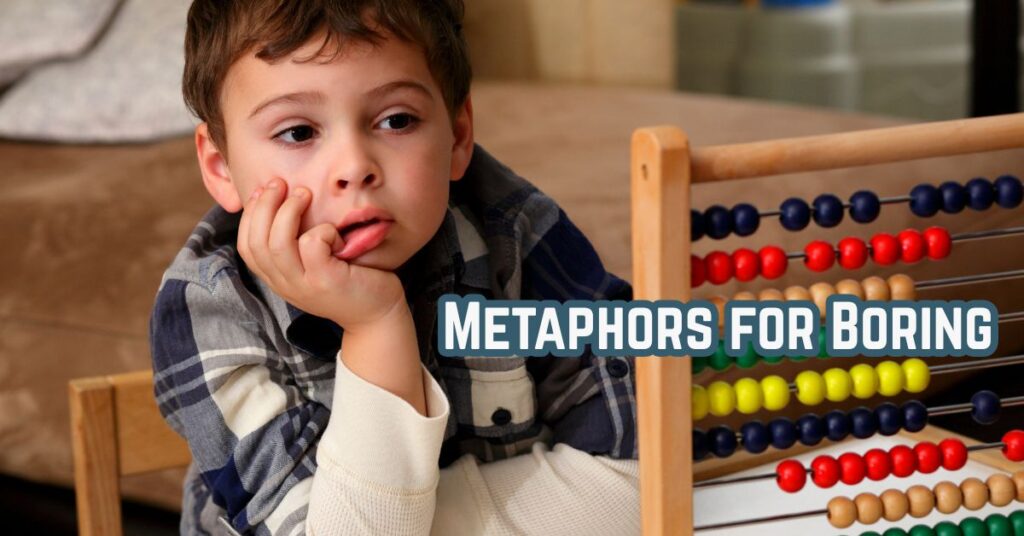

Understanding metaphors is crucial for mastering the nuances of the English language. Metaphors allow us to express abstract concepts in more vivid and relatable ways. When it comes to describing something as “boring,” the English language offers a rich array of metaphorical expressions that go far beyond the simple adjective. This article will explore various metaphors for boredom, their structural components, usage rules, and provide numerous examples to help you enhance your vocabulary and expressive abilities. This guide is perfect for English language learners, writers, and anyone looking to make their speech and writing more engaging.
By delving into these metaphors, you’ll gain a deeper appreciation for the creative potential of language and the subtle ways we use figurative language to convey meaning. This exploration will not only improve your comprehension skills but also empower you to communicate more effectively and creatively.
Table of Contents
- Introduction
- Definition of Metaphor and Boredom
- Structural Breakdown of Boring Metaphors
- Types of Boring Metaphors
- Examples of Metaphors for Boring
- Usage Rules for Metaphors
- Common Mistakes with Metaphors
- Practice Exercises
- Advanced Topics in Metaphorical Language
- Frequently Asked Questions
- Conclusion
Definition of Metaphor and Boredom
A metaphor is a figure of speech that directly compares two unrelated things. Unlike similes, which use “like” or “as” to make a comparison, metaphors state that one thing is another. This comparison is not meant to be taken literally but rather to highlight a shared quality or characteristic. Metaphors add depth and color to language, making it more engaging and evocative.
Boredom, on the other hand, is a state of feeling weary, restless, and uninterested. It’s a lack of stimulation or excitement that can lead to feelings of apathy and dissatisfaction. Because boredom is an internal state, it is often described metaphorically, using comparisons to things that are equally unstimulating or undesirable.
Understanding the interplay between metaphor and the concept of boredom allows us to explore the creative ways in which language can capture and convey this common human experience. By using metaphorical language, we can express the intensity and texture of boredom in a way that resonates with others.
Structural Breakdown of Boring Metaphors
Metaphors for boredom often rely on a few key structural elements. These elements contribute to the effectiveness and clarity of the metaphor.
- The Topic: This is the subject being described as boring (e.g., a lecture, a movie, a job).
- The Vehicle: This is the thing to which the topic is being compared (e.g., watching paint dry, a blank wall, a snail’s pace). The vehicle is usually something known to be inherently uninteresting or slow.
- The Ground: This is the shared characteristic or quality that connects the topic and the vehicle. In the case of boredom metaphors, the ground is usually a lack of stimulation, excitement, or interest.
- The Implication: This is the underlying meaning or feeling that the metaphor conveys. It suggests the degree or intensity of boredom.
For example, in the metaphor “The meeting was like watching paint dry,” the topic is the meeting, the vehicle is watching paint dry, the ground is the lack of stimulation, and the implication is that the meeting was extremely boring.
By understanding these structural elements, you can analyze and create your own metaphors for boredom, ensuring that they are both effective and meaningful.
Types of Boring Metaphors
Metaphors for boredom can be categorized based on the specific imagery or concepts they invoke. Here are some common types:
Sleep-Related Metaphors
These metaphors draw a comparison between boredom and sleep, suggesting that something is so uninteresting that it induces drowsiness or apathy. They often use imagery of inactivity, rest, or a lack of energy.
Examples include: “It was a sleeping pill in disguise,” or “The presentation was a lullaby.” These metaphors directly connect the experience of boredom with the feeling of wanting to sleep, emphasizing the lack of engagement and stimulation.
Lifelessness Metaphors
These metaphors associate boredom with a lack of vitality or animation, implying that something is dull, stagnant, or devoid of energy. This category often includes comparisons to inanimate objects or environments.
Expressions like “It was like watching grass grow” or “as exciting as a blank wall” fall into this category. These metaphors highlight the absence of any dynamic or engaging elements, emphasizing the feeling of being stuck or inert.
Monotony Metaphors
Metaphors in this category focus on the repetitive and unchanging nature of something boring. They emphasize the lack of variety or novelty, leading to a sense of weariness and tedium.
Examples include: “It was the same song on repeat” or “like a broken record.” These metaphors underscore the feeling of being trapped in a cycle of sameness, where nothing new or interesting ever happens.
Emptiness Metaphors
These metaphors convey the feeling of boredom through imagery of emptiness, hollowness, or a lack of substance. They suggest that something is devoid of meaning or significance, leaving one feeling unfulfilled and disinterested.
Expressions like “It was a void of entertainment” or “like staring into a blank canvas” are examples of this type. These metaphors emphasize the absence of anything engaging or stimulating, creating a sense of emptiness and dissatisfaction.
Weight-Related Metaphors
These metaphors use the concept of weight to describe boredom, suggesting that something is heavy, burdensome, or oppressive. They often convey a feeling of being weighed down by the lack of stimulation.
Examples include: “It was a lead balloon” or “like wading through molasses.” These metaphors highlight the feeling of being slowed down or burdened by the boring experience, making it feel even more unpleasant.
Examples of Metaphors for Boring
The following tables provide a comprehensive list of metaphors for “boring,” categorized by the types discussed above. Each table includes a variety of examples to illustrate the different ways in which boredom can be expressed metaphorically.
The following table shows sleep-related metaphors for boredom. Notice how each metaphor uses imagery associated with sleep or inactivity to convey the feeling of being bored.
| Metaphor | Explanation |
|---|---|
| The lecture was a sleeping pill. | The lecture was so boring it made people feel sleepy. |
| It was a lullaby in disguise. | The event was so dull it had a soothing, sleep-inducing effect. |
| The meeting was a cure for insomnia. | The meeting was so boring it could help someone fall asleep. |
| Listening to him was like counting sheep. | His speech was so monotonous it was like trying to fall asleep by counting sheep. |
| The movie was a snore fest. | The movie was extremely boring and caused people to lose interest. |
| His stories were a one-way ticket to dreamland. | His stories were incredibly boring and made you want to sleep. |
| The presentation was a sedative. | The presentation was so dull it had a calming, sleep-inducing effect. |
| That class is like a coma. | That class is extremely boring and makes you feel lifeless. |
| The seminar was a narcoleptic’s dream. | The seminar was so boring it would easily induce sleep. |
| It’s like watching paint dry, but slower. | It’s incredibly boring and slow-moving. |
| She spoke with the enthusiasm of a sloth. | She spoke very slowly and without energy, making the topic seem boring. |
| The book was a cure for my hyperactivity. | The book was so boring it calmed me down significantly. |
| His voice was a monotonous drone that could put anyone to sleep. | His voice was so boring and unchanging that it was sleep-inducing. |
| The game was a sleeping draught. | The game was so boring it made me want to sleep. |
| The entire evening was a somnambulist’s delight. | The entire evening was so boring it felt like sleepwalking. |
| The opera was a dose of NyQuil. | The opera was so boring it felt like taking a strong sleep aid. |
| He delivered the speech with the energy of someone just waking up. | He delivered the speech in such a boring and unenthusiastic way. |
| The play was a hypnotic suggestion to sleep. | The play was so boring it felt like being hypnotized to fall asleep. |
| The museum tour was a pathway to slumber. | The museum tour was so uninteresting it made me want to sleep. |
| The documentary was a soporific experience. | The documentary was so boring it induced sleepiness. |
| Attending that conference was like being in suspended animation. | Attending that conference was so uninteresting, it felt like being in suspended animation. |
| The after-dinner speech was a snooze-fest. | The after-dinner speech was extremely boring and caused people to lose interest. |
| The novel was a bromide for my excitement. | The novel was so boring it calmed me down significantly. |
The following table provides examples of lifelessness metaphors for boredom. These metaphors often use imagery of inanimate objects or stagnant environments to convey the feeling of being bored.
| Metaphor | Explanation |
|---|---|
| It was like watching grass grow. | The activity was extremely slow and uninteresting. |
| The conversation was as exciting as a blank wall. | The conversation was completely devoid of interest or stimulation. |
| The game was a complete dead end. | The game offered no excitement or progress. |
| The party was a tomb. | The party was lifeless and dull. |
| The class felt like a museum exhibit. | The class was static and unengaging. |
| The meeting was a still life. | The meeting lacked any movement or excitement. |
| The presentation was a desert of information. | The presentation was barren and lacked any interesting content. |
| The play was a mannequin parade. | The play lacked any real emotion or vitality. |
| The event was an animated corpse. | The event was trying to be lively but was ultimately lifeless. |
| The whole thing was a petrified forest. | The whole thing was stagnant and unchanging. |
| Listening to him was like watching dust settle. | Listening to him was incredibly boring and uneventful. |
| Her enthusiasm was as flat as a pancake. | Her enthusiasm was completely lacking, making the topic seem boring. |
| The show was a taxidermied spectacle. | The show was lifeless and artificial. |
| The book was a cement block of prose. | The book was heavy, dense, and difficult to get through. |
| The conference was a graveyard of ideas. | The conference lacked any new or exciting ideas. |
| The exhibition was a mausoleum of art. | The exhibition felt lifeless and uninspired. |
| The performance was a frozen tableau. | The performance lacked any movement or dynamism. |
| The project was a stillborn endeavor. | The project was lifeless and doomed from the start. |
| The discussion was a dried-up well. | The discussion lacked any fresh or interesting ideas. |
| The exercise was a mechanical routine. | The exercise was repetitive and uninspired. |
| The task was as thrilling as counting grains of sand. | The task was incredibly mundane and unexciting. |
| The assignment was a barren wasteland of creativity. | The assignment lacked any opportunity for creative expression. |
| The game was a lifeless automaton of entertainment. | The game was uninspired and devoid of genuine excitement. |
The following table demonstrates monotony metaphors for boredom. These metaphors often emphasize the repetitive or unchanging nature of something boring.
| Metaphor | Explanation |
|---|---|
| It was the same song on repeat. | The situation was repetitive and unchanging. |
| The day was a broken record. | The day was monotonous and predictable. |
| The job was a hamster wheel. | The job was repetitive and offered no progress. |
| The routine was a never-ending cycle. | The routine was monotonous and unchanging. |
| The task was a treadmill of drudgery. | The task was repetitive and exhausting. |
| The process was a loop of tedium. | The process was repetitive and boring. |
| The experience was a groundhog day. | The experience was repetitive and predictable. |
| The conversation was a carousel of clichés. | The conversation was full of predictable and unoriginal phrases. |
| The work was a chain gang of tasks. | The work was repetitive and oppressive. |
| The project was a circular firing squad. | The project was going nowhere and causing frustration. |
| His argument was a recursive function with no base case. | His argument was repetitive and never reached a conclusion. |
| The presentation was a slideshow of the obvious. | The presentation was repetitive and presented nothing new. |
| Her life was a series of Ctrl+C, Ctrl+V moments. | Her life lacked originality and was full of repetitive actions. |
| The lecture was an echo chamber of old ideas. | The lecture was repetitive and offered nothing new or innovative. |
| The meeting was a rerun of last week’s meeting. | The meeting was repetitive and covered the same ground as before. |
| The exercise was a ritual of redundancy. | The exercise was repetitive and pointless. |
| The discussion was a recurring nightmare. | The discussion was repetitive and unpleasant. |
| The assignment was a Sisyphean task. | The assignment was repetitive and seemingly endless. |
| The feedback loop was an ouroboros eating its own tail. | The feedback loop was self-referential and unproductive. |
| The entire process was a Mobius strip of monotony. | The entire process was repetitive and disorienting. |
| The conference was a monotonous drone. | The conference was repetitive and unchanging. |
| His speech was a constant loop. | His speech was repetitive and unchanging. |
| The play was a recurring dream. | The play was repetitive and predictable. |
The following table provides emptiness metaphors for boredom. These metaphors invoke imagery of emptiness, hollowness, or a lack of substance.
| Metaphor | Explanation |
|---|---|
| It was a void of entertainment. | The event lacked any engaging or stimulating elements. |
| The movie was a black hole of plot. | The movie lacked any substance or coherent storyline. |
| The conversation was an empty vessel. | The conversation was devoid of any meaningful content. |
| The presentation was a vacuum of ideas. | The presentation lacked any fresh or innovative ideas. |
| The party was a hollow shell of fun. | The party lacked any genuine excitement or enjoyment. |
| The class was an intellectual desert. | The class lacked any stimulating or challenging content. |
| The project was a bottomless pit of tasks. | The project seemed endless and unfulfilling. |
| The meeting was an echo chamber of silence. | The meeting was devoid of any meaningful discussion. |
| The performance was a ghost of creativity. | The performance lacked any original or inspired elements. |
| The whole thing was a vacuum-packed experience. | The whole thing lacked any real substance or excitement. |
| The book was a desert mirage of a story. | The book was a disappointing and insubstantial story. |
| Her enthusiasm was a barren landscape. | Her enthusiasm was completely lacking, making the topic seem boring. |
| The show was an empty stage. | The show lacked any real substance or entertainment value. |
| The conference was a hollow echo of past events. | The conference lacked any new or exciting content. |
| The exhibition was a sterile display of objects. | The exhibition felt lifeless and uninspired. |
| The performance was a vacant spectacle. | The performance lacked any real emotion or depth. |
| The discussion was a dry well of ideas. | The discussion lacked any fresh or interesting ideas. |
| The assignment was a blank canvas of opportunity. | The assignment lacked any clear direction or purpose. |
| The lecture was a blank slate. | The lecture lacked any interesting or engaging content. |
| The game was a hollow victory. | The game lacked any real satisfaction or reward. |
| The event was an empty promise. | The event failed to deliver any excitement or interest. |
| The seminar was a void of inspiration. | The seminar lacked any engaging or stimulating content. |
| The journey was a road to nowhere. | The journey lacked any meaningful destination or purpose. |
The following table presents weight-related metaphors for boredom, using the concept of weight to describe something as heavy, burdensome, or oppressive.
| Metaphor | Explanation |
|---|---|
| It was a lead balloon. | The event was a complete failure and dragged everyone down. |
| The meeting was like wading through molasses. | The meeting was slow, difficult, and exhausting. |
| The task was a ton of bricks. | The task was overwhelming and burdensome. |
| The class was a heavy load to bear. | The class was difficult and draining. |
| The project was a millstone around my neck. | The project was a burden and a source of stress. |
| The burden of boredom weighed heavily on us. | The feeling of boredom was oppressive and draining. |
| The lecture was a concrete block of information. | The lecture was dense, difficult to understand, and boring. |
| The day was a long, heavy slog. | The day was difficult and exhausting due to boredom. |
| The work was a drag. | The work was tedious and uninteresting. |
| The entire experience was a heavy weight on my shoulders. | The entire experience was oppressive and draining. |
| The book was a leaden tome. | The book was heavy, dense, and difficult to read. |
| The movie was a slog. | The movie was tedious and uninteresting. |
| The evening was a drag. | The evening was tedious and uninteresting. |
| The conversation was a dead weight. | The conversation was uninteresting and burdensome. |
| The assignment was a heavy burden. | The assignment was difficult and draining. |
| The speech was a heavy weight. | The speech was uninteresting and burdensome. |
| The presentation was a heavy load. | The presentation was difficult and draining. |
| The whole day was a heavy slog. | The whole day was difficult and exhausting due to boredom. |
| The film was like trudging through mud. | The film was slow, difficult, and exhausting. |
| The experience was a lead weight on my soul. | The experience was oppressive and draining. |
| The task was as heavy as a wet blanket. | The task was overwhelming and burdensome. |
| The class was a millstone around my neck. | The class was a burden and a source of stress. |
| The seminar was a heavy weight lifted from my shoulders when it ended. | The seminar was oppressive and draining until it concluded. |
Usage Rules for Metaphors
Using metaphors effectively requires attention to several key rules:
- Clarity: The metaphor should be easily understood. The connection between the topic and the vehicle should be clear and logical. Avoid obscure or overly complex metaphors.
- Relevance: The metaphor should be relevant to the context. It should enhance the meaning and impact of the message, not distract from it.
- Originality: While common metaphors can be effective, original metaphors can be more engaging and memorable. Strive to create fresh and imaginative comparisons.
- Consistency: Avoid mixing metaphors within the same sentence or paragraph. This can create confusion and undermine the effectiveness of the figurative language.
- Appropriateness: Consider the audience and the situation when choosing a metaphor. What might be appropriate in a casual conversation may not be suitable for a formal presentation.
By following these rules, you can use metaphors effectively to add depth, color, and impact to your communication.
Common Mistakes with Metaphors
Several common mistakes can undermine the effectiveness of metaphors. Being aware of these pitfalls can help you avoid them.
- Mixed Metaphors: Combining two or more incompatible metaphors in the same sentence or paragraph.
- Incorrect: “We need to nip it in the bud before it snowballs out of control.” (Mixing plant and snowball metaphors).
- Correct: “We need to nip it in the bud before it becomes a bigger problem.”
- Correct: “We need to address it before it snowballs out of control.”
- Clichéd Metaphors: Using overused or predictable metaphors that have lost their impact.
- Clichéd: “It was like a walk in the park.”
- Better: “It was surprisingly easy, like finding a hidden shortcut.”
- Inappropriate Metaphors: Using metaphors that are unsuitable for the audience or context.
- Inappropriate: (In a formal presentation) “The project was a total train wreck.”
- Better: “The project faced significant challenges and did not achieve its objectives.”
- Overly Complex Metaphors: Using metaphors that are too difficult to understand or interpret.
- Complex: “The algorithm was a labyrinthine tapestry of computational threads.”
- Better: “The algorithm was complex and difficult to navigate.”
By avoiding these common mistakes, you can ensure that your metaphors are clear, effective, and appropriate for the situation.
Practice Exercises
Test your understanding of metaphors for boredom with these exercises.
Exercise 1: Identify the Metaphor
Identify the metaphor in each sentence and explain its meaning.
| Question | Answer |
|---|---|
| 1. The lecture was a sedative. | Metaphor: “sedative.” Meaning: The lecture was so boring it made people feel sleepy. |
| 2. The meeting was a desert of ideas. | Metaphor: “desert.” Meaning: The meeting lacked any fresh or interesting ideas. |
| 3. The job was a hamster wheel. | Metaphor: “hamster wheel.” Meaning: The job was repetitive and offered no progress. |
| 4. The movie was a black hole of plot. | Metaphor: “black hole.” Meaning: The movie lacked any substance or coherent storyline. |
| 5. It was like watching grass grow. | Metaphor: “watching grass grow.” Meaning: The activity was extremely slow and uninteresting. |
| 6. The task was a ton of bricks. | Metaphor: “ton of bricks.” Meaning: The task was overwhelming and burdensome. |
| 7. The conversation was an empty vessel. | Metaphor: “empty vessel.” Meaning: The conversation was devoid of any meaningful content. |
| 8. The day was a broken record. | Metaphor: “broken record.” Meaning: The day was monotonous and predictable. |
| 9. The presentation was a vacuum of ideas. | Metaphor: “vacuum.” Meaning: The presentation lacked any fresh or innovative ideas. |
| 10. The class was a heavy load to bear. | Metaphor: “heavy load.” Meaning: The class was difficult and draining. |
Exercise 2: Create Your Own Metaphors
Create a metaphor for “boring” to describe each of the following scenarios.
| Scenario | Your Metaphor (Example Answer) |
|---|---|
| 1. A long train journey | A long train journey is a slow drip of time. |
| 2. A mandatory training session | A mandatory training session is a forced march through a field of clichés. |
| 3. A political debate | A political debate is a tedious dance of avoidance and misdirection. |
| 4. Waiting in a queue | Waiting in a queue is a slow-motion parade of impatience. |
| 5. Reading a legal document | Reading a legal document is like navigating a labyrinth of jargon. |
| 6. Listening to a voicemail message | Listening to a voicemail message is like hearing a ghost speak. |
| 7. Attending a family gathering | Attending a family gathering is like watching a play with a predictable plot. |
| 8. Watching a reality TV show | Watching a reality TV show is like eating junk food for the brain. |
| 9. Doing household chores | Doing household chores is like pushing a rock up a hill, only to have it roll back down. |
| 10. Listening to someone complain | Listening to someone complain is like swimming in a sea of negativity. |
Exercise 3: Correct the Mixed Metaphor
Rewrite each sentence to correct the mixed metaphor.
| Question | Answer (Example) |
|---|---|
| 1. We need to nip it in the bud before it snowballs out of control. | We need to address it before it snowballs out of control. OR We need to nip it in the bud before it becomes a bigger problem. |
| 2. The project was a rollercoaster ride that hit a brick wall. | The project was a rollercoaster ride with unexpected twists and turns. OR The project was heading for success until it hit a brick wall. |
| 3. He was walking on thin ice but kept digging his heels in. | He was walking on thin ice and risked falling through. OR He was steadfast in his decision, despite the risks. |
| 4. She was skating on thin ice and burning the candle at both ends. | She was skating on thin ice, taking risks that could have serious consequences. OR She was burning the candle at both ends, pushing herself to the limit. |
| 5. The company was navigating uncharted waters while also keeping a tight ship. | The company was navigating uncharted waters, facing new challenges and uncertainties. OR The company was keeping a tight ship, maintaining strict control and efficiency. |
| 6. He was caught between a rock and a hard place, but he decided to bite the bullet. | He was caught between a rock and a hard place, facing a difficult decision with no easy solution. OR He decided to bite the bullet and face the unpleasant consequences. |
| 7. The politician was trying to walk a tightrope while also playing his cards close to his chest. | The politician was trying to walk a tightrope, balancing competing interests and pressures. OR The politician was playing his cards close to his chest, keeping his plans and intentions secret. |
| 8. The team was firing on all cylinders while also keeping their eye on the ball. | The team was firing on all cylinders, working efficiently and effectively. OR The team was keeping their eye on the ball, staying focused on their primary objective. |
| 9. The project was a runaway train that was also dead in the water. | The project was a runaway train, spiraling out of control. OR The project was dead in the water, unable to move forward. |
| 10. The situation was a perfect storm, but they managed to weather the storm and come out smelling like roses. | The situation was a perfect storm, with multiple challenges converging at once. OR They managed to weather the storm, emerging stronger and more resilient. OR They managed to overcome the challenges and come out smelling like roses. |
Advanced Topics in Metaphorical Language
For advanced learners, exploring the theory and application of extended metaphors and conceptual metaphors can provide a deeper understanding of how metaphors function in language and thought.
- Extended Metaphors: These are metaphors that are sustained over several sentences or paragraphs, developing a more complex and nuanced comparison. They allow for a more detailed exploration of the shared qualities between the topic and the vehicle.
- Conceptual Metaphors: These are underlying cognitive structures that shape our understanding of abstract concepts. For example, the conceptual metaphor “ARGUMENT IS WAR” influences how we think and talk about arguments, using terms like “attack,” “defend,” and “win.”
Studying these advanced topics can enhance your ability to analyze and create sophisticated and impactful metaphorical language.
Frequently Asked Questions
- What is the difference between a metaphor
and a simile?
- How can I create original metaphors?
- Are metaphors only used in literature?
- Can a metaphor be too complex?
- How do I avoid using clichéd metaphors?
A metaphor directly states that one thing is another, while a simile uses “like” or “as” to make a comparison. For example, “The lecture was a sleeping pill” is a metaphor, while “The lecture was like a sleeping pill” is a simile.
To create original metaphors, try to think outside the box and look for unexpected connections between seemingly unrelated things. Consider the specific qualities or characteristics you want to emphasize and brainstorm a variety of potential vehicles that share those qualities.
No, metaphors are used in all forms of communication, including everyday conversation, business presentations, and scientific writing. They are a fundamental part of how we understand and express abstract concepts.
Yes, a metaphor can be too complex if it is difficult to understand or interpret. The connection between the topic and the vehicle should be clear and logical. If the metaphor requires too much effort to decipher, it may lose its impact.
To avoid using clichéd metaphors, try to be more specific and descriptive in your comparisons. Instead of saying “It was like a walk in the park,” try saying “It was surprisingly easy, like finding a hidden shortcut.”
Conclusion
Metaphors are powerful tools for expressing the abstract concept of boredom in vivid and engaging ways. By understanding the different types of metaphors, their structural elements, and the rules for using them effectively, you can enhance your vocabulary and improve your communication skills. Whether you’re writing a novel, giving a presentation, or simply trying to spice up a conversation, mastering metaphors for boredom will allow you to convey your message with greater clarity, creativity, and impact. Keep practicing, experimenting, and exploring the rich possibilities of metaphorical language to unlock your full expressive potential.