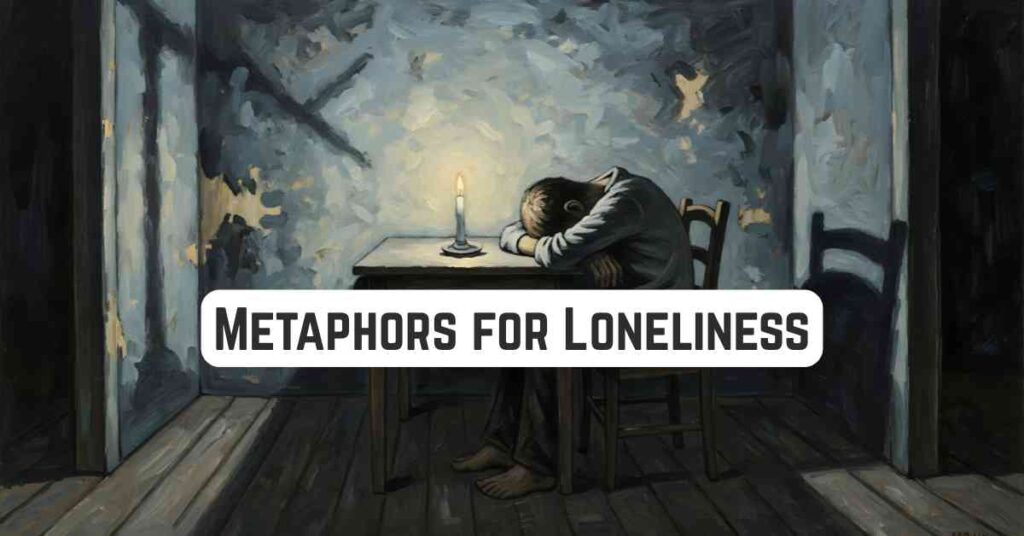

Loneliness is a universal human experience, yet it’s often difficult to articulate. Metaphors provide a powerful tool for expressing the complex emotions and sensations associated with feeling alone. Understanding the metaphors used to describe loneliness enhances our ability to empathize, communicate effectively, and appreciate literature and poetry. This article delves into the diverse world of metaphors for loneliness, exploring their grammatical structures, usage rules, and common pitfalls. Whether you’re an English language learner, a creative writer, or simply someone seeking to better understand human emotion, this guide will equip you with the knowledge and skills to navigate the language of loneliness with greater confidence and nuance.
This comprehensive guide will cover the definition of metaphors for loneliness, including their function and contexts, the structural elements of these metaphors, and the different types or categories. We’ll explore extensive examples organized by category and usage rules governing their proper use, including exceptions and special cases. We’ll also address common mistakes and provide practice exercises to solidify your understanding. Finally, we’ll touch on advanced topics and answer frequently asked questions.
Table of Contents
- Definition of Metaphors for Loneliness
- Structural Breakdown
- Types and Categories of Metaphors for Loneliness
- Examples of Metaphors for Loneliness
- Usage Rules for Metaphors of Loneliness
- Common Mistakes
- Practice Exercises
- Advanced Topics
- FAQ
- Conclusion
Definition of Metaphors for Loneliness
A metaphor is a figure of speech that directly compares two unlike things without using “like” or “as.” It asserts that one thing is another, creating a vivid and often surprising connection. When applied to loneliness, metaphors allow us to express the abstract and often painful feelings associated with isolation and disconnection in concrete, relatable terms. They function as a bridge, connecting the internal experience of loneliness to external, more easily understood concepts.
In the context of English grammar, metaphors for loneliness often involve nouns, verbs, and adjectives that carry connotations of isolation, emptiness, darkness, or other related concepts. The grammatical structure usually involves equating the feeling of loneliness to something else, often a physical object, environment, or state of being. For instance, saying “Loneliness is a vast desert” uses the noun “desert” to represent the feeling of emptiness and isolation.
Metaphors for loneliness can appear in various contexts, including literature, poetry, song lyrics, and everyday conversation. They are particularly prevalent in creative writing, where authors use them to evoke specific emotions and create a deeper connection with the reader. Understanding these metaphors allows for deeper comprehension and appreciation of the text.
Structural Breakdown
The structure of a metaphor for loneliness typically involves two key elements: the tenor and the vehicle. The tenor is the subject being described (in this case, loneliness), and the vehicle is the object or concept to which it is being compared. The connection between the tenor and the vehicle is what creates the metaphorical meaning.
Grammatically, these elements can be linked in several ways:
- Using the verb “to be”: Loneliness is a prison. (Loneliness = Tenor, Prison = Vehicle)
- Using possessive adjectives: Loneliness is the shadow of my heart. (Loneliness = Tenor, Shadow = Vehicle)
- Using adjectives: The lonely hours stretched on. (Lonely = Adjective that describes the hours.
- Implied Metaphors: The silence echoed my despair. (Implies loneliness through the echoing silence).
The effectiveness of a metaphor depends on the strength and relevance of the connection between the tenor and the vehicle. A powerful metaphor will resonate with the reader, evoking a clear sense of the intended emotion. A weak or confusing metaphor may fail to communicate effectively.
For example, “Loneliness is a heavy cloak” is effective because the image of a heavy cloak evokes feelings of being weighed down and burdened, which are common experiences associated with loneliness. The vehicle (cloak) provides a tangible representation of the abstract feeling (loneliness).
Types and Categories of Metaphors for Loneliness
Metaphors for loneliness can be categorized based on the specific imagery and emotions they evoke. Here are some common categories:
Isolation Metaphors
These metaphors emphasize the feeling of being cut off from others, separated from society, or trapped in one’s own world. They often use imagery of physical barriers, remote locations, or solitary figures.
Emptiness Metaphors
These metaphors focus on the sense of hollowness, lack of fulfillment, and absence of connection that often accompanies loneliness. They may use imagery of empty spaces, voids, or barren landscapes.
Darkness Metaphors
These metaphors associate loneliness with darkness, shadows, or obscurity. They evoke feelings of sadness, despair, and a lack of hope. The darkness can represent the absence of joy, light, or connection.
Weather Metaphors
These metaphors use weather phenomena to describe the emotional state of loneliness. Rain, storms, and cold winds can symbolize feelings of sadness, isolation, and emotional turmoil. Sunshine, in its absence, can represent the lack of joy and connection.
Weight Metaphors
These metaphors describe loneliness as a burden or a heavy weight. They convey the feeling of being weighed down by sadness, isolation, and the lack of connection. The weight can represent the emotional toll of loneliness.
Examples of Metaphors for Loneliness
Here are some examples of metaphors for loneliness, organized by category:
Isolation Metaphor Examples
These examples illustrate the feeling of being separated or cut off from others. The table below provides a range of metaphorical expressions.
| Metaphor | Explanation |
|---|---|
| Loneliness is an island. | Suggests being surrounded by isolation, cut off from the mainland of human connection. |
| He felt like a solitary tree in a vast field. | Implies a lone figure standing alone in a large, empty space. |
| She was a ship lost at sea. | Conveys a sense of being adrift and without direction or connection. |
| My heart is a walled garden. | Represents a closed-off and inaccessible emotional state. |
| He lived in a bubble of isolation. | Suggests being protected from and disconnected from the outside world. |
| The room was a cage of silence. | Implies being trapped and isolated by the lack of communication. |
| She felt like a ghost in her own life. | Conveys a feeling of invisibility and disconnection from reality. |
| Loneliness is a high wall separating me from everyone else. | A clear image of a barrier preventing connection. |
| He was exiled to the land of solitude. | Suggests a forced separation and a feeling of being banished. |
| Her heart was a deserted castle. | Represents a once-vibrant place now empty and abandoned. |
| He felt like a lighthouse, alone and constantly signalling. | He feels alone, constantly reaching out, but not receiving. |
| She was a single star in a dark sky. | Outlines how she feels like the only person experiencing this. |
| His soul was a solitary cell. | The soul is trapped and isolated. |
| The world was a stage, and he was backstage, unseen. | He is present, but unacknowledged. |
| His voice was a whisper in a crowded room. | His feelings and thoughts are not being heard. |
| She was a lone wolf, prowling the edges of society. | She is on the outside, looking in. |
| He was an astronaut, floating in the void of space. | Disconnected from his home planet, he is lonely. |
| She felt like a puzzle piece that didn’t fit. | Unable to connect with those around her. |
| He was a forgotten book on a dusty shelf. | Feeling as though he has been forgotten. |
| Her laughter was a single echo in a canyon. | The canyon isolates her laughter as the only sound. |
| The silence in the house was a fortress around her. | The silence is trapping her and isolating her. |
| He was a lone pawn on a chessboard. | He is alone and vulnerable. |
| She felt like a mime, trapped behind an invisible wall. | Her emotions are unable to be expressed. |
Emptiness Metaphor Examples
These metaphors highlight the feeling of hollowness and lack of fulfillment associated with loneliness. The table below provides a range of metaphorical expressions.
| Metaphor | Explanation |
|---|---|
| Loneliness is a bottomless pit. | Suggests an endless and unfillable void. |
| Her heart was an empty room. | Represents a lack of warmth, love, and connection. |
| He felt like a shell, hollow inside. | Conveys a sense of being empty and devoid of emotion. |
| My soul is a barren wasteland. | Represents a lack of life, growth, and fulfillment. |
| Loneliness is a vacuum in my chest. | Suggests a painful absence and a longing for connection. |
| His life felt like an empty canvas. | Implies a lack of purpose, meaning, and direction. |
| She was a ghost town, abandoned and forgotten. | Conveys a sense of desolation and lack of human presence. |
| Loneliness is a gaping hole in my life. | A clear image of something missing. |
| He felt like a blank page, waiting to be filled. | Suggests a lack of identity and a desire for experiences. |
| Her laughter was a hollow echo. | Represents a lack of genuine joy and connection. |
| He was a dried-up well, unable to quench anyone’s thirst. | He can’t provide any emotional support. |
| She felt like a deflated balloon, limp and lifeless. | She has no energy and is feeling low. |
| His words were empty calories, providing no real sustenance. | His words are meaningless and empty. |
| Her heart was a museum, filled with relics of the past but no present life. | She is living in the past and not the present. |
| He was a broken vase, unable to hold anything precious. | He is unable to hold anything valuable. |
| She felt like a cracked mirror, reflecting a distorted image of herself. | She feels like a flawed individual. |
| His soul was an empty theatre, the audience long gone. | He is performing to no one. |
| She felt like a discarded toy, unwanted and unloved. | She is unwanted and unloved. |
| He was a burnt-out lightbulb, casting no light on the world. | He is unable to help with anything. |
| Her smile was a painted mask, hiding the emptiness beneath. | She is hiding her true emotions. |
| The silence was a vast, empty ocean. | The ocean is isolating and has vast emptiness. |
| He was a ship with no sails, drifting aimlessly. | He is drifting aimlessly through life. |
| She felt like a skeleton, stripped bare of all emotion. | She feels like she has no emotions. |
Darkness Metaphor Examples
These metaphors associate loneliness with darkness, shadows, and a lack of light. The table below provides a range of metaphorical expressions.
| Metaphor | Explanation |
|---|---|
| Loneliness is a dark cloud hanging over me. | Suggests a pervasive and oppressive feeling of sadness. |
| Her heart was shrouded in shadows. | Represents a lack of joy, hope, and connection. |
| He felt like he was wandering in the dark. | Conveys a sense of confusion, uncertainty, and lack of direction. |
| My soul is a moonless night. | Represents a lack of light, guidance, and comfort. |
| Loneliness is a black hole swallowing my happiness. | Suggests a destructive force that consumes joy and positivity. |
| His life was a long, dark tunnel. | Implies a difficult and hopeless journey. |
| She was lost in the shadows of her own mind. | Conveys a sense of being trapped in negative thoughts and emotions. |
| Loneliness is a veil of darkness over my eyes. | A clear image of being unable to see clearly. |
| He felt like a shadow, fading into the background. | Suggests a lack of presence and importance. |
| Her laughter was a flickering candle in the wind. | Represents a fragile and easily extinguished joy. |
| He was a moth drawn to a flame, only to be burned by the loneliness. | He is drawn to something that will hurt him. |
| She felt like a black and white photograph in a world of color. | She feels like she is not part of the world. |
| His voice was a muffled whisper in the darkness. | He is unable to express his emotions. |
| Her heart was a locked room, filled with shadows and secrets. | She is unable to open up to anyone. |
| He was a fallen star, plummeting into the abyss. | He feels like he has fallen from grace. |
| She felt like a wilted flower, drooping in the shade. | She is feeling sad and depressed. |
| His soul was a haunted house, filled with ghosts of the past. | He is haunted by his past. |
| She felt like a broken record, repeating the same sad song. | She is repeating the same mistakes. |
| He was a ship lost in a fog, unable to find his way. | He is lost and confused. |
| Her smile was a fleeting glimpse of sunlight on a cloudy day. | She is momentarily happy, but it doesn’t last. |
| The night was a blanket, suffocating her. | The night traps her in her thoughts. |
| He was a scarecrow, standing in the field, ignored. | He is ignored by everyone. |
| She felt like a pebble, lost in the sand. | She is insignificant. |
Weather Metaphor Examples
These metaphors use weather phenomena to describe the emotional state of loneliness. The table below provides a range of metaphorical expressions.
| Metaphor | Explanation |
|---|---|
| Loneliness is a cold, driving rain. | Suggests a harsh and unpleasant feeling of isolation. |
| Her heart was a frozen tundra. | Represents a lack of warmth, emotion, and connection. |
| He felt like he was caught in a storm of sadness. | Conveys a sense of being overwhelmed by negative emotions. |
| My soul is a drought-stricken land. | Represents a lack of nourishment, growth, and fulfillment. |
| Loneliness is a blizzard burying my spirit. | Suggests a suffocating and overwhelming feeling of isolation. |
| His life was a long, gray winter. | Implies a period of sadness, stagnation, and lack of joy. |
| She was like a withered flower, starved of sunlight. | Conveys a sense of being neglected and deprived of happiness. |
| Loneliness is a heavy fog clouding my mind. | A clear image of being unable to think clearly. |
| He felt like a leaf blown about by the wind. | Suggests a lack of control and direction. |
| Her laughter was a distant echo of thunder. | Represents a fading and infrequent joy. |
| He was a tree struck by lightning, forever scarred by the loneliness. | He is damaged from his loneliness. |
| She felt like a sandcastle being washed away by the tide. | She is losing everything. |
| His voice was a crack of thunder, startling but quickly fading. | He is trying to speak up, but is ignored. |
| Her heart was a dormant volcano, waiting to erupt with emotion. | She is keeping her emotions buried. |
| He was a lone raindrop, falling into a vast ocean. | He is insignificant. |
| She felt like a snowflake, unique but destined to melt away. | She feels like she is going to disappear. |
| His soul was a parched desert, longing for rain. | He craves connection. |
| She felt like a kite with a broken string, drifting aimlessly in the wind. | She has no direction. |
| He was a lighthouse battered by the storm, standing strong but alone. | He is strong, but isolated. |
| Her smile was a rainbow after the storm, a brief moment of beauty. | She is momentarily happy, but it doesn’t last. |
| The wind whispered secrets she couldn’t understand. | She doesn’t understand her own emotions. |
| He was a frozen river, unmoving and cold. | He is unable to move on. |
| She felt like a tumbleweed, blown from place to place. | She has no roots. |
Weight Metaphor Examples
These metaphors describe loneliness as a burden or a heavy weight. The table below provides a range of metaphorical expressions.
| Metaphor | Explanation |
|---|---|
| Loneliness is a heavy weight on my shoulders. | Suggests a burdensome and oppressive feeling. |
| Her heart was weighed down by sadness. | Represents a feeling of being burdened and overwhelmed. |
| He felt like he was carrying the world on his shoulders. | Conveys a sense of responsibility and pressure. |
| My soul is burdened by solitude. | Represents a feeling of being weighed down by isolation. |
| Loneliness is an anchor dragging me down. | Suggests a force that prevents progress and happiness. |
| His life was a heavy chain holding him back. | Implies a restriction and lack of freedom. |
| She felt like she was drowning in sorrow. | Conveys a sense of being overwhelmed by negative emotions. |
| Loneliness is a burden I can barely carry. | A clear image of struggling under pressure. |
| He felt like he was sinking in quicksand. | Suggests a feeling of being trapped and unable to escape. |
| Her laughter was a fragile bubble, easily popped by the weight of sadness. | Represents a fleeting and easily extinguished joy. |
| He was a mountain climber, burdened by the weight of his supplies and the loneliness of the summit. | He is burdened on his climb. |
| She felt like a diver with lead boots, sinking deeper into despair. | She is sinking into despair. |
| His voice was a strained whisper, weighed down by unspoken words. | He is unable to express his emotions. |
| Her heart was a stone, heavy and cold in her chest. | She is unable to feel any emotions. |
| He was a marathon runner, his legs heavy with fatigue and the loneliness of the long road. | He is exhausted. |
| She felt like a marionette, her strings pulled by the weight of expectation and the emptiness of her own desires. | She is not in control of her life. |
| His soul was a ship laden with cargo, the weight of the world threatening to sink him. | He is overwhelmed. |
| She felt like a butterfly pinned to a board, its wings heavy with dust and the weight of its own stillness. | She is unable to move on. |
| He was a tightrope walker, the weight of his fears threatening to send him plummeting. | He is scared. |
| Her smile was a thin mask, barely concealing the weight of her sadness. | She is hiding her true emotions. |
| The world was a millstone, grinding down her spirit. | The world is wearing her down. |
| He was a prisoner, shackled by his own thoughts. | He is trapped by his own thoughts. |
| She felt like a statue, cold and lifeless. | She is unable to feel anything. |
Usage Rules for Metaphors of Loneliness
While metaphors offer creative flexibility, it’s essential to use them effectively and appropriately. Here are some usage rules to consider:
- Clarity: Ensure the connection between the tenor and the vehicle is clear and understandable. Avoid obscure or confusing metaphors.
- Relevance: Choose vehicles that are relevant to the context and the intended emotion. The metaphor should resonate with the reader.
- Originality: Strive for originality in your metaphors. Overused or clichéd metaphors can lose their impact.
- Consistency: Maintain consistency in your metaphorical language. Avoid mixing metaphors that create conflicting images.
- Audience: Consider your audience when choosing metaphors. What might be effective for one audience may not be for another.
For instance, instead of saying “Loneliness is like a rock,” which is a common and somewhat weak comparison, try “Loneliness is a granite statue in the park of my heart, cold and unyielding.” This is more descriptive and impactful.
Common Mistakes
Here are some common mistakes to avoid when using metaphors for loneliness:
| Incorrect | Correct | Explanation |
|---|---|---|
| Loneliness is like a rock and a hard place. | Loneliness is a granite statue in the park of my heart, cold and unyielding. | The original sentence is a mixed metaphor and cliché. The revised sentence is clearer and more descriptive. |
| He felt lonely, like a fish out of water and also like a tree in a forest. | He felt like a fish out of water. OR He felt like a solitary tree in a vast field. | Avoid using multiple metaphors in the same sentence that don’t connect. Choose the one that best conveys the intended meaning. |
| Loneliness is a happy day. | Loneliness is a dark cloud hanging over me. | Ensure the vehicle accurately represents the tenor. “Happy day” is contradictory to the feeling of loneliness. |
| The house was lonely. | He felt lonely in the house, like a ghost in an empty mansion. | Houses cannot feel lonely. People can feel lonely. |
Practice Exercises
Test your understanding of metaphors for loneliness with these exercises:
| Question | Answer |
|---|---|
| 1. Complete the metaphor: Loneliness is a ____ in my life. | a) gaping hole |
| 2. Rewrite the following sentence using a metaphor: He felt very alone. | He felt like a solitary tree in a vast field. |
| 3. Identify the vehicle in the metaphor: Loneliness is a prison. | Prison |
| 4. Which type of metaphor is this: Loneliness is a cold, driving rain? | Weather Metaphor |
| 5. Correct the mistake: Loneliness is like a rock and a boat. | Loneliness is a heavy anchor dragging me down. |
| 6. Create a weight metaphor for loneliness. | Loneliness is a heavy weight on my shoulders. |
| 7. Complete the metaphor: Her heart was a ____ tundra. | a) frozen |
| 8. Rewrite the following sentence using a metaphor: She felt like no one understood her. | She felt like her voice was a whisper in a crowded room. |
| 9. What type of metaphor is this: My soul is shrouded in shadows. | Darkness Metaphor |
| 10. Correct the mistake: The sky was lonely. | He felt lonely under the vast sky. |
Exercise 2: Metaphor Identification
| Sentence | Type of Metaphor (Isolation, Emptiness, Darkness, Weather, Weight) |
|---|---|
| 1. Loneliness is a vast, empty ocean. | Emptiness |
| 2. He felt like a lone wolf, prowling the edges of society. | Isolation |
| 3. Loneliness is a heavy fog clouding my mind. | Weather |
| 4. Her heart was a locked room, filled with shadows and secrets. | Darkness |
| 5. Loneliness is an anchor dragging me down. | Weight |
| 6. He felt like a forgotten book on a dusty shelf. | Isolation |
| 7. Loneliness is a drought-stricken land. | Emptiness |
| 8. She was like a withered flower, starved of sunlight. | Darkness |
| 9. Loneliness is a cold, driving rain. | Weather |
| 10. Her heart was weighed down by sadness. | Weight |
Exercise 3: Metaphor Creation
Create your own metaphors for loneliness based on the following prompts. Try to use imagery that evokes a strong emotional response.
| Prompt | Your Metaphor |
|---|---|
| 1. Describe the feeling of being excluded. | I felt like an uninvited guest at a party, standing awkwardly in the corner while everyone else danced. |
| 2. Describe the feeling of emotional emptiness. | My heart felt like a vast, echoey cathedral after the congregation had left. |
| 3. Describe the feeling of being overwhelmed by sadness. | Sadness was a tidal wave, crashing over me and pulling me under the surface. |
| 4. Describe the feeling of isolation from society. | I felt like a lighthouse keeper on a deserted island, watching the ships pass by but never able to join them. |
| 5. Describe the feeling of carrying a heavy burden of loneliness. | Loneliness was a backpack filled with stones, each one representing a missed connection and a silent tear. |
| 6. Describe the feeling of being lost and without direction. | I felt like a paper boat adrift on the ocean, tossed and turned by the waves with no land in sight. |
| 7. Describe the feeling of being invisible to others. | I felt like a ghost, wandering through the world unnoticed and unheard. |
| 8. Describe the feeling of being trapped in your own mind. | My thoughts were a labyrinth, twisting and turning with no escape. |
| 9. Describe the feeling of being starved for affection. | My heart was a parched desert, craving the rain of human connection. |
| 10. Describe the feeling of being cut off from your emotions. | My emotions were a frozen lake, cold and unyielding beneath a layer of ice. |
Advanced Topics
For advanced learners, consider exploring the following topics:
- Extended Metaphors: These are metaphors that are developed over multiple sentences or paragraphs, creating a more complex and nuanced comparison.
- Symbolism: Explore how symbols can be used to represent loneliness in literature and art.
- Cultural Variations: Investigate how metaphors for loneliness may differ across cultures and languages.
- The Psychology of Metaphors: Research how metaphors influence our understanding and experience of emotions.
By studying these advanced topics, you can deepen your understanding of metaphors for loneliness and their impact on communication and expression.
FAQ
Here are some frequently asked questions about metaphors for loneliness:
- What is the difference between a metaphor and a simile?
A metaphor directly compares two unlike things, stating that one thing is another. A simile uses “like” or “as” to make a comparison, acknowledging that the two things are similar but not identical. For example, “Loneliness is a prison” (metaphor) vs. “Loneliness is like a prison” (simile).
- Why are metaphors effective for describing loneliness?
Metaphors provide a concrete way to express abstract and complex emotions. They allow us to connect the internal experience of loneliness to external, more easily understood concepts, making it easier for others to empathize and understand.
- How can I improve my use of metaphors?
Read widely, pay attention to the metaphors used by skilled writers and speakers, and practice creating your own metaphors. Focus
on making the connection between the tenor and vehicle as clear and impactful as possible.
Conclusion
Metaphors for loneliness are powerful tools for expressing the complex and often painful emotions associated with isolation and disconnection. By understanding the structure, types, and usage rules of these metaphors, you can improve your ability to communicate effectively, empathize with others, and appreciate literature and poetry. Whether you’re a native English speaker or an English language learner, mastering the art of metaphorical expression will enrich your understanding of the human experience and enhance your communication skills. Embrace the power of metaphors to give voice to the silent struggles of loneliness and foster deeper connections with those around you.